
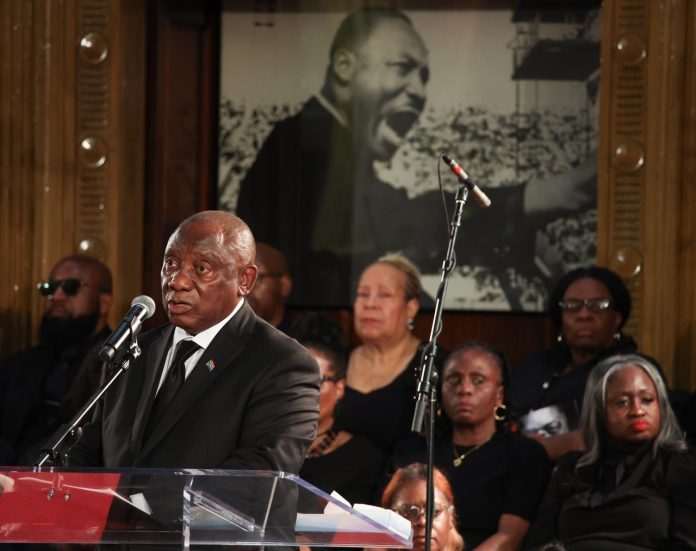
President Cyril Ramaphosa has paid tribute to American civil rights leader Reverend Jesse Jackson, describing him as a champion of justice who stood firmly with South Africa during the struggle against apartheid.
Speaking at Jackson’s private funeral in Chicago on Saturday, 7 March 2026, Ramaphosa said South Africans claim Jackson as “one of our own” because he raised his voice internationally against apartheid when many others remained silent.
The president highlighted Jackson’s visits to South Africa, his calls for sanctions against the apartheid government, and his support for the release of Nelson Mandela.
The people of South Africa are with you today as you lay to rest a great man and celebrate a remarkable life that altered the moral direction of a nation and inspired the conscience of the world.
~ My Tribute at the Homecoming Celebration of Reverend Jesse Jackson pic.twitter.com/4fdZbgXQWN
— Cyril Ramaphosa 🇿🇦 (@CyrilRamaphosa) March 7, 2026
IN FULL: TRIBUTE BY PRESIDENT CYRIL RAMAPHOSA AT THE HOMECOMING CELEBRATION OF REV JESSE JACKSON
The Family of the late Rev Jesse Jackson,
Your Excellencies,
Friends,
The people of South Africa are with you today as you lay to rest a great man and celebrate a remarkable life that altered the moral direction of a nation and inspired the conscience of the world.
We are here to join you as you say farewell to a man who carried the message of hope from the streets of Chicago to the streets of Johannesburg.
Today we are also here, as South Africans, to claim Reverend Jesse Jackson as one of our own. We lay claim on him today because he laid claim on us first.
You may ask: how can a son of South Carolina belong to the people of Soweto?
How can a man born into the segregated American South be claimed by the people of a faraway land that was bedevilled by a racist system of apartheid?
We will tell you how. We will tell you why.
Belonging is not determined by the soil on which you were born.
Belonging is determined by the soil on which you choose to join the fight against an evil racist and oppressive system.
In the long and painful years of our struggle, when the voices of our people were often silenced, Jesse Jackson chose to belong to us by raising his voice against apartheid on our behalf.
When our cause was ignored, and many would look away he stood firm in solidarity with us.
He looked at a people he had never met and said: their pain is my pain. Their chains are my chains. Their struggle for freedom is my struggle.
And for this, the people of South Africa remember him not as a distant friend, but as a brother in the struggle for justice and freedom.
That is why we proclaim that he is ours too.
Jesse Jackson was an African. We lay claim to him because he was an African. Pledging his solidarity with our struggle made him one of us.
An African. An African American.
He epitomised the image that was depicted by one of the key founders of the African National Congress, Pixley ka Isaka Seme, who delivered a most famous speech in 1906 when he was a student at Columbia University.
He said: “I am an African, and I set my pride in my race over against a hostile public opinion… The brighter day is rising upon Africa. Already I seem to see her chains dissolved.”
That speech captured the spirit of African pride and hope. This is what Jesse Jackson meant to South Africa and Africa. Hence we stand here today and say he also belongs to us.
Jesse Jackson stood with the people of South Africa during our darkest hour. He told the world that the struggle for dignity in the United States of America was inseparable from the fight against apartheid and injustice in South Africa.
When Jesse Jackson reminded the United States that its strength lies not in exclusion, but in the beautiful diversity of its people – black and white, rich and poor, urban and rural, workers and farmers, immigrants and the forgotten – we were inspired by his message and embraced the universal values of diversity, inclusion and equity that he preached.
Nelson Mandela and his comrades were hugely inspired by Jesse Jackson whilst they were serving life sentences on Robben Island as they observed how he carried our struggle for justice beyond the borders of the United States.
He was a voice — a voice that refused to be silenced when silence would have been easier. A voice that preached a message of hope from the streets of Chicago to the dusty streets of Soweto, that justice was not a privilege for the few, but a birthright for all.
His rallying call “Keep hope alive” became a compass for our struggle and gave us hope for victory over the evil of the system of apartheid exclusion, division and oppression.
Jesse Jackson expressed his solidarity with the people of South Africa when he first visited South Africa in 1979, two years after the callous killing of Steve Biko in apartheid police cells. He drew massive crowds at rallies in Soweto, where he famously declared that: “This land is changing hands.”
When the Reagan administration chose “constructive engagement” – diplomatic language for doing nothing – Jesse Jackson chose unconditional solidarity with the oppressed majority in South Africa.
He became the most visible American political figure advocating for comprehensive pressure and economic sanctions against South Africa.
By placing South Africa at the centre of American electoral politics during his presidential election campaign, Jesse Jackson influenced millions of voters to confront apartheid as their moral responsibility too.
He led many marches here in the United States and in 1985 was arrested with his two sons, Jesse Jr. and Jonathan, outside the South African Embassy. As they were arrested, they sang “We shall Overcome”. It was a song that became part of our struggle and from which we drew inspiration.
He took the fight against apartheid global.
On the 2nd of November 1985, he marched with then ANC President Oliver Tambo, Anti-Apartheid Movement President Trevor Huddleston and more than 150,000 people – in what was one of the largest anti-apartheid demonstrations ever held in Britain – to demand sanctions against South Africa and the release of Nelson Mandela.
Not only did he march in the streets; he walked into the corridors of power.
He personally lobbied Pope John Paul II to visit South Africa and hasten change. He pressed Mikhail Gorbachev to cut all Soviet diplomatic ties with Pretoria. He challenged Margaret Thatcher to her face. She refused to budge, but he did not stop.
When Nelson Mandela finally walked free in 1990 after 27 long years of imprisonment, Jesse Jackson was there in Cape Town, witnessing a moment the world would never forget. He described the atmosphere as a “release of glee and joy,” as millions celebrated not only the freedom of a man, but the rising hope of a nation.
In 1994, he was present when Nelson Mandela was inaugurated as the first democratically elected President of South Africa. Jackson kept returning after 1994, when many of his contemporaries moved on.
We claim Jesse Jackson as one of our own because he never saw the struggle in South Africa as a distant or foreign cause, but as a struggle that belonged to him as well.
His greatest gift to the oppressed people of South Africa was the courage he gave us to believe that we must never surrender hope, that justice would prevail, and freedom would come.
He encouraged us not to lose hope in the face of oppression.
Not to lose hope in the face of injustice.
To have hope that ordinary people, standing together, would write their own history of triumph against apartheid.
The life of Reverend Jesse Jackson reminds us that the struggle for justice is never the work of a single lifetime. It is a long and noble journey carried forward across generations. It is a relay in which the torch of freedom is passed from one courageous hand to another.
Martin Luther King Jr. lifted that torch and gave the world a dream of justice and equality.
Jesse Jackson carried that dream forward with hope, keeping its flame alive in the hearts of those who refused to surrender to injustice.
And Nelson Mandela carried that dream into freedom, helping to build a rainbow nation where dignity and liberty could belong to all.
And so today that torch still burns. It is now in our hands – to guard it, to carry it forward, and to ensure that the dream of justice continues to light the path for generations yet to come.
Now we must ask ourselves how we can honour the life and memory of Jesse Jackson.
We honour him by carrying forward the values he lived for: justice, dignity, equality,
By committing to a lifetime of service to others.
By showing up when others look away from injustice, when they fear to stand up to power and when they walk away from suffering.
By pledging solidarity and using every opportunity to support the just struggle of others.
By ensuring that there is justice for all.
By keeping hope alive, as Jesse Jackson taught us.
Today we honour a man whose voice stirred the conscience of leaders and ordinary people, whose courage strengthened movements across the world, and whose faith never wavered even when the road was long.
To our mother, Mrs Jacqueline Jackson, to Santita, Jesse Jr., Jonathan, Yusef, Jacqueline, Ashley and the entire Jackson family:
We, the people of South Africa, are here to say thank you.
The African National Congress, with which Jesse Jackson worked closely, thanks you.
We are here not only in mourning, but in gratitude.
Deep, abiding, unrepayable gratitude.
You gave us your husband. Your father. Your patriarch.
You shared him across an ocean, across continents.
Across marches and prison gates and inauguration days.
When South Africa needed a friend in the corridors of power you allowed Jesse Jackson to be that friend.
His support meant that when our people were tear-gassed in Soweto someone in America was weeping with us.
It meant that when our leaders sat in prison cells on Robben Island, someone was standing in the capitals of the world, in Washington and in London, saying: Nelson Mandela and his comrades are not terrorists or criminals. They are freedom fighters. The world must listen and act.
We are grateful that on the day Nelson Mandela walked free – on that historic and miraculous day – Jesse Jackson was standing in the sunlight with us.
Not because it was required of him. But because it was in him to witness the emergence of the South Africa he had campaigned for, been arrested for, struggled for and prophesied about in Soweto in 1979.
We honour him for his enduring commitment, his expression of real love, sacrificial love.
The commitment he displayed did not wait to be invited. It made him simply show up.
Jesse Jackson showed up for South Africa.
Again. And again. And again.
Long after the cameras moved on.
Long after the sanctions were won.
Long after apartheid had been defeated and relegated to the ash heap of history he kept coming back.
To express its gratitude as a free nation, South Africa awarded him the Order of the Companions of OR Tambo.
But no medal, no honour, no citation is wide enough to express what Jesse Jackson gave and meant to us.
What he gave to us cannot be framed and hung on a wall.
It lives in our Constitution.
It lives in our freedom. It lives in the hearts of our people.
That is why we are here today: to carry of Jesse Jackson’s spirit home with us.
For the hope he nurtured, the courage he inspired and the solidarity he showed to our people must not end with this moment.
It must continue to inspire us in our shared journey to build a better life for all our people.
So, on behalf of sixty-two million freedom loving South Africans, we say thank you.
Go well, Reverend. Go well, Mkhulu.
The ancestors – Martin Luther King Jr, Nelson Mandela, Oliver Tambo, Winnie Mandela and many others both here and in South Africa – have been waiting to embrace you.
And we, the people of the rainbow nation that you helped to build, salute you and we say: Amandla. Power to the People.
Rest in eternal peace.