


South Africa’s municipalities are in a perilous state, and while Cape Town remains one of the country’s better-performing metros, it has regressed and did not receive a clean audit.
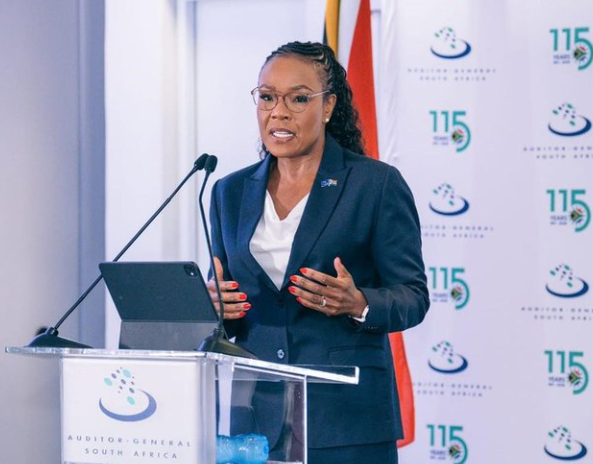
Presenting the Auditor-General South Africa’s (AGSA) 2024/25 local government audit report in Parliament on Tuesday, Auditor-General Tsakani Maluleke said the outgoing sixth local government administration had made only limited progress in strengthening governance and improving service delivery.
According to the report, only 39 municipalities, representing 15% of all municipalities, achieved clean audits.
At the same time, 38 municipalities regressed since the 2020/21 financial year, including three metropolitan municipalities.
The report found that the performance of South Africa’s metros continued to decline, with none of the country’s eight metropolitan municipalities achieving a clean audit.
However, Cape Town was among only three metros to receive an unqualified audit opinion, meaning its financial statements were found to be credible. The city was also one of only two metros that did not receive material findings on performance reporting.
Despite this, Cape Town was not exempt from broader governance concerns. Like all metros, it received material findings related to compliance with key legislation.
The report also highlighted some positive developments nationally.
The number of municipalities receiving disclaimed audit opinions – the worst possible audit outcome – declined from 29 in 2020/21 to just eight in 2024/25.
In addition, 61% of municipalities received unqualified audit opinions, while 98% submitted their financial statements on time.
Despite these gains, the financial health of many municipalities remains under pressure.
More than half did not have enough current assets to cover their liabilities, while 72% lacked sufficient cash to pay creditors.
The report also found widespread non-compliance with legislation, with 84% of municipalities receiving material findings on compliance.
Irregular expenditure reached R40.14 billion during the 2024/25 financial year, largely due to failures in procurement and contract management.
Maluleke warned that poor governance, weak accountability and inadequate consequence management continue to undermine local government performance and service delivery.
Key findings on Cape Town:
- The City of Cape Town was one of only three metros that received an unqualified audit opinion, meaning its financial statements were found to be credible.
- Cape Town was one of only two metros that did not receive material findings on performance reporting, indicating stronger systems for measuring and reporting performance.
- However, like all metros, Cape Town still received material findings on compliance with key legislation, particularly around governance and procurement controls.
- The report noted that none of South Africa’s eight metros achieved a clean audit, meaning Cape Town also fell short of the highest audit standard.
Mayor Hill-Lewis responds:
In response to a question about the audit report at a Cape Town Press Club event this week, Cape Town Mayor Geordin Hill-Lewis said he was pleased that the City retained an unqualified audit, expanding on some of the matters that the Auditor-General raised.
He says one of the issues the AG raised relates to contractors who fail to deliver.
“This happens all the time, particularly on smaller construction projects. Some of you may have seen this in your neighbourhoods. A contractor does a poor job, and we terminate the contract.”
He explained that the City then places that company on a red list, preventing it from doing business with us again. Even the directors of that company may not re-tender because they have a history of poor performance.
But he says in practice, what often happens is that red-flagged construction companies then start brand new companies overnight, and they tender again.
“So we began tracing whether directors of new companies had previously been directors of companies that had tendered with the City, failed in their work and been dismissed. The Auditor-General found that approach to be prejudicial to those new companies. My view is that the whole point is to be prejudiced against poor workmanship. That’s exactly the point.”
Hill-Lewis says some of the other findings he does agree with, and the City will need to sharpen procedures and processes. But others he doesn’t agree with.
“For example, you may have a 10-year contract that is proceeding smoothly and delivering exactly what it was intended to deliver. Then, in year eight, the AG identifies an issue with a particular invoice, a sign-off process or a similar compliance matter. In the past, that specific invoice or transaction would be flagged. The newer approach appears to be that the entire contract, from year one to year 10, is flagged. I think most people would agree that even if that is what the strict letter of the law requires, it is not a reasonable way to assess issues of that nature.”
The Mayor says he will be taking up some of these matters with the Auditor-General.
“Nevertheless, I am pleased that, despite those findings, we retained our unqualified audit.”