14.8 C
Cape Town
Thursday, July 9, 2026
Home Blog Page 171

Strand Man Arrested for Illegal Crayfish and Abalone Trade

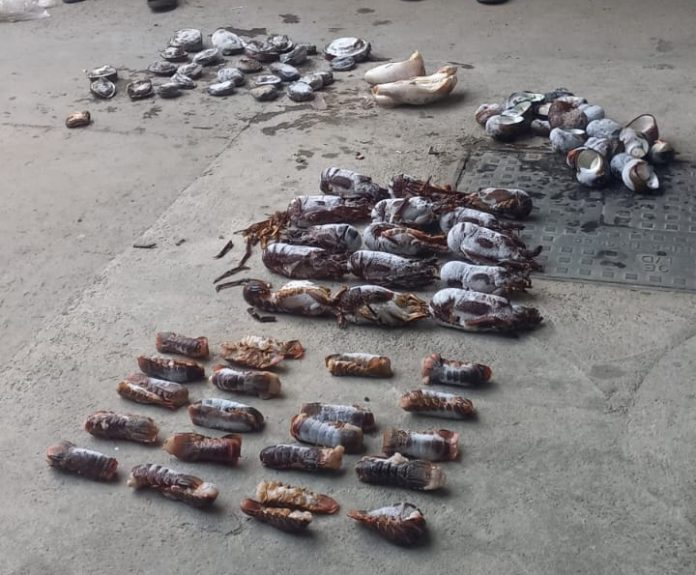
Crayfish seized


A 50-year-old man was arrested yesterday following a tip-off that he was selling crayfish from a residence in Rusthof, Strand.


Following a joint operation conducted by the police’s Law Enforcement Marine and Environmental Unit, the Department of Forestry, Fisheries, and the Environment (DFFE), and Cape Nature, several protected marine species was seized.


The City’s Law Enforcement spokesperson, Wayne Dyason, says that upon inspection of the premises, several bags were found in a fridge, containing the items.


“When arriving at the location they conducted an inspection, and found bags in a fridge containing 40 West Coast Rock Lobster Tails, 15  West Coast Rock Lobster whole state, 21 Alikrikel, 3 Silver Fish, 26 whole Abalone, and one Shucked Abalone.”


Dyason says the suspect was transported to the Strand police station where he will be formally charged.


The City reiterates that the illegal possession or trade in abalone and crayfish remains a criminal offense.


Ryan’s School Run wraps up at Wynberg Girls Junior School

In the final edition of Ryan’s School Run for 2026 we visited Wynberg Girls Junior School. The school was established in 1884 with 27 learners and 5 teachers. Today they have over 800 pupils and remains one of Cape Town’s top-performing public junior schools.

Low income earners drowning in debt

debt


A new report from National Debt Advisors has revealed perhaps an unsurprising fact: low-income earners are drowning in debt.


The debt counselling company’s latest consumer report shows South Africans earning under R10,000 a month are in debt of up to EIGHT times their income, and it only gets worse as salaries rise.


The report is based on over 70,000 consumers, showing that the average person in debt review owes more than R91,000 while earning under R10,000.


Higher earners (those earning between R30,000 and R50,000) are even more exposed, with debt levels exceeding 28 times their income.


Sebastien Alexanderson, Head of National Debt Advisors, says the numbers reflect a growing disconnect between income and the cost of living.


“South Africans are not living beyond their means anymore. Their means are simply not enough to live on. Debt has become the way people are closing that gap.”


He says the current economic environment is making it harder for that gap to close.


“Interest rate relief is not coming as quickly as many people hoped. With the repo rate still around 6.5% and prime close to 10%, borrowing remains expensive. That keeps pressure on anyone with a loan, a credit card, or a bond.”


Alexanderson says currency weakness is adding to the strain.


“The rand has been under pressure, and when that happens, the cost of living goes up. As petrol, food, and other essentials become more expensive, households feel it immediately. Even if inflation looks like it is easing, the reality on the ground is very different.”


In addition, slow economic growth is limiting any real income relief.


“We are sitting with growth of around 1% and unemployment close to 32%. That means incomes are not growing fast enough, and for many people, they are not growing at all. At the same time, there is pressure on government finances, which brings uncertainty around jobs and wages, especially in the public sector.”


According to Alexanderson, the type of debt people are relying on is part of the problem.

“Almost all the debt we are seeing is unsecured. That means personal loans, credit cards, and store accounts. It is expensive credit, but it is also the most accessible.”


Among lower-income earners, 96% of debt is unsecured, leaving people very exposed.


Alexanderson says this is not just affecting the most vulnerable, but also working South Africans.

“More than half of the people coming to us are between 31 and 45. These are working South Africans in their prime, but they are already overextended.”


Over-indebtedness exceeds 50% in lower-income groups and remains above 40% even among higher earners.


“There is a perception that if you earn more, you are safer. What we are seeing is the opposite. Higher income gives you access to more credit, but in this environment, that also increases your risk.”


Alexanderson says the data points to a deeper issue in the economy, that this is not just about people making bad choices, but that there is a structural gap between income and the real cost of living.


“Debt is no longer something people use occasionally. For a lot of households, it has become part of how they survive every single month.”


To access debt advice, contact National Debt Advisors.

 

WC SAPS confirms operational exercises underway ahead of SANDF deployment

prosper


The office of the Provincial Police Commissioner has confirmed that preparations are underway for the much-anticipated deployment of the SANDF to crime and gang hotspots in Cape Town.


According to information received by the provincial government, the deployment could commence from 1 April 2026.


The Western Cape SAPS has not confirmed this date, but said a select group of SAPS officials with SANDF members are currently conducting an operational scanning exercise at various locations. The exercises took place on Wednesday (18 March) and will again occur today (Thursday 19 March).


The exercises comprise air and ground presence, with SAPS stressing that this should not be confused with the actual deployment of the army.


In a statement, Brigadier Novela Potelwa said:


“The operational exercise currently underway is essential preparation for the integrated forces ahead of the actual deployment. Members of the public are urged to respect the operational space these forces require and refrain from speculating about their presence in the targeted areas.”


President Cyril Ramaphosa announced during the State of the Nation Address on 12 February 2026 that 2,200 SANDF members would be deployed to support the SAPS to deal with gang violence and illicit mining at identified crime hotspots.


Communities on the Cape Flats have been plagued by gun and gang violence in the last few weeks, with dozens of fatal shootings in several areas.


2 teens killed, girl & elderly woman injured amid gang shootings in Elsies River

elsies river


Two teenagers have been killed, as gang-related shootings escalate in Elsies River.


The 16- and 19-year-olds were gunned down on the corner of Bourne Road and Kriebos Link in Leonsdale on Wednesday night.


A Western Cape SAPS spokesperson, Captain F.C. Van Wyk, confirmed that by the time officers arrived on the scene, medical personnel had advised that they were declared dead due to the wounds sustained. 


A 12-year-old girl and 63-year-old woman were also wounded in the shooting. 


“The community also alerted the members of the 12-year-old girl who sustained gunshot wounds to the hip and thigh, and the 63-year-old woman who sustained a gunshot wound to the stomach. They found the girl at a premises in Glochester Place, 15th Avenue, Leonsdale and the 63-year-old woman at a nearby hospital,” said Van Wyk.


The Western Cape SAPS confirmed that they are investigating whether the incident could be linked to gang violence.  


“The circumstances surrounding the incident are under investigation, and arrests are yet to be made,” said Van Wyk.


This incident follows another fatal shooting in the area on Tuesday, in which a man believed to be a gang boss from Bishop Lavis was killed.


The 42-year-old man was gunned down while in a vehicle, which police say was a lime/green Toyota Auris, on the corners of 35th Street and Old Stellenbosch Road that afternoon. Another man was injured in the incident. 


“Elsies River detectives are investigating a murder and an attempted murder. The motive for this shooting incident is believed to be gang-related,” said Van Wyk in a statement on Tuesday.


These incidents come weeks ahead of the deployment of the South African National Defence Force, which is expected in the first week of April.


ALSO READ: SANDF boots on the ground in the Western Cape from 1 April – Smile 90.4FM

error: Content is protected !!