

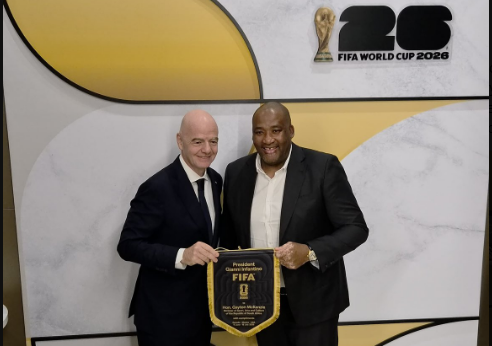
Sports Minister Gayton McKenzie has defended the government’s spending nearly R31 million of taxpayers’ money at the 2026 FIFA World Cup, as online commentators demand a more precise breakdown of the associated costs and benefits for South Africa.
According to the Minister, who released a statement on 19 July, R7.8 million was spent on “official trips and travel-related expenditure” for himself, two support staff, the Director General, and the Project Team of 14 members.
That included international flights, accommodation, local transport, travel insurance, daily allowances and all approved travel costs for the Minister, executive management and officials responsible for logistics, communications, protocol, governance and programme delivery, as well as the South African artists and cultural representatives who formed part of our official delegation.
The next expenses line is for the “South Africa 2010 Legends Exhibition Match” which involved 27 people in total, at a cost of R6.7 million. A full breakdown of what this covered has not been provided
Hospitality suites for officials in Atlanta (USA) and Monterrey (Mexico) cost R3.3 million. McKenzie says these were “working spaces where government leaders, investors, sponsors, football officials and international partners met to discuss investment, tourism, sport and future opportunities for South Africa.”
Spectator match tickets cost about R3 million. 294 official FIFA match tickets across three host cities were purchased. McKenzie says these tickets formed part of the approved programme and allowed the government “delegation, stakeholders and programme participants to attend official World Cup fixtures linked to South Africa’s activation and engagement programme.”
A round figure of exactly R10 million was spent on “programme activities linked to fan engagement”, Aldea Global participation, Atlanta partnership activations, Monterrey and legacy activities, which included the “costs of 30 artists and cultural participants” as well as the “project delivery team from a service provider.”
Many social media commentators have called for scrutiny of this figure as it seems unclear what exactly the R10 million was supposed to cover.
McKenzie says the R10 million “built South Africa’s physical presence at the FIFA World Cup.”
He has defended it, denying it is wasteful.
“It paid for the design, construction and installation of our exhibition spaces in Mexico City, Atlanta and Monterrey. It covered the branding, décor, lighting, sound, screens, technical equipment, furniture, logistics, transport, security, maintenance and the teams who built, operated and later dismantled everything.”
“It funded the actual programme that thousands of football fans experienced. South African musicians performed live. Our chefs introduced the world to South African food. Local artists and crafters displayed and sold South African products proudly. Businesses promoted South Africa as a tourism destination and an investment destination.”
“Visitors walked away with a better understanding of our country, our people and what South Africa has to offer. That is not wasteful spending – it is nation building, economic promotion and creating opportunities for South Africans.”
McKenzie has also given a breakdown of the number of delegates who travelled to the World Cup:
- 18 officials (including the Minister, two support staff, Director-General, and the Project Team)
- 30 Artists/cultural participants 30
- 27 participants in the “Legends Match” (Bafana Bafana 2010 legends team)
That is 75 people who were funded by the state.
McKenzie states that the state did not pay for the trips for the 47 lucky fans, 29 journalists, influencers and podcasters, who totalled 76 people. He says they were funded by sponsors.
“Private sector partners – including Brand South Africa, Coca-Cola, HONOR, Betway, Cell C and Old School – funded Lucky Fans, journalists, podcasters and influencers who travelled as part of this programme, along with further fan mobilisation activities.”
The Minister added that a final consolidation of what exactly private sponsors covered, with possible shortfalls to be funded separately, is currently underway through post-event reconciliation.
In total, the Minister says, 151 people travelled to the United States and Mexico, excluding the service provider team. It is unknown how many people are on the service provider team.
While questions swirl around the hefty budget, McKenzie says spending a departmental budget on the department’s mandate is not, in itself, evidence of wrongdoing.
“If any person believes money was improperly allocated, appropriated, or spent, or that I personally benefited in a corrupt manner, I invite them to bring that evidence forward, to Parliament, the Auditor-General, or to any law enforcement body with the power to investigate it.”
The Minister asserts that his own “personal footprint” for this five-week trip – flights, accommodation and insurance, as invoiced by the department’s travel agent – came to R1 058 379.75
He added that he actively tried to contain costs, taking lifts with his adviser instead of hiring chauffeurs, using Ubers and taxis instead of official ground transportation options, and turned down claiming on his subsistence and travel allowance of R55,000.
McKenzie says when a big delegation of his family joined him on part of this trip, they paid for their own flights and accommodation, in full.
“Not one rand of that was state money. For the record, I have not had the state pay for the travel of any member of my family, since I became a minister. I have seen people online claiming that the state paid for my family, and targeting them. These are lies.”
While the Minister claims every rand has been accounted for, social commentators have called for closer scrutiny.
McKenzie says the Department is preparing a consolidated close-out report, to be finalised once “every invoice, travel claim, sponsorship contribution and implementing-partner account has been reconciled.”
“When it is ready, it will be tabled, and I remain available to account to the Portfolio Committee, as I always have been.”
The state paid for the suites and the match tickets. Who attended those matches? Let’s see the list. https://t.co/YmRYD9Kwj2 pic.twitter.com/7lsfpLLM7o
— Andrew Fraser (@Arfness) July 20, 2026
Minister @GaytonMcK
For transparency would it be possible to release the list of the artists and cultural practitioners that were contracted for the activations? https://t.co/cITpro0Os6
— Kgopolo (@PhilMphela) July 19, 2026
R31 mil to spend on World Cup travel, tickets, suites, random exhibitions and some legacy soccer game.
-Olympic and paralympic team – always chronically under funded.
-SA Women’s hockey team – crowd funding for the Olympics.
-SA Men’s hockey team – self funded
-SA women’s…— Jordan Griffiths (@JordiGriff) July 19, 2026