


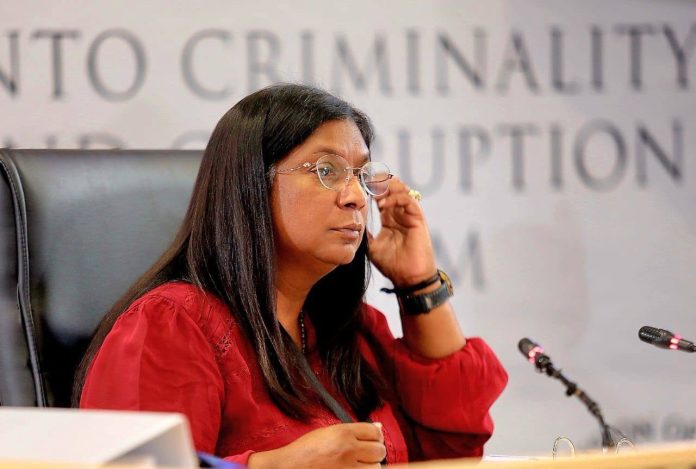
Advocate Andrea Johnson, head of the Investigating Directorate Against Corruption, is not planning to incriminate herself at the Madlanga Commission.
She invoked her constitutional right against self-incrimination during her first appearance at the Commission on Tuesday, refusing to answer questions related to her link to suspended Crime Intelligence head Feroz Khan.
It is alleged that Johnson had shared a criminal docket with Khan for an assault case that he was being investigated for in 2018.
“I hold the view that the Commission’s fact-finding mandate does not override my constitutional protection against self-incrimination under any circumstances,” Johnson told the Madlanga Commission.
MADLANGA COMMISSION | IDAC head Advocate Andrea Johnson says: “I hold the view that the Commission’s fact-finding mandate does not override my constitutional protection against self-incrimination under any circumstances.” pic.twitter.com/XkGp5lfRIP
— SABC News (@SABCNews) July 21, 2026
Meanwhile, with Johnson in the spotlight, the conduct of IDAC officials will now be investigated by a newly established Oversight Office.
The Office was established in Pretoria on Sunday, and will be led by retired Judge Takalani Joseph Raulinga.
The goal of the office is to ensure that investigations by IDAC are carried out lawfully, fairly and accountably. It will also independently investigate complaints against IDAC. The Oversight Office will report to the Minister of Justice and Constitutional Development and Parliament’s related portfolio committee.
“By providing independent judicial scrutiny, the Office contributes to public confidence in the justice system and reinforces the principles that sustain our constitutional democracy… The Office will operate with strict judicial detachment. We do not participate in public debate, nor are we influenced by external pressure or popular opinion,” said Raulinga.
At the same time, the Investigating Directorate Against Corruption confirmed receipt of complaints about Johnson.
It says it is attending to the complaints, as per its mandate, but notes that it will not make public the nature thereof or the steps it’s taking to address them.
“The Office emphasises that the receipt of a complaint does not constitute a finding of wrongdoing, nor should it be interpreted as evidence of misconduct. Every complaint is considered independently, objectively, and in accordance with the principles of procedural fairness,” read IDAC’s statement.


