


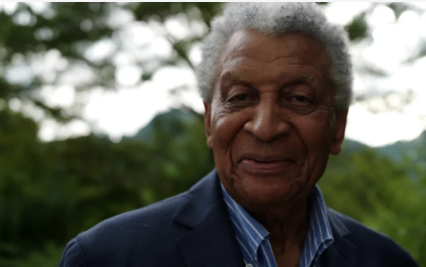
Tributes have been pouring in after the passing of global jazz legend Abdullah Ibrahim earlier today, 15 June. Ibrahim died peacefully, surrounded by family in Germany, following a short illness.
President Cyril Ramaphosa has expressed his profound sadness at the passing of the cultural activist, global jazz icon and Esteemed Member of the Order of Ikhamanga.
Ramaphosa says Ibrahim lived a life of music that “spanned jazz genres and geographies.”
Ramaphosa offered his deep condolences to Ibrahim’s children, pianist Tsakwe and hip-hop artist Jean Grae. Their mother, Sathima Bea Benjamin, a performer and recording artist herself, passed away in 2013, nine years after she received the Order of Ikhamanga.
As a pianist, composer, arranger and mentor, Abdullah Ibrahim campaigned against apartheid and drew audiences to his highly curated performances that showcased his accomplishment as a soloist and his collaboration with established and emerging talent.
His music also projected his spirituality and contemplative practice of martial arts.
In 2009, he was awarded the Order of Ikhamanga in Silver, in recognition of his excellent contribution to the arts, his success in putting South African music on the international map, and his lifelong fight against racism and apartheid.
President Ramaphosa said: “Today our nation mourns the passing of an international icon and global citizen whose profound creations honoured the South Africa that shaped his political commitment and musical brilliance.
“As we commemorate the 50th anniversary of the Youth Uprising, the passing of Abdullah Ibrahim reminds us of the then illegal benefit concert he organised in support of the liberation movement following the Uprising, as a demonstration of his commitment to our struggle.
“We give thanks for the many decades of his life that he devoted to his personal passion which he shared with humanity through his recordings and his appearances in clubs and concert halls throughout the globe.
“He has enriched our lives with his musical gifts and his involvement in making the world a better place.
“May his soul rest in peace.”
Cape Town Mayor Geordin Hill-Lewis has also expressed the City’s deep sadness at the passing of Ibrahim.
“Abdullah Ibrahim counts among Cape Town’s greatest cultural ambassadors, carrying the sounds, stories and spirit of the Mother City to audiences around the world.
Generations of Capetonians have found meaning and inspiration in his music, which stands as his immortal legacy, and gift to humanity. I encourage everyone, especially young people, to explore and delight in this rich heritage.
Cape Town has lost a defining artist who transcended divides and generations. We extend our condolences to Abdullah Ibrahim’s family, friends, and all those around the world who were touched by his extraordinary music. We will never forget this cultural legend’s contribution to our city’s identity and to South Africa’s proud heritage.”
After years of international acclaim and periods of exile during apartheid, Ibrahim continued to draw deeply from his Cape Town roots. His iconic composition ‘Mannenberg’, recorded in Cape Town in 1974, became one of the most recognisable pieces of South African music and a powerful symbol of the country’s struggle for freedom.
Despite his global career, Ibrahim maintained a profound connection to the city of his birth. His final public performance in South Africa was at the Cape Town International Jazz Festival in 2026.
In a statement, the Cape Town International Jazz Festival described Ibrahim as one of South Africa’s most revered cultural icons and a towering figure in the global jazz community.
“The CTIJF is especially honoured to have formed part of the final chapter of his extraordinary musical journey. Ibrahim’s final public performance took place at the festival on the Rosies Stage on Friday, 27 March 2026.
In what will now be remembered as a historic homecoming moment, audiences witnessed one of the greatest musicians of our time deliver a performance that reflected the grace, depth and mastery that defined his remarkable career. It was a fitting farewell in Cape Town, where he was born and raised. The city shaped so much of his musical identity.”
His relationship with the festival spanned many years, having also performed in 2004 as the Abdullah Ibrahim Trio, in 2014 with Ekaya and in 2019 with Ibrahim Khalil Shihab. A pianist, composer, bandleader and visionary, Ibrahim’s contribution to South African music transcended genres, generations and borders.
Through his extraordinary body of work, he gave voice to the spirit, resilience and aspirations of South Africans, creating a musical legacy that will continue to inspire audiences around the world for generations to come.
His life and career spanned nine decades and multiple continents. A pioneer of bebop infused with a distinct Cape Town sensibility, he formed the Dollar Brand Trio in 1958 and, in 1959, co-founded The Jazz Epistles alongside Hugh Masekela, Kippie Moeketsi, Jonas Gwangwa, Johnny Gertze and Makaya Ntshoko.
Their recording became the first jazz album by South African musicians. That same year, he began a lifelong partnership with South African vocalist and composer Sathima Bea Benjamin (1936-2013). Following the 1960 Sharpeville Massacre and intensifying apartheid repression, Ibrahim went into exile.
In Zurich, he was introduced to Duke Ellington, leading to recordings and major European appearances. After Nelson Mandela’s release, he returned home in 1990 and later performed at the presidential inauguration in 1994, marking a historic homecoming.
Paying tribute to his life and legacy, CTIJF Chairman Rayhaan Survé said:
“Uncle Abdullah was one of South Africa’s greatest musicians; he was one of our nation’s most profound storytellers. Through his piano, he captured the soul of a people, the pain of a divided past, and the hope of a democratic future. His music carried South Africa to the world and brought the world closer to South Africa.
“We are particularly privileged that his final performance was shared with audiences at the Cape Town International Jazz Festival. It is a memory that we will cherish forever and a reminder of the enduring connection between Uncle Abdullah, the city of Cape Town and a festival that celebrates the rich heritage of jazz.
“As the Cape Town International Jazz Festival, we honour a man whose artistry helped define the very foundations of South African jazz and whose influence continues to shape generations of musicians and audiences alike. His legacy extends far beyond the stage. It lives in every artist inspired by his work and every listener moved by his compositions.
“We extend our deepest condolences to his partner Dr Marina Umari, family, friends and colleagues. While we mourn his passing, we celebrate a remarkable life dedicated to excellence, creativity and the transformative power of music. His voice may be silent, but his music will continue to resonate for generations to come.”
CTIJF Co-director Carolyn Savage said:
“It was a profound honour for us to welcome Abdullah Ibrahim to perform on our Rosies Stage at the Cape Town International Jazz Festival in March this year. His presence was both humbling and inspiring, a reminder of the depth, soul, and history that he brought to every note he played.
“Ibrahim was more than an icon of the music industry, he was a musical storyteller, a cultural ambassador, and a symbol of resilience whose work transcended borders and generations. His legacy is deeply woven into the fabric of jazz and will continue to inspire artists and audiences around the world for years to come.”
CTIJF Co-director Georgia Jones said:
“What an immense privilege it was to dine with Abdullah, to share in his stories and humour, and to bear witness to his final performance in South Africa at the CTIJF. We are incredibly moved by his contribution to our country and its music. He has, without a doubt, left a remarkable legacy and a lasting impression on us all. We are sending our love to Marina and his family during this time.”
Ibrahim’s influence on the South African and international jazz landscape is immeasurable. His commitment to artistic excellence, cultural preservation and creative freedom helped shape the evolution of jazz in South Africa and inspired countless musicians to follow in his footsteps.