


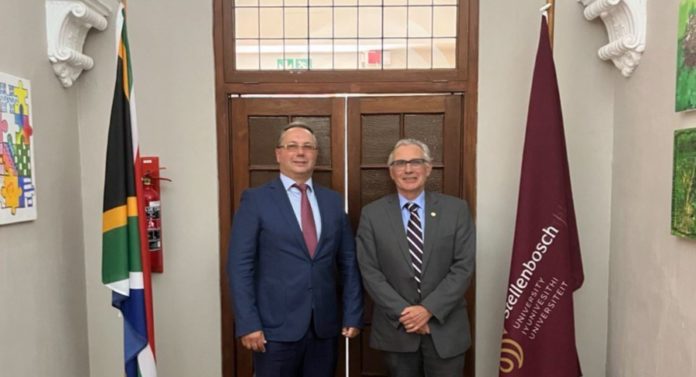
Stellenbosch University (SU) said it did not intend to collaborate with the Russian government or academic institutions, despite a social media post from the Russian Consulate implying otherwise.
On Friday, the Russian Consulate posted a picture of the consulate-general, Aleksei Malenko, with the university’s rector and vice-chancellor, Professor Wim de Villiers.
The consulate said the two had “discussed prospective of future cooperation in different spheres”.
Today #Russian Consul General in Cape Town Mr A.Malenko held a meeting with Rector and Vice-Chancellor of Stellenbosch University W. de Villiers. The parties discussed prospective of future cooperation in different spheres. pic.twitter.com/ORNKow7BzK
— ГК РФ в Кейптауне (@RusConsCapetown) February 17, 2023
However, in response to the post, the university said it had made it clear that collaboration was “impossible”.
The university said that, from time to time, the vice-chancellor met members of the diplomatic corps.
“Such meetings are purely academic in nature, with a focus on exploring possible areas of grassroots academic and research collaboration,” the statement said.
“With reference to the meeting with the Russian consul general this past Friday, the rector and vice-chancellor clearly framed the meeting within the understanding of the current geo-political environment that makes collaboration impossible.”
The university “stands firmly against Russia’s incursion of Ukraine”, the statement said.
READ MORE: The countries that supported Russia or Ukraine
“[SU] reiterates its unconditional commitment to human rights as well as its strong condemnation of any violation of such rights, including acts of incursion and warfare,” it said.
Just last week, South African civil society groups and activists staged a peaceful protest against the joint training exercise in Durban between the Russian, Chinese and SA navies.
Anti-war protesters held demonstrations on Tuesday in close proximity to the Russian warship, Admiral Gorshkov, which was docked in Cape Town.
Protesters demanded that the government called off the naval exercise, condemned the Russian invasion of Ukraine, and rather used SANDF resources for disaster relief, which was desperately needed as a result of the recent floods.
The multilateral maritime exercise was scheduled to take place until Friday.
Dzvinka Kachur, the honorary president of the Ukrainian Association of South Africa, said South African academic institutions were, on the whole, independent and able to exercise the choice of which governments and institutions they collaborated with.
She added that the university particularly focused on work around sustainable development goals, and the invasion of Ukraine made it difficult to achieve such goals. The university also received a lot of funding from democratic countries to whom global peace was very important, Kachur said.
“Russia has been known to use all opportunities to advance propaganda, and it would not be surprising to see it attempting to use academic institutions to advance those messages.”
READ MORE: Stellenbosch University VC: ‘Racism’ report a sobering moment
News24