

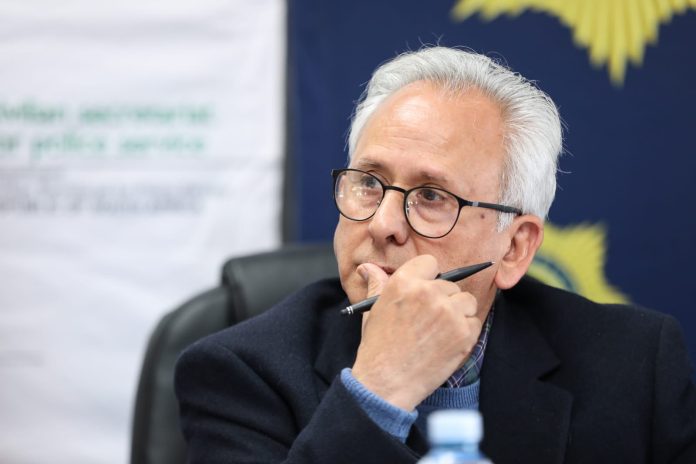
Police Minister Firoz Cachalia says gangs have tightened their grip on communities, warning they are no longer just local groups but part of organised, transnational crime networks.
Cachalia, Deputy Police Minister Polly Boshielo, and Deputy Justice Minister Andries Nel held engagements with civic groups, religious leaders, and community policing forums in Mitchells Plain and Mfuleni on Tuesday amid ongoing gang violence.
Speaking in Mitchells Plain, Cachalia admitted there are no quick fixes, but promised to listen and act responsibly.
He says gangs are becoming richer and more violent, infiltrating community organisations, including CPFs.
The Minister says the situation must first be stabilised. Flanked by National Police Commissioner Fannie Masemola and Provincial Police Commissioner Thembisile Patekile, Cachalia said this includes stronger intelligence, more patrols, raids, and prosecutions to confront drug lords and restore public trust.
“The National Commissioner and the Provincial Commissioner are here with me for a reason. It is not by mistake. They must listen to what you are saying. Let me say this: I like to listen to the voice of anger. I do not want empty platitudes.
“I do not have all the answers. I do not have a magic wand. I will not solve these deep problems overnight. But I commit to listen, to respond, and to be accountable. Our conversation with the Provincial Commissioner does not end here in Mitchells Plain today.”
The Minister says gangs have tightened their grip on communities.
“They must understand that they cannot kill our children and expect the state to sit idly by. We cannot allow gangs to control our communities. The more violent they become, the more determined we must be.
That is why the Commissioner is here. Not for a show, but because we need results. Together with the head of Crime Intelligence, he presented me with a plan. Intelligence is critical. We cannot win without it, because criminal networks infiltrate our communities and even institutions. There is a trust deficit. I cannot expect you to trust me today, but I will work to earn your trust.”
Cachalia went on to say that beyond a stabilisation plan, a broader strategy is needed to confront organised crime.
“These are no longer just local gangs. They are evolving into transnational, organized criminal networks with vast resources. They recruit, they pay more than most jobs, and they kill without hesitation. This is not only a Mitchells Plain problem — it is a national problem.
We are behind the curve, and we need a serious national plan. Construction mafias, extortion mafias, drug lords — they are spreading like wildfire in a depressed economy. And unless we act decisively, they will entrench themselves further.”
He says he met with 67 station commanders across the Western Cape.
“The same problems came up: under-resourcing, too few detectives, vehicles that are broken, and dockets piling up. Over the last decade, we have been losing more police officers than we recruit. Today we have fewer officers than ten years ago. That is the reality.
I have asked for a resourcing plan for Mitchells Plain and at least the 13 priority stations in this province. The Commissioner has committed to producing that plan within two weeks. I will come back here to present it.”
Masemola told the gathering that vacant posts will soon be filled in Mitchells Plain. Masemola acknowledged that a shortage in sector policing is linked to resource constraints.
He confirmed that Mitchells Plain has nearly 400 police members, with just 54 vacancies caused by resignations, retirements and transfers. Masemola said these vacancies will be filled in two halves by December and next year.
Meanwhile, both Premier Alan Winde and Mayor Geordin Hill-Lewis are expected to meet with Cachalia before the end of the week to discuss policing needs and the need for additional policing powers in the Western Cape.