


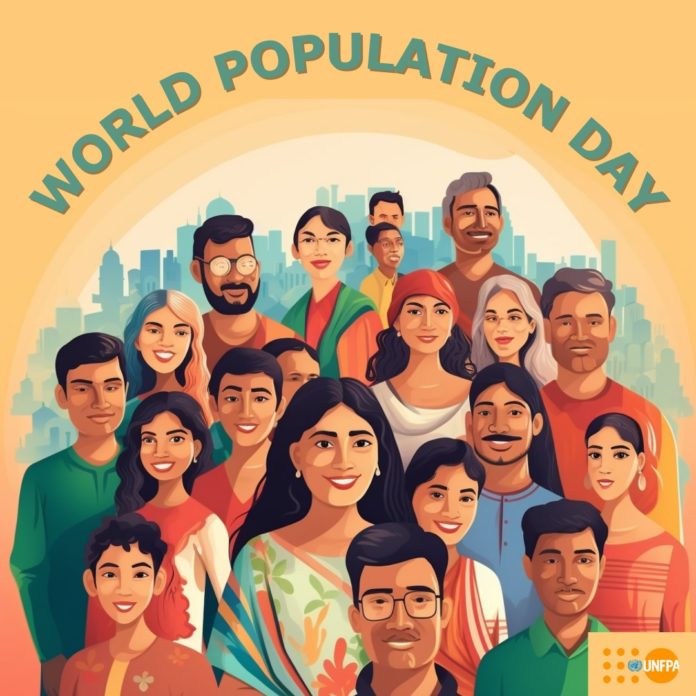
World Population Day is observed on July 11. The UN designated this day to focus on the urgency and importance of population issues. This includes their relation to human development and the environment.
The theme for 2023: Unleashing the power of gender equality: Uplifting the voices of women and girls to unlock our world’s infinite possibilities.
This as “pervasive injustices” keep women and girls out of school, the workplace and leadership roles, explains the United Nations. These injustices also “limits their agency and ability to make decisions” concerning their health and reproductive lives.
Gender-based discrimination harms everyone – women, girls, men, and boys.
Investing in women uplifts all people, communities, and countries.
On #WorldPopulationDay and every day, let’s stand with women and girls fighting for their rights. pic.twitter.com/kZNACytskr
— António Guterres (@antonioguterres) July 11, 2023
“We must advance gender equality to create a more just, resilient and sustainable world,” says UN Secretary-General António Guterres. The “power” of women and girls are vital in addressing challenges that threaten the future of the world, says Guterres.
RELATED: 9 Alternatives to University After High School
World populations tripled in 70 years
Back in 1955, there were reportedly 2.8 million people on Earth. Today, this is the population of India and China alone.
The world’s population stands at 8 billion in 2022. And according to estimates from the UN’s Population Division, the world will reach a population of some 9.7 billion people by 2050.
The dramatic growth has been attributed to increasing numbers of people living until a reproductive age. It is also closely linked to urbanisation and accelerating migration. The past few years have also seen dramatic changes in fertility rates and life expectancy.
In the early 70s women reportedly have on average 4.5 children each. Fast forward to 2015, global fertility rates had fallen to below 2.5 children per women. Meanwhile, the average global lifespans have increased: from 64.6 years (early 90s) to 72.6 years in 2019.
Better homes, better opportunities
Back on the topic of urbanisation and migration. 2007 was the first year in which more people were living in urban areas than in rural areas. It is expected that by 2050, about 66% of the world population will be living in cities.
RELATED: Reality check, we are still holding on to past trauma
These “mega-trends” greatly impact people’s way of life. It affects “economic development, employment, income distribution, poverty and social protections”, explains the UN. But they also affect efforts to provide universal access to education, sanitation, housing, health care, food and energy. The UN says policymakers truly need to understand how many people are living on the planet. Specifically, where they are, their age, and how many people will come after them. All in an effort to sustainably meet the needs of each person.
By 2050, after India and China, which come in first and second place respectively, Nigeria will become the world’s third most populous nation in the world. Followed by the United States, Pakistan, Indonesia and Brazil in that order.
This #WorldPopulationDay, instead of talking about the number of people…
…let’s talk about the number of choices women and girls have.
Drop a 💯 if you agree!
Help change the conversation with @UNFPA: https://t.co/tTLpElCinl#GlobalGoals pic.twitter.com/kFVyatI3au
— UNFPA (@UNFPA) July 8, 2023
Our ‘billion’ milestones
The global population growth to 8 billion (in 2022) can be largely attributed to the development of modern medicines and agricultural industrialisation.
- 1 billion people in 1804
- 2 billion people in 1927 (took 123 years)
- 3 billion people in 1960 (took 33 years)
- 4 billion people in 1974 (took 14 years)
- 5 billion people in 1987 (took 13 years)
- 6 billion people in 1999 (took 12 years)
- 7 billion people in 2011 (took 12 years)
- 8 billion people in 2022 (took 11 years)
- 9 billion people in 2037* (UN forecast)
- 10 billion people in 2057* (UN forecast)
RELATED: PICS: Nepal celebrates Paddy Festival with mud splashes, feasts
The UN notes that while the global population continues to grow, experts have pointed out that the annual growth rate has consistently declined to below 1%. Based on this, the world’s population is set to peak at roughly 10.4 billion people. This is projected for the 2080s, and will remain at the level until 2100.