

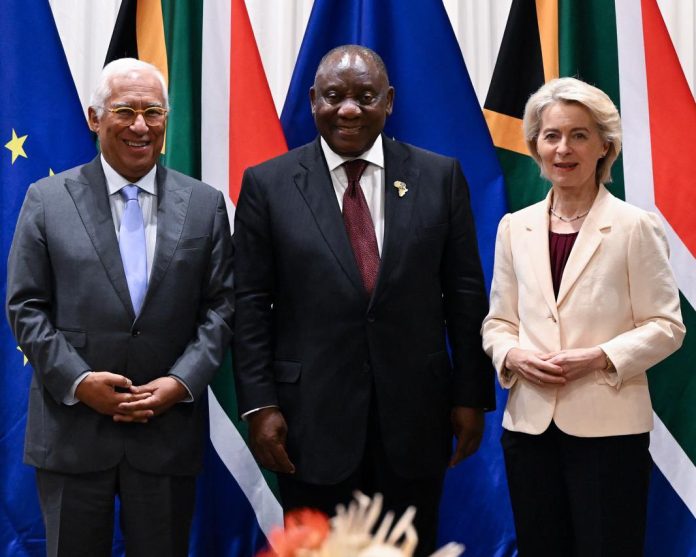
As leaders from across the globe convene in Johannesburg for the G20 Leaders’ Summit, the United States Government finds itself conspicuously absent from the main stage.
President Cyril Ramaphosa has made it clear that South Africa will not be bullied into silence, while Washington’s sharp response has deepened a diplomatic row.
Ramaphosa told a G20 briefing on Thursday that the US was reconsidering its decision not to attend the summit, suggesting discussions were ongoing.
We have received notice from the United States with regards to participation in the G20 Leaders’ Summit. Discussions are ongoing. #G20SouthAfrica pic.twitter.com/xnQJ4X5iOI
— Cyril Ramaphosa 🇿🇦 (@CyrilRamaphosa) November 20, 2025
However, White House Press Secretary Karoline Leavitt quickly dismissed the claim, insisting that the US will not participate in formal talks.
Instead, Washington will send Chargé d’Affaires Marc Dillard to Sunday’s ceremonial presidency handover, a move widely seen as symbolic rather than substantive.
Leavitt’s remarks sparked controversy, with commentators describing the phrasing as disrespectful, noting the unusual bluntness of a White House spokesperson toward a head of state.
“I saw the South African President running his mouth a little bit against the United States and @POTUS… and that language is not appreciated by @POTUS and his team,” she said.
.@PressSec: “The United States is not participating in official talks at the G20 in South Africa. I saw the South African President running his mouth a little bit against the United States and @POTUS… and that language is not appreciated by @POTUS and his team.” pic.twitter.com/82sli52oRD
— Rapid Response 47 (@RapidResponse47) November 20, 2025
Presidential spokesperson Vincent Magwenya responded that South Africa would not hand over the G20 Summit to a chargé d’affaires, underscoring Pretoria’s insistence that the summit remains a leaders’ forum.
During the closing ceremony of the G20 Social Summit earlier this week, Ramaphosa himself doubled down, declaring:
“It cannot be that a country’s geographical location, income level or army determines who has a voice or who is spoken down to. It basically means there should be no bullying of one nation by another nation.”
“ it cannot be that a country’s geographical location , income level or army determines who has a voice or who is spoken down to , it basically means that should be NO BULLYING of one nation by another nation “
- President Cyril Ramaphosa 🇿🇦🫰🏽
Video cred @Newzroom405 pic.twitter.com/rimsXNamHV
— Zhuliyia 朱莉娅 (@JuliRee_Mts) November 20, 2025
The tension comes amid reports that Washington warned Pretoria against issuing a joint leaders’ declaration at the end of the summit. US officials threatened to block any consensus statement, arguing that American policy goals do not align with South Africa’s.
Yet Pretoria has rejected the warning, insisting that the US cannot boycott the meeting while simultaneously demanding influence over its outcomes.
President Donald Trump announced earlier this month that the US would not take part in the G20, a decision that has left America isolated as leaders from Asia, Europe, Africa, and Latin America gather to discuss global economic and political challenges.
Ramaphosa’s defiant message, “We will not be bullied”, has resonated across South Africa and beyond.
As the G20 unfolds, the absence of the United States may prove as significant as the presence of those who chose to attend.
'We will not be bullied," says President Cyril Ramaphosa pic.twitter.com/YiLg6iwoM3
— Times LIVE (@TimesLIVE) November 20, 2025