

International reaction is intensifying following a dramatic United States military operation in Venezuela that resulted in the capture of President Nicolás Maduro and his wife, Cilia Flores, in Caracas.
The unprecedented raid, confirmed by Washington on Saturday, has sent shockwaves through the international community, with governments divided over the legality and implications of the action. Developments continue to unfold as US President Donald Trump claimed the United States would place Venezuela under temporary American control following the operation.
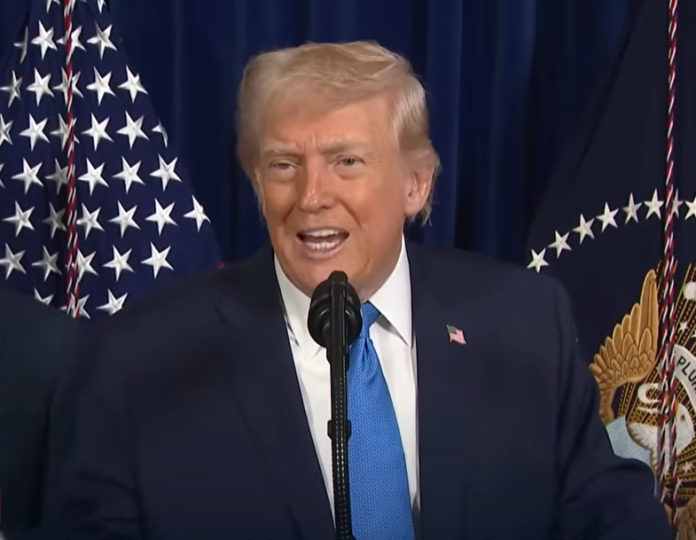
Speaking after the strikes, Trump said the US was “going to run” Venezuela until what he described as a “safe, proper and judicious transition” of power could be achieved. He did not provide details on how such control would be administered.
Trump also said US companies would be sent into Venezuela to repair the country’s oil infrastructure, arguing this would help “start making money for the country”. He added that the United States was prepared to launch a second military strike if necessary, though he suggested it was unlikely to be required.
Referring to Maduro as an illegitimate dictator, Trump spoke of a future “partnership” between the US and Venezuela that would make Venezuelans “rich, independent and safe”. He confirmed that Maduro and his wife were being flown to New York to face drug trafficking-related charges and so-called narco-terrorism, allegations the Venezuelan leader has previously denied.
In Caracas, Venezuela’s Supreme Court moved swiftly to address the leadership vacuum. The Constitutional Chamber ruled that Vice President Delcy Rodríguez would assume the role of acting president in Maduro’s absence, citing the need to guarantee administrative continuity and the comprehensive defence of the nation.
Rodríguez rejected any authority claimed by the Trump administration over Venezuela’s political future, insisting the country would ignore US instructions on succession. She has demanded the immediate return of Maduro and his wife, maintaining that Maduro remains Venezuela’s legitimate president and describing his removal as a kidnapping.
South Africa condemns US action
South Africa has joined a growing list of countries expressing alarm over the developments. In a statement, the Government of the Republic of South Africa said it viewed the US action as a “manifest violation” of the United Nations Charter, which prohibits the use of force against the territorial integrity or political independence of sovereign states.
Pretoria said the UN Charter does not authorise external military intervention in matters that fall within a country’s domestic jurisdiction, warning that history has shown such invasions lead only to instability and deepening crises. South Africa called on the UN Security Council to urgently convene to address the situation and uphold international peace and security.
European leaders divided
European leaders have also reacted cautiously, with responses reflecting deep divisions.
UK Prime Minister Keir Starmer said Britain was not involved in the operation and that he intended to speak to Trump to establish the facts before commenting further.
French President Emmanuel Macron called for Venezuela’s 2024 opposition candidate, Edmundo González, whom he referred to as president, to oversee a peaceful and democratic transition.
Germany’s Chancellor Friedrich Merz said Maduro had “led his country to ruin”, but added Berlin was still assessing whether the US action breached international law.
Italian Prime Minister Giorgia Meloni said external military intervention was not the correct way to end totalitarian regimes, though she argued it could be legitimate to defend against threats to national security.
Spain’s Prime Minister Pedro Sánchez said Madrid did not recognise Maduro’s government but would also not recognise an intervention that violated international law, calling for respect for the UN Charter.
European Union foreign policy chief Kaja Kallas said the EU has repeatedly stated that Maduro lacks legitimacy, but urged restraint and respect for international law.