
The South African Weather Service has warned that the approaching El Niño event, which has formed in the Pacific Ocean, is likely to become the strongest in living memory, with very hot and dry conditions expected between October and December 2026 and into early 2027.
In a statement issued yesterday, 1 September, the SAWS said the latest weekly-averaged sea surface temperature anomalies over the eastern central tropical Pacific Ocean are already exceeding the threshold that defines a very strong El Niño.
“The latest predictions are indicative that the El Niño will likely intensify further to become the strongest event in living memory.”
El Niño refers to an event where 3-monthly averaged sea surface temperature anomalies over the eastern central tropical Pacific Ocean are exceeding 1,5°C with respect to climatology, while during a very strong El Niño, this part of the ocean is 2°C warmer than normal.
The weather service warns that the latest forecasts indicate that the current event will very likely exceed the 3°C threshold.
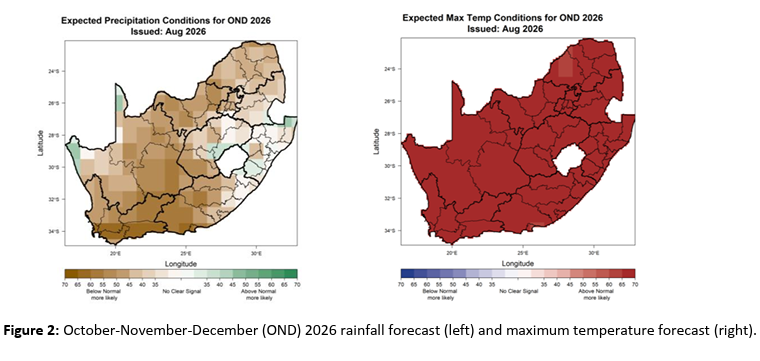
“The latest seasonal forecast of the South African Weather Service for the October to December 2026 period indicates that below-normal rainfall is the most likely outcome over most of South Africa. This period is also very likely to be associated with above-normal temperatures.”
SAWS adds that 2027 is likely to become the warmest year ever recorded.
The weather service has appealed to the public and weather-sensitive industries to follow the monthly seasonal forecast updates and daily short-term weather forecasts to be prepared. SAWS will also communicate closely with Disaster Management structures.
During the Western Cape Government’s recent digicon on the looming El Niño event, officials called on all residents to save water now and prepare fire breaks ahead of the summer.
ALSO READ: El Niño: Western Cape faces triple threat of fires, extreme heat and water insecurity this summer
Most El Niño events bring conditions of below-normal rainfall and above-normal temperatures to the southern African region. Two of the most impactful El Niño events for the southern African region were in 1982/83 and 2015/16, which brought widespread drought.
Cape Town famously staved off Day Zero following an intense water-saving campaign in late 2017 and into 2018.
The SAWS says it should, however, be noted that although below-normal rainfall is statistically the most likely outcome in southern Africa this summer, not every single El Niño event is associated with drought.
The very strong El Niño event of 1997/98 was associated with slightly above-normal rainfall over parts of South Africa’s summer rainfall region.