


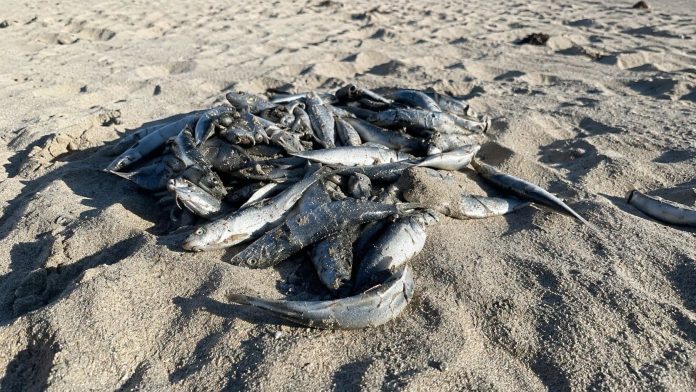
The City of Cape Town’s Spatial Planning and Environment Directorate has confirmed that the recent sardine die-off reported along the Western Cape coastline is not connected to the Milnerton Lagoon pollution.
Dead and dying sardines have reportedly been washing ashore at various locations across the province over the past few weeks, stretching from Saldanha Bay on the West Coast to Cape Agulhas on the Cape south coast.
In a statement, the Directorate has confirmed that in Cape Town, sightings have been reported at Silverstroomstrand, the Milnerton area and Camps Bay, among other locations.
The National Department of Forestry, Fisheries and the Environment (DFFE) has released the results of diagnostic testing conducted on affected fish collected from various beaches.
The tests confirmed the presence of pilchard herpesvirus genetic material in sampled sardines. However, the role of the virus in the recent mortality remains under investigation.
The City says the fish deaths are part of a wider marine phenomenon and have no connection to the Milnerton Lagoon.
“We want to assure residents that this phenomenon has nothing to do with the Milnerton Lagoon. Sardines do not live in the Milnerton Lagoon, neither in the estuary, they are oceanic fish,” said the City’s Deputy Mayor and Mayoral Committee Member for Spatial Planning and Environment, Eddie Andrews
Andrews said the City would continue monitoring developments as the DFFE investigates the cause of the mortality along the West Coast.
“The National Department of Forestry, Fisheries and the Environment (DFFE) is busy investigating the cause of the sardine mortality along the West Coast, and we will be sure to stay abreast of these findings.”
The City confirmed sightings at several locations along Cape Town’s west coast, with the mortalities attributed to the wider fish die-off.
Andrews has also urged residents to exercise caution when encountering dead fish or other unidentified objects along the shoreline.
“We would like to remind residents not to allow their pets to consume marine life or unidentified objects found along the shoreline in general.”
Residents have also been advised not to move or dispose of the fish themselves if they encounter any along the shoreline.
READ MORE: Renewed warning not to consume washed up sardines


