
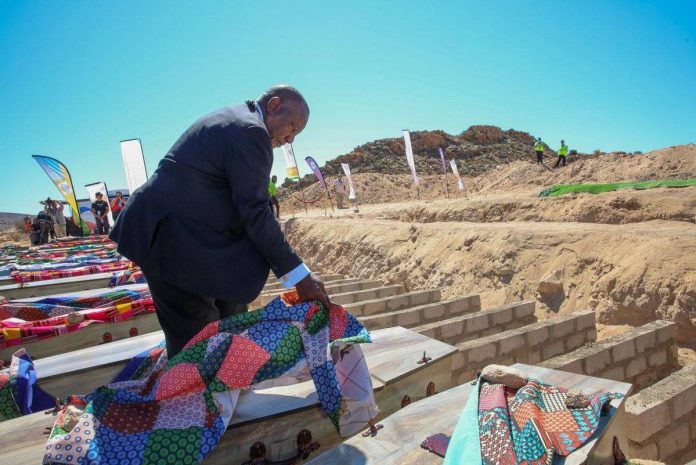
President Cyril Ramaphosa has led a solemn reburial ceremony for ancestral Khoi and San remains in Kinderlê, in the Northern Cape.
The remains, some dating back to the 1800s, were previously taken to European institutions during the colonial era and have now been repatriated.
Ramaphosa has described the reburial as an important act of dignity and restitution, acknowledging the historical injustices suffered by indigenous communities.
He says returning the remains is part of ongoing efforts to heal the divisions of the past and restore cultural heritage.
Read President Ramaphosa’s full speech below, during the official ceremony on Monday, 23 March, 2026:
It is an honour to be here today as we lay our ancestors to rest.
A dignified burial is but the least we can do as the democratic government to honour these, our countrymen and countrywomen, who were victims of a terrible past.
The Nama, Khoi, Korana, Griqua and San people bore the brunt of European conquest of southern Africa. They were dispossessed of their lands, and unimaginable violence was unleashed upon them.
In life, they were robbed of their names, their culture, and their very humanity.
During a dark period of scientific racism in the late 18th century and 19th century, many of our people were coerced to leave southern Africa for Europe; where their physical features made them exotic specimens for exhibition, study and exploitation.
Not even death would spare them from indignity.
Their remains were dug up from graves and sold to museums and medical institutions in Europe. The sale of human remains of indigenous peoples for study in Europe was rooted in racism and used to advance theories of European racial superiority.
Others, like Sara Baartman, died sick and alone in these faraway lands.
Today, as their remains are finally returned to the land from which they were taken, we restore the dignity that was so cruelly denied to them in life and even in death.
It is a culmination of a long journey and a collaborative partnership between government and various stakeholders. They include the Iziko Museum, formerly the South African Museum, the South African Heritage Resources Agency (SAHRA), and the Hunterian Museum at the University of Glasgow in Scotland.
I would like to welcome the representatives from the Hunterian Museum who are with us today.
Following discussions that began in 2022, last year we successfully repatriated the remains of five individuals, together with two plaster face-casts and a smoking pipe that was excavated from a burial ground.
These remains were unethically exhumed between 1868 and 1924 from graves in the Northern Cape and were donated to the university.
The other remains that will be buried today had been housed at the Iziko Museum since the 1920’s.
The return of our ancestors to their descendant communities is a vital act of restoration and restitution that goes beyond acknowledging the colonial legacy, it is also a manifestation of ubuntu – a recognition of our common humanity.
Today, we accompany them to their final rest here at Kinderlê, a place with a tragic history.
It was here, in 1867 that 32 Nama children were murdered while their parents were away at a church service.
The Northern Cape Reburial Task Team has chosen this site as an act of reconciliation, and as a reminder that despite the deep divisions in our past, we are one people.
The greater tragedy of the erasure of the indigenous peoples of southern Africa is that much of it went unacknowledged.
It was only in the late 20th century that European countries began to seriously confront their colonial legacies, and even then, it has only been some of them.
Even amidst the emergence of serious critiques on the part of these European powers in the late 1970’s, many have avoided a deeper reckoning.
Some of these countries have apologized for specific atrocities, but in the main they have fallen short of full, unqualified apologies for colonialism as a whole.
As democratic South Africa, we do not linger in the shadow of unspoken apologies or deferred reckonings.
We will restore dignity – on our own terms.
This year marks thirty years since our democratic Constitution was signed into law.
The preamble of the Constitution calls on us to heal the divisions of the past and establish a society based on democratic values, social justice and fundamental human rights.
Our Constitution obliges us to advance restitution for all those who were the victims of colonial and apartheid atrocities.
Since 1994 we have actively implemented legislative and policy reforms to address the historical exclusion of our indigenous communities. We have done this through land restitution and redress, legal recognition of leadership structures, and support for cultural revival and language preservation.
Through the National Policy on Repatriation of Human Remains and Heritage Objects we will continue to forge partnerships with institutions and individuals across the world to recover ancestral human remains that were illegally taken from South Africa.
I would like to thank the Ministry of Sports, Arts and Culture, the Northern Cape Reburial Task Team, the Iziko Museums of South Africa and the South African Heritage Resources Agency for their ongoing work in this regard.
We thank the traditional leadership who are with us today for being part of this important act of redress that we hope will bring a measure of closure to the affected communities.
Human dignity is not dependent on who you are, what language you speak, what colour your skin is, where you were born or how much or how little you have.
Human dignity is inherent. We claim it for ourselves.
It cannot be deferred. And it cannot be erased.
The illegal exhumation of our ancestors for sale in faraway lands exposed the depths of depravity to which human beings could descend.
They were dug up and turned into commodities and specimens, displayed under the cold gaze of pseudoscience.
Their restless spirits were left to wander here in the Northern Cape, the land where they once lived.
Today we welcome their mortal remains, that they may at last be reunited with their spirits.
They were not nobodies.
They came from communities. They had families. Each and every one of their lives had meaning and purpose.
They were our people.
They came from this land, to which we now return them.
And we have brought them home to be buried here alongside the children of Kinderlê.
In the words of our great legend Diana Ferrus:
“I have come to take you home, where the ancient mountains shout your name. I have made your bed at the foot of the hill. Your blankets are covered in buchu and mint. The proteas stand in yellow and white.
I have come to take you home where I will sing for you, for you have brought me peace. For you have brought us peace.”
We honour you. We remember your precious lives. We pray that you may finally rest in peace.