


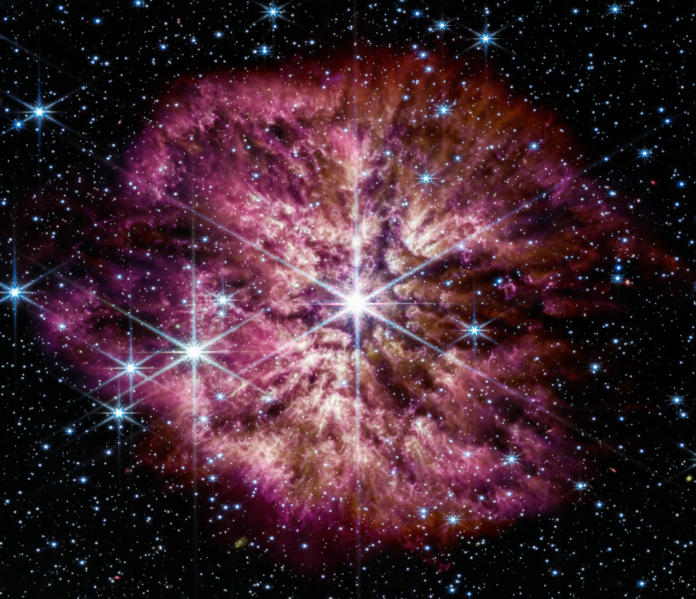
NASA’s James Webb telescope has captured a stunning image of a star that is on the cusp of dying.
NASA says the rare sight of a Wolf-Rayet star – among the most luminous, most massive, and most briefly detectable stars known – was one of the first observations made by NASA’s James Webb Space Telescope in June 2022.
Webb shows the star, WR 124, in unprecedented detail with its powerful infrared instruments. The star is 15,000 light-years away in the constellation Sagittarius.
Massive stars race through their lifecycles, and only some of them go through a brief Wolf-Rayet phase before going supernova, making Webb’s detailed observations of this rare phase valuable to astronomers.
Wolf-Rayet stars are in the process of casting off their outer layers, resulting in their characteristic halos of gas and dust.
The star WR 124 is 30 times the mass of the Sun and has shed 10 Suns’ worth of material – so far. As the ejected gas moves away from the star and cools cosmic dust forms and glows in the infrared light detectable by Webb.
The origin of cosmic dust that can survive a supernova blast and contribute to the universe’s overall “dust budget” is of great interest to astronomers for multiple reasons. Dust is integral to the workings of the universe: It shelters forming stars, gathers together to help form planets, and serves as a platform for molecules to form and clump together – including the building blocks of life on Earth.
Despite the many essential roles that dust plays, there is still more dust in the universe than astronomers’ current dust-formation theories can explain. The universe is operating with a dust budget surplus.
Stars like WR 124 also help astronomers understand a crucial period in the early history of the universe. Similar dying stars first seeded the young universe with heavy elements forged in their cores – elements that are now common in the current era, including on Earth.
NASA says Webb’s detailed image of the dying star preserves forever a brief, turbulent time of transformation, and promises future discoveries that will reveal the long-shrouded mysteries of cosmic dust.
PICS: James Webb Telescope captures iconic ‘Pillars of Creation’