


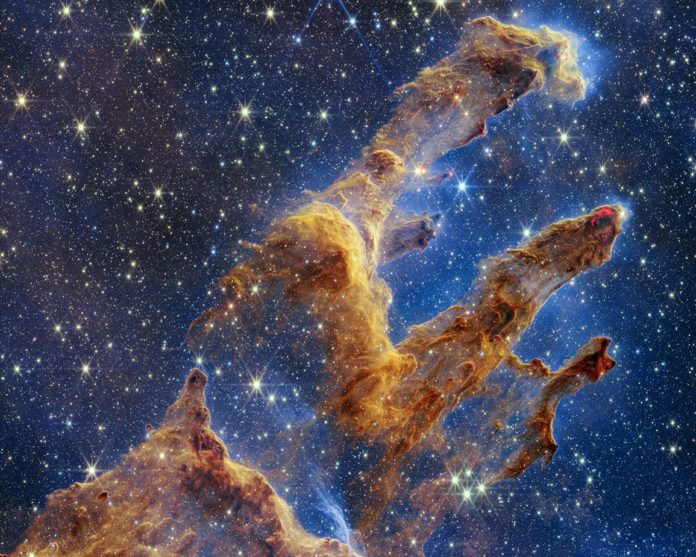
The world’s largest and most powerful space telescope has captured the iconic Pillars of Creation, huge structures of gas and dust teeming with stars, according to NASA.
The James Webb Space Telescope has taken its first shot of the gigantic gold, copper and brown columns standing within the vast Eagle Nebula, 6,500 light years away from Earth, the United States space agency said in a statement on Wednesday.
NASA’s Hubble Space Telescope first captured images of the Pillars in 1995.
But thanks to Webb’s infrared capabilities, the newer telescope – launched into space less than a year ago – can peer through the opacity of the Pillars, revealing new stars forming.
The Webb images show bright red, lava-like spots at the ends of several Pillars. “These are ejections from stars that are still forming,” only a few hundred thousand years old, NASA said
These “young stars periodically shoot out supersonic jets that collide with clouds of material, like these thick pillars,” it added. ‘So many stars’
“By popular demand, we had to do the Pillars of Creation,” Klaus Pontoppidan, science programme manager at the Space Telescope Science Institute (STScI), said on Twitter.
STScI operates Webb from Baltimore, Maryland.
“There are just so many stars!” Pontoppidan added.
NASA astrophysicist Amber Straughn summed it up: “The universe is beautiful!” she wrote on Twitter.
This is what you’ve waited for.
Journey with us through Webb’s breathtaking view of the Pillars of Creation, where scores of newly formed stars glisten like dewdrops among floating, translucent columns of gas and dust: https://t.co/5ea1kCzU5x
Here’s your guided tour ⬇️ pic.twitter.com/jFiDDrMUPl
— NASA Hallo-Webb Telescope 🕸🕷🎃 (@NASAWebb) October 19, 2022
The image, covering an area of about eight light years, was taken by Webb’s primary imager NIRCam, which captures near-infrared wavelengths – invisible to the human eye.
The colours of the image have been “translated” into visible light.
According to NASA, the new image “will help researchers revamp their models of star formation by identifying far more precise counts of newly formed stars, along with the quantities of gas and dust in the region.”
They also said that “each advanced instrument offers researchers new details about this region, which is practically overflowing with stars.”
Operational since July, Webb is the most powerful space telescope ever built and has already unleashed a raft of unprecedented data. Scientists are hopeful it will herald a new era of discovery.
One of the main goals of the $10bn telescope is to study the life cycle of stars. Another main research focus is on exoplanets, planets outside Earth’s solar system.