Seasonal workers in Robertson often struggle to get to the clinic to access basic healthcare during the day, so community health workers in the Langeberg have set up mobile clinics to visit the township at night. Sue Segar reports for Spotlight.
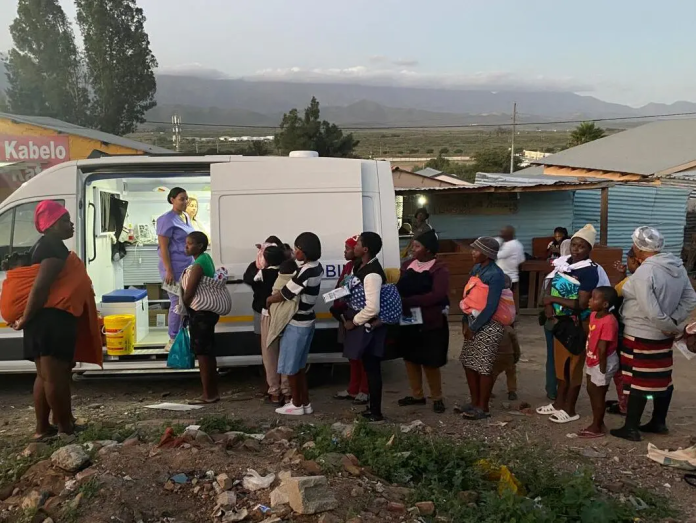
It’s late afternoon on a balmy Autumn Thursday in Nkqubela township, which is nestled in the picturesque farming town of Robertson in the Western Cape. Against a mountainous backdrop, four large mobile clinics are winding their way along the streets.
On arrival at the Kabelo spaza shop, the vehicles park next to each other, leaving enough space so people can move between them.
Sitting in the front seat of one vehicle, Marilize du Toit, coordinator of community-based services programmes for the Langeberg area, looks out of the front window. “See, the people are already waiting for us,” she says to her colleague, Sister Feroza Fielies.
At least thirty people, mostly women, some with babies on their backs, are thronging outside. Community health worker, Perseverance Madwabe, ushers people into groups according to which mobile clinic they should visit. Within minutes, there are four long, orderly lines.
Raymond Mhobo, an admin clerk from Robertson Hospital, places a large box of condoms on the ground between the vehicles for people to help themselves.
Just before 17:00, the clinics open their doors. Inside each are two or three health workers in different uniforms. Tonight, the team is made up of four professional nurses, four community health workers, a dietician, and a speech therapist. In a matter of minutes, they are all busy.
Every Thursday in summer
This is the scene in Nkqubela every Thursday evening in summer, as healthcare workers from the area join forces to serve people who can’t access health services during standard working hours. Demand for such after-hours services is higher in summer due to seasonal farm work in the area.
Robertson is located in a fertile valley and is mostly known for wine, fruit and roses, and for being on the Route 62 tourist map. Nkqubela, situated across the railway line from the town centre, is home to a large population of local and migrant workers from neighbouring countries, many of whom are seasonal workers on surrounding farms.
Earlier this year, after identifying Nkqubela as a crime hotspot, Western Cape Premier Alan Winde visited the township to encourage collaboration between local police and community structures. In March 2022, there were reports of public unrest between unemployed locals and foreign nationals amidst allegations of “discriminatory employment issues on farms in the area”.
During Spotlight’s visit to Nkqubela, the mood is very calm. People walk between homesteads. Children run around in the streets and dogs sniff for titbits. There’s washing hanging on the lines outside some of the homes, a woman fills a kettle from an outside tap. Small bags of tomatoes hang on a fence outside someone’s house for sale.
Variety of health services
A line of at least twenty women, all carrying babies, wait outside the van in which dietician Leanna Lubbe; community service speech therapist Leah Esau, and community health worker Phumeza Tyalili are already hard at work. They are measuring and weighing babies to check for malnutrition; deworming them and giving them Vitamin A supplements. They’re also checking their Road-to-Health cards to see whether they are up to date with immunisations.
“If they’re due for an immunisation, we send them to the other vehicle,” says Lubbe. “If a child is really not well, we either treat them or book them an appointment at the clinic.”
Esau is doing basic screenings for speech and hearing with the babies – checking how they respond to sounds. If problems are detected, she’ll refer them to her department at the Robertson Hospital.
In another van, professional nurse, Sister Sada Mkokelwa and her team are doing immunisations; in the third, Sister Elizabeth Kriel, a professional nurse from Montagu and her team are doing general health checks, like measuring weight and blood pressure, and also helping with family planning.
In the fourth, Du Toit and Fielies are hard at work doing family planning consultations – discussing and providing contraceptives to women; as well as doing pregnancy tests.
Contraceptive choice
“Our services include the removal and insertion of Implanon devices (the contraceptive which is inserted under the skin of a woman’s upper arm, which can prevent pregnancy for at least three years), provision of both the two-month and three-month injectable contraceptives, as well as oral contraception,” Du Toit explains.
“Some women are overdue in collecting their contraceptives. Those presenting late for their scheduled contraception are asked to provide a urine sample for pregnancy testing,” she says. The testing of their samples is all done on the spot, inside the mobile clinic, and the women are immediately told their results.
“If they test negative for pregnancy, we offer them a choice of contraceptive method – oral or injectable methods, or Implanon,” says Fielies. “We also give them health education based on their selected method.”
If a client tests positive for pregnancy, they are given a referral letter to the clinic. Pap smears have also been incorporated into the outreach services to strengthen cervical cancer preventive care.
There are also treatments offered for sexually transmitted infections. “Clients presenting with symptoms of STIs are treated on site, provided with condoms and given education on safe sexual practices. We also advise them that their partners should seek treatment,” says Du Toit.
Chesrine Koch, a community health worker who is working with Kriel has just spent time consulting with a woman whose husband lives on a farm far away. “She’s worried she has picked up an STI. We tested her for HIV and for STIs and she was negative for both,” says Koch. “I’m pleased people can come here and feel safe to share their fears with us. We treated her for a urinary tract infection, and she’s relieved to have clarity,” she adds.
“Beyond the call of duty”
Spotlight first heard about the night clinic from Handri Liebenberg, Director for Comprehensive Health Services in the Cape Winelands, who praised the evening outreach team for their dedication beyond the normal call of duty.
“The clinic at Nkqubela closes at 16:00 every day and farmworkers only get home round 18:00, so they don’t always have access to preventative services, like immunisation, family planning, and HIV and TB screening,” Liebenberg told Spotlight.
The night outreaches were the brainchild of Sister Megan Williams, Primary Healthcare Manager for Langeberg, and Sister Magda Mareo, the previous CBS coordinator, from whom Du Toit took over.
“When I first started working in this position about six years ago, I’d watch people climbing onto the farm trucks early every morning and getting off in the evenings, many of whom were women,” says Williams who grew up in Robertson. “Their priority is to get on those trucks, to go to work and get money to put food on the table. If they miss that truck, they miss a day’s pay.”
She says that she realised that many patients who were landing up in hospital were the children of these farmworkers who weren’t getting to the clinic for immunisations and general health. “They were the ones suffering from malnutrition, diarrhea and other illnesses.”
Proposing a much-needed solution, Williams says she eventually suggested to her staff that they go into Nkqubela after hours when the trucks have brought the farmworkers home.
“We decided to give it a try,” she says and their first evening outreach with a single mobile clinic was a hit. “When we arrived, we wondered if anybody would come. All of a sudden, there were queues of people arriving. We worked late into the evening and went back the following Thursday.”
Before long, Williams and her team expanded the services offered at these after-hours clinics.
When Du Toit started working as the community-based services programme coordinator earlier this year, she invited all the professional nurses from the Robertson and Nkqubela clinics to participate in the outreach programme.
“All services rendered during the outreach are voluntary, with no financial compensation or incentives provided to team members,” she says, adding that healthcare workers are not paid extra for this work but they can take time off to make up for the hours spent in the evening clinics.
“If I don’t work, I am not paid”
Fikiswa Guda, who works on a farm picking lemons, stands outside the mobile clinic van which is doing immunisations. Her daughter Sipo is three months old. “I’ve brought her for her ten-week injections. I finish work every day at 5pm. If I don’t work, I am not paid, so I can’t find the time to take my baby to the clinic,” she says.
“I am grateful for these mobile clinics on Thursday nights. We don’t get the help at the clinic that we get here,” Guda says.
Auxillia Majiga, who works as a hairdresser, has brought her baby, Liam for his four-month injection. “This mobile service is good because during the day, I am busy doing people’s hair. Also, we don’t always get what we need at the clinic because we have to book a date,” she says.
Margaret Toerien says she works as a domestic worker on a fruit farm. “This mobile clinic is good because I can come here after work. I don’t have to have an appointment like we do at the clinic,” she says. She says thanks to the evening clinic, her baby is up to date with injections. “Having this clinic on Thursdays means, I can go home after work, pick up the baby and walk from home to the mobile clinic. They weigh the baby, measure her and check that she’s healthy.”
Relieving the pressure on clinics
One benefit of these evening clinics is that it lightens the load on the daytime clinics in the area.
Sister Leandri Apollos, operations manager of Nkqubela Clinic, says the clinic is small and they are relatively under-staffed. “We have a lot of challenges. The migrant population adds to our workload, and we can’t see all the patients we need to see,” she says.
“Since the night clinics started running, we’ve had far fewer sick children coming to the clinic; and far fewer people coming for unbooked immunisations,” says Apollos.
“The night clinics also take a lot of the burden of family planning away from the clinic; and the fact that they also do HIV tests and treat a lot of sexually transmitted infections is also a great help,” she adds.
“There are still queues when we leave”
Back in Nkqubela, heavy clouds hang over the surrounding mountains and darkness is coming fast. It’s getting cold. Smoke whisps out of some of the homes as night fires are lit. A taxi pulls up and parks outside a house for the night.
There’s a general bustle as people walk between houses and make their way home. A few babies wail in their mothers’ arms, still smarting from their injections. Sounds of drums and loud, poignant singing emerge from a small, corrugated iron hall as the local youth choir practices. People rush into the spaza shop and emerge with half loaves of bread just before the owner brings down the steel gate.
At the mobile clinics, there are still people who have not been attended to. But it’s time to close now, says Du Toit. “The people can’t believe we are closing. They will stay until they see us drive off,” she says. “I really feel for them… but the police do not want us staying too long into the night. We are just women doing this outreach. And I still have to go home and spend time with my own family.”

This article was first published by Spotlight – health journalism in the public interest. Sign up to the Spotlight newsletter.