


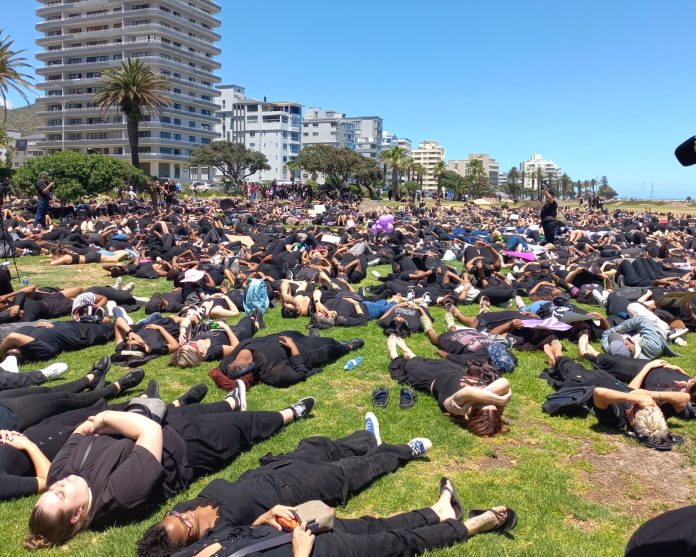
Nearly a year after the government declared gender-based violence and femicide a national disaster, questions are being raised over what has actually changed for women in South Africa.
The declaration, on 21 November 2025, came amid nationwide protests and was welcomed as a turning point, but a string of femicide cases in Ekurhuleni, concerns over policing and crime data, and ongoing calls for greater resources and accountability are once again putting the state’s response to GBVF under the spotlight.
The declaration came as world leaders gathered for the historic first G20 summit on African soil, with the announcement happening hours after thousands of women across the country lay on the ground for 15 minutes in honour of women who are murdered every day. This was part of the Women for Change movement’s “G20 Women’s Shutdown” protests.
The GBVF disaster declaration was meant to spark real action, implementation of risk-reduction and prevention measures, and regular progress reports. At the time, co-operative Governance Minister Velenkosini Hlabisa said:
“This effort pulls together every sphere of government and every critical sector: policing, social development, justice, health, education, economic development, and traditional leadership. Above all, it confirms a fundamental truth: GBVF is not a women’s issue. It is a national crisis.”
The femicide cases in Ekurhuleni have, however, highlighted a stark reality: Women are not safe in South Africa, and they may never be.
Advocacy group Action Society says the Ekurhuleni murders expose dangerous gaps in crime data and local policing, as police revealed on 14 September that 17 women had been reported missing in the Kempton Park area since January 2026.
Thirteen women were reportedly located and safely reunited with their families. SAPS did not clarify the status of the remaining four. This is as nine bodies have been found since July.
Juanita du Preez, national spokesperson for Action Society, says the country cannot be told that gender-based violence and femicide constitute a national crisis, yet SAPS does not publish the detailed statistics needed to understand and respond to that crisis.
She has expressed concern that it appears local police stations are not equipped to identify developing crime patterns in their communities and act before numerous cases attract national attention.
“Local police stations should know what is happening in the communities they serve. They must have the personnel, information systems and specialist support needed to connect missing-person reports with violent crimes across neighbouring precincts. If meaningful capacity were localised, warning signs could be identified much earlier. A high-level team arriving after eight women have been found dead is crisis management, not effective policing.”
Du Preez added that a collapsed DNA system could keep a possible serial murderer hidden.
Amnesty International South Africa Executive Director, Shenilla Mohamed, says the criminal justice system is not responsive to the context in South Africa and the threats women and children face every day.
“With the police under the microscope at the Madlanga Commission, this is the moment for the state to design a policing system that is responsive and yields results rather than consistent failures. Women being told not to walk or run alone is not the answer, and is not protection. Women should not have to bear the burden of being constantly vigilant to protect themselves from violence. Women are tired of platitudes. We want to know what is going to be done to make women and children safe in South Africa. We do not only want condolences, we want action.”
According to recent reports, police recorded 50,511 gender-based violence and femicide (GBVF) cases during the 2025/26 financial year, with only 30,736 leading to arrests or referrals to the National Prosecuting Authority (NPA).
Mohamed adds the state must urgently recognise femicide as a statutory crime.
“South Africa continues to experience one of the highest femicide rates in the world. But it is currently not recognised as a crime. Every day that femicide remains unrecognised as a crime is a failure to confront the targeted killing of women. It is time to call it what it is: Femicide.”
She says recognising femicide as a crime would highlight the drivers behind the killing.
“The criminalisation of femicide alone will not stop the killing of women but it will be a powerful tool to hold the state accountable for not doing more to protect women in South Africa, and ensure dedicated resources are allocated to address femicide. It would compel the state to confront their failure to protect women and girls from violence. You cannot fix what you are not tracking.”
Attorney at the Centre for Human Rights at the University of Pretoria, Rethabile Mosese, recently wrote for AfricLaw that declaring GBVF a national disaster was an important political acknowledgement, but the legal mechanism used by government is too weak to force meaningful action.
“The GBVF response is a pipeline in which resources consistently evaporate before reaching survivors. Provincial departments receive allocations that pass to district offices, which contract implementing partners such as shelters and legal advocacy organisations. At each tier, a portion is retained for programme management; the funds eventually reaching frontline organisations are a fraction of what Parliament intended. According to the National Shelter Movement of South Africa, Gauteng alone returned hundreds of millions of rands in unspent GBVF allocations in recent financial years, not because the need had gone, but because procurement law blocked the money from reaching the organisations capable of spending it. Shelters operated at or beyond capacity while the funds sat unspent. Survivors were told no beds were available, handed a list of numbers, and instructed to try again.”
At the end of August 2026, the National Council on Gender-Based Violence and Femicide (GBVF) held its inaugural meeting, formally beginning the work of the body established under the 2024 National Council on GBVF Act.
Minister Sindisiwe Chikunga said the Council was now officially operational and is intended to bring government and society together to coordinate, monitor and strengthen the fight against GBVF, with a focus on measurable results, resources and accountability.
Chikunga recently told Parliament that the GBVF national disaster remains largely unfunded.