


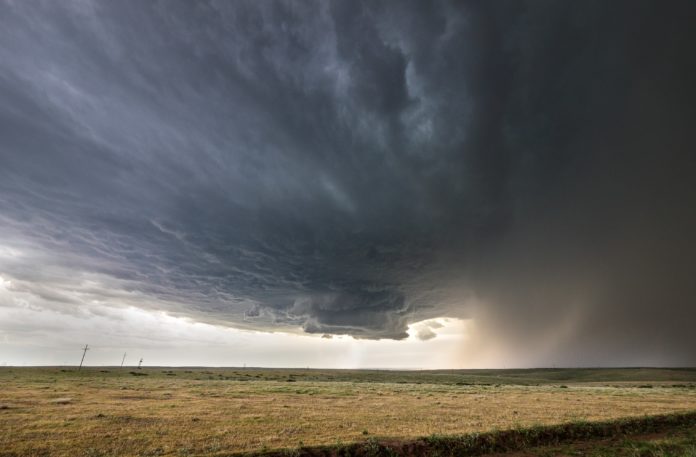
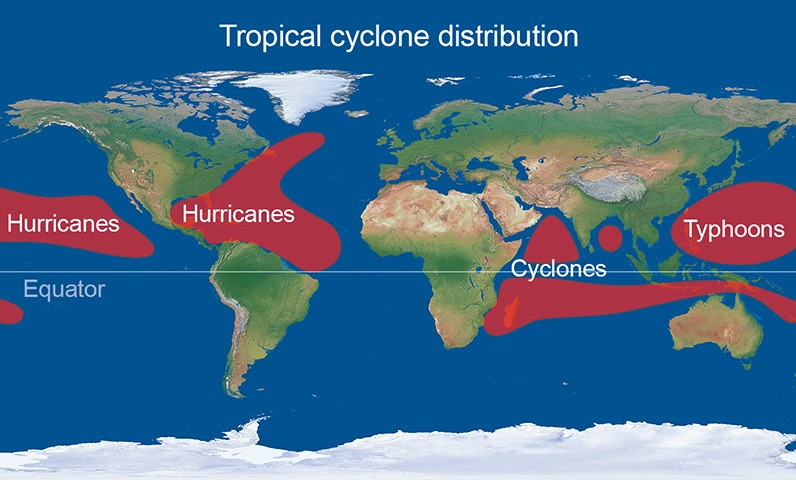
Hurricanes, typhoons and cyclones are all (in essence) the same thing – storms sputtering winds of more than 110 km/h. What sets them apart is where in the world they occur.
These tropical phenomenon form over warm ocean waters near the equator. When warm air rises an area of low air pressure is created. When the air cools its settles back down. It is then pushed aside by more warm air rising from below it. This then creates strong winds and rainfall. When this cycle strengthens a tropical storm is birthed.
When the system rotates faster and faster, the eye of the storm is created in the centre. In this area, the storm is calm and clear.
When winds reach speeds of over 60 km/h it is labelled a tropical storm. In the case of cyclones, hurricanes and typhoons – their winds have to reach speeds of 119 km/h for the classification.
READ MORE: Extreme weather in Somalia sees children die of hunger
Typhoon
Forms in the northwestern Pacific Ocean. The Philippines and Japan are frequently hit by these storms. Whilst they can occur year-round, typhoon season is commonly found between May and October. The strength of a typhoon can be classified on various scales, with the most severe being named super typhoons.
Hurricane
These storms occur in the North Atlantic Ocean and Northeast Pacific. The United States and the Caribbean are often impacted. Hurricanes have their winds measured to determine the strength from a category of 1 to 5. A Category 1 hurricane will have sustained winds of 119-153 km/h. A Category 5 hurricane can exceed a limit of 252 km/h.
Cyclone
Found in the South Pacific and the Indian Ocean. Australia and Mozambique are often affected by cyclones. Cyclone season usually takes place between November and April. Cyclones often have wind gusts greater than 90 km/h, with the most severe cyclones reaching 280 km/h. Their diameter is typically measured between 200 and 500 km but has been recorded to reach 1000 km.
Here is a run down of some of this year’s destructive storms:
Hurricane Ian
At the time of publishing this article, 85 storm-related deaths were confirmed. Iam made landfall on Florida’s Gulf Coast on September 28. It is now a Category 2 storm, barreling towards Cuba. Authorities are working to evacuate tens of thousands of people in preparation for the heavy rainfall and winds.
Typhoon Nanmadol
This storm hit Japan’s southwestern coast in September. It was classified as a super typhoon. According to the country’s local media, at least 43 people were injured. About 300,000 household were without power as powerful rains and wind smashed into the country.
Cyclone Batsirai
More than 55,000 people were displaced, with at least 120 people dead after the stormed crashed in Madagascar. Batsirai slammed into the eastern coast on February 5.
READ MORE: The death toll from the tropical storm that hit Mozambique, Madagascar & Malawi
Cyclone Gombe
During early march, at least 53 people were killed during the intense storm in Mozambique. At least 80 people were injured. Gombe completely decimated the country, leaving more then 45,000 homes destroyed.