


Concerns are growing about the environmental impact of South Africa’s rapidly expanding data centre industry, with civil society groups asking the South African Human Rights Commission to investigate the sector.
Among their concerns are the amount of electricity and water that large data centres could require, as well as whether communities are getting enough information about these developments.
But when it comes to water, there is an important distinction between what campaigners fear could happen and what Equinix says it actually plans to do.
Why are data centres using so much water?
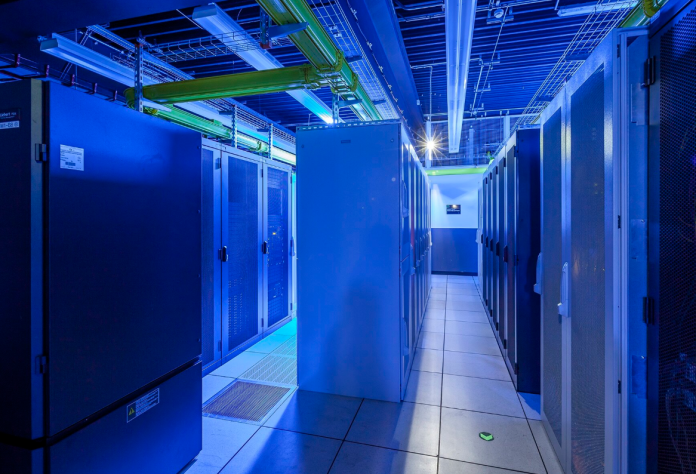
Data centres are large buildings filled with computer equipment. Those computers generate a lot of heat and need to be kept cool.
One way of doing this is with evaporative cooling, which uses water to remove heat. Some of that water evaporates and is therefore not returned immediately to the water system.
Civil society groups say that, using this type of cooling, the proposed Equinix facilities in Cape Town could consume more than 4.4 billion litres of water a year.
They say this would be roughly the amount used by more than 18,000 South African households.
But that is not a confirmed forecast of Equinix’s water use.
So how much water could Equinix actually use?
Equinix has proposed two data centres in Cape Town with a combined potential electricity capacity of up to 160 megawatts.
The company has also told reporters that the Cape Town facilities would use dry, air-based cooling.
In simple terms, that means using air rather than water to cool the computer equipment.
Equinix says its proposed system would require no water for cooling the data halls, apart from limited water used for things such as toilets and other domestic and support activities.
That makes a major difference.
If Equinix sticks to this design, its water use could be far below the 4.4-billion-litre estimate made by campaigners.
Equinix’s own global data
Equinix’s global sustainability report gives us another way of looking at the issue.
In 2025, Equinix’s data centres around the world consumed about 4.6 billion litres of water.
Its facilities that use evaporative cooling had a water-use rate of 1.41 litres for every kilowatt-hour of electricity used.
If we take the proposed 160-megawatt Cape Town facility and hypothetically run it at full capacity, 24 hours a day, for an entire year, that rate would work out at about two billion litres of water a year.
But this is a what-if calculation.
It does not mean Equinix will use two billion litres in Cape Town.
It simply shows what the water demand could look like if the facility operated like Equinix’s more water-intensive data centres elsewhere.
How big is two billion litres?
Cape Town currently uses roughly 850 million litres of water a day, according to recent City figures.
So two billion litres is roughly equivalent to two to three days of Cape Town’s total water use.
Across an entire year, it would represent around half of one percent of the city’s water consumption.
That is a lot of water for one industrial development, but it would not come close to using a large share of Cape Town’s overall water supply.
And again, Equinix says it plans to use dry cooling, meaning the two-billion-litre calculation may substantially overstate its actual water requirement.
There is already a local example
Cape Town already has a large data centre using a system designed to avoid consuming fresh water for cooling.
Teraco’s CT2 facility in Brackenfell uses a closed-loop cooling system that does not require fresh water for cooling under normal operations.
This shows that large data centres can be designed to operate with very little or no water used for cooling.
The trade-off is that systems using air rather than evaporative cooling can require more electricity.
Why are campaigners still concerned?
For the organisations that have approached the Human Rights Commission, the issue is bigger than Equinix’s water bill.
They argue that South Africa does not currently have a complete picture of how much water and electricity the country’s growing number of data centres use.
They want government to create a national register of data centres and require operators to publicly report their water and electricity consumption.
They are also calling for an independent investigation into the industry’s economic, environmental and human-rights impacts.
Housing Assembly says it is concerned that valuable land, electricity and water could increasingly be directed towards large technology projects while poorer communities continue to struggle to access basic services.
The groups are not calling for all data centre development to stop. Instead, they want greater transparency and stronger rules before the industry expands further.
What does government say?
The Department of Water and Sanitation says any company wanting to take water from the country’s water resources must first obtain a water-use authorisation.
At a recent briefing, Department head Ntombizanele Bila-Mupariwa says the relevant catchment management agency will assess whether there is enough water available for a proposed project.
If there is not, alternative sources would have to be considered.
She also says environmental impact assessments are a lengthy process and can take about three years.
Equinix says it is still early days
Equinix has confirmed that it has bought land in Cape Town, but says it has not yet submitted a site development plan.
The company says that, if it proceeds, it will engage with local authorities, utilities and communities and provide more detailed information.
That means the final water requirements of the proposed facility are not yet known.
The bottom line
The headline figure of 4.4 billion litres of water a year represents a scenario based on water-intensive cooling.
A separate calculation using Equinix’s own global data produces a figure of about two billion litres a year if a 160-megawatt facility operated continuously using evaporative cooling.
But neither figure is Equinix’s forecast for Cape Town.
The company says its Cape Town facilities will use dry, air-based cooling, which would mean little or no water is needed to cool the computer equipment.
So the real issue is not whether Equinix is definitely going to consume billions of litres of Cape Town’s water.
It isn’t known yet.
The question is whether the company will stick to its proposed water-saving cooling system, how much water the finished facility will actually use, and whether the public will be able to see and verify those figures.
For a city that has already experienced the threat of Day Zero, and where water demand remains a concern, campaigners argue that those answers should be known before more large data centres are approved.