


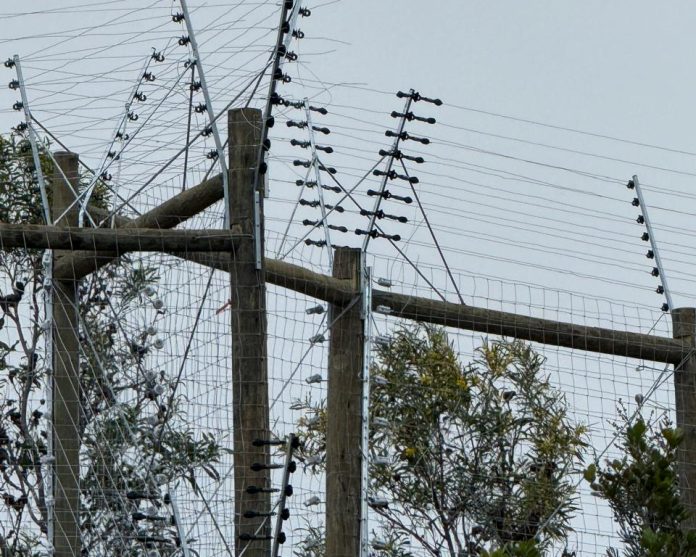
The Cape Peninsula Baboon Management Joint Task Team (CPBMJTT), consisting of representatives from SANParks, CapeNature, and the City of Cape Town, has confirmed that the Waterfall troop has been successfully relocated from Simon’s Town.
The operation started on Friday, 13 November 2026, after the necessary permits were issued on Thursday, 12 November 2026.
The CPBMJTT says the troop is adjusting well to their new environment at the Urban Wildlife Centre in Kogelfontein and is being monitored 24/7.
The relocation sparked an outcry from some environmentalists and community members who have labelled the Centre a “death camp.” Protests were also noted at the entrance gate to the enclosure.
The CPBMJTT has released the following information into the public domain:
- 27 baboons were captured and relocated on Friday, and another 18 on Saturday, 14 November. All of these baboons arrived in Kogelfontein safely and unharmed.
- Every baboon underwent a screening and health check by three wildlife veterinarians before they were released into the enclosure at Kogelfontein.
- None of the males was vasectomised; the females received contraceptive implants.
- One old female baboon was euthanised after it transpired during the health screening that she had a growth on her chest, fluid in her bowels, and no teeth.
- The 44 baboons who have been released at Kogelfontein are settling in very well, are comfortable, and are getting used to their new surroundings. They are being monitored 24/7.
- One female baboon still needs to be captured and relocated. The team is giving her time to settle down and will proceed with the capture as soon as possible. She is being monitored by the baboon rangers and is not left on her own.
- Daily monitoring of the individual and troop behaviour is taking place, with a focus on their social interactions and feeding. Veterinary oversight is ongoing.
- The Waterfall troop has been relocated due to the severity and persistence of human-baboon conflict in the Simon’s Town urban environment, the limited available natural low-lying habitat, the increasing risk to the baboons’ welfare, and public safety concerns.
- The operation was implemented in terms of the approved Cape Peninsula Baboon Management Action Plan.
- The intention to relocate these baboons has been clearly communicated to all affected communities in the Far South for over a year, has been implemented as a very last resort after other interventions were evaluated and deemed ineffective, and as an alternative to culling.
“The CPBMJTT would like to reiterate that placing wildlife into captivity is always undesirable. Constant and proactive management of our Chacma baboon population is essential to ensure that we do not end up in a situation where untenable human/wildlife conflict reoccurs in the urban environment.”
Cape Town Urban Wildlife Centre
The centre is located at Kogelfontein on City-owned land, in a natural area that has riverine features, and stands of indigenous and exotic vegetation, varying heights of thick ground cover, bushes, small trees, rocks and sandy areas for foraging and digging.
It consists of two purpose-built semi-wild enclosures with baboon-proof and perimeter fences, each with custom-designed sleep and play structures for the baboons, and water points in a natural setting adjacent to Table Mountain National Park. The setting allows for typical social interaction and natural foraging behaviour.
The Waterfall troop has been released into one of the enclosures on the property. This specific enclosure is 2,31 hectares in size which exceeds the minimum requirements of the Global Federation of Animal Sanctuaries Standards for Old World Primates approximately 5,5 times.
According to the CPBMJTT, the baboons have continuous access to fresh potable water for drinking and a pond for cooling and enrichment. Their natural diet is supplemented with daily enrichment by using browse and scatter feeding around the enclosures to ensure ongoing environmental novelty.
The enclosure provides shelters for shade, weather protection, and two platforms for sleeping and resting. A variety of stimuli of vertical and horizontal complexity, and fixtures for climbing and swinging are provided.
The centre is not open to the general public.
“The centre will provide lifelong care of the baboons, with the aim of incorporating environmental education and other conservation efforts to improve the welfare of all urban wildlife in Cape Town in future. The baboons will not be allowed to reproduce. Apart from the Waterfall and Seaforth troops, no additional baboons will be introduced to the centre.”
It is not yet clear when the Seaforth troop will be relocated.
“The Cape Peninsula Baboon Management Joint Task Team remains committed to the implementation of the approved Cape Peninsula Baboon Strategic Management Plan (CPBSMP). The Action Plan that guides the practical implementation of the CPBSMP was approved by SANParks, CapeNature, and the City of Cape Town in November 2025.”
The CPBMJTT says implementing the strategic management plan is in the interest of conserving and maintaining a healthy, well-managed, sustainable, free-ranging baboon population with minimal human interference, overlap and conflict and a reduction in day-to-day aversive measures.
“The relocation of the Seaforth and Waterfall troops from the urban areas will significantly reduce human-baboon conflict, and improve the welfare of these baboons, as well as the safety and security of the residents in affected communities.”
“The plan is based on the principles that baboons are a valuable and integral part of the natural ecology and biodiversity of the Cape Peninsula; and that free-ranging baboons living in natural habitats form part of our collective biodiversity and cultural heritage.”
There are still over 530 free-ranging baboons across the Cape Peninsula, and these troops fulfil a vital ecological role in the ecosystem.
“The free-ranging baboon population is deserving of conservation and active wildlife management interventions to promote their health, welfare, and sustainability.”
Members of the public who require more information can email: hello@baboons.org.za