


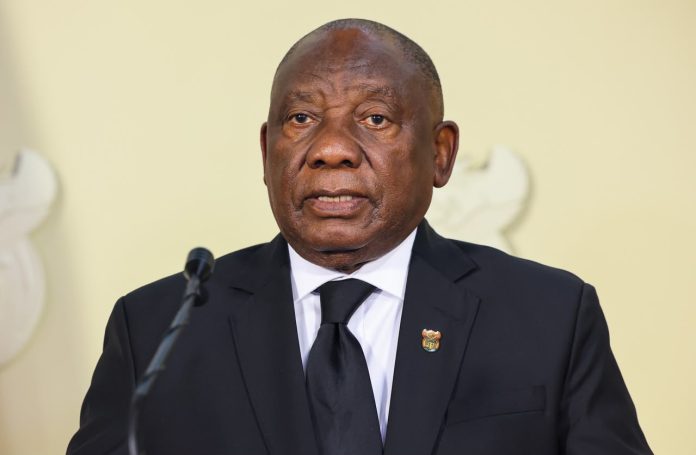
President Cyril Ramaphosa has announced immediate measures to strengthen South Africa’s response to gender-based violence and femicide, while also making a direct appeal to men and boys to take responsibility for confronting violence against women.
Addressing the nation on Tuesday night, Ramaphosa acknowledged that the government’s efforts have not been enough.
“What we have done has not been enough. We need to do much more.”
Ekurhuleni murders investigated at national level
The killings of women in Ekurhuleni are now receiving attention at the highest level of government and law enforcement.
Arrests have already been made in some of the cases.
The President said there has been widespread concern that the proximity of the killings could point to a single perpetrator.
However, he stressed that police have not found evidence establishing that the killings were committed by one person and that all possibilities remain under investigation.
There have been 11 women’s bodies found in Ekurhuleni since July.
Ramaphosa said the investigations would not be allowed to go cold.
“To the families of the women who have been brutally killed, I say that these cases will not be allowed to go cold.”
He also urged members of the public to provide information to investigators.
“If you know something, say something.”
He said only two of the women found in Ekurhuleni had been reported missing, stressing that there is no requirement to wait 24 hours before reporting someone missing.
“Hours matter. Information matters. A photograph matters. A vehicle registration number matters.”
The government has also increased visible policing in Ekurhuleni, with operations set to continue for as long as required.
Four immediate measures
Ramaphosa announced four immediate measures to strengthen the national response to GBV and femicide.
1. National case-recovery operation
Ramaphosa has directed the Minister of Police and the Minister of Justice and Constitutional Development, working with SAPS and, with due regard to prosecutorial independence, the National Prosecuting Authority, to undertake a national case-recovery operation.
It will focus on unresolved:
- murders involving women and children
- attempted murders
- rapes
- serious sexual offences.
Within 60 days, the audit must identify:
- the number and age of unresolved cases
- cases awaiting forensic evidence
- cases where suspects have been identified but not arrested
- cases where investigative or prosecutorial action has been unreasonably delayed.
Within 90 days, individual recovery plans must be in place for priority and stalled cases. Each plan must identify the outstanding action, the responsible official and a deadline for moving the case forward.
2. Forensic backlogs
The Minister of Police, the National Commissioner of Police and relevant forensic authorities must present a funded plan within 60 days to reduce forensic backlogs and establish clear turnaround standards for priority GBV and femicide cases.
The plan must set out:
- the size and age of the backlog
- shortages of personnel and equipment
- the resources required
- dates by which the backlog will be reduced.
Priority forensic samples in cases involving the rape or murder of women and children must be ring-fenced for urgent processing.
Progress against the turnaround standards must be reported publicly every quarter.
3. Women’s safety audits in every municipality
Every municipality must begin a women’s safety audit without delay, working with provincial governments and police to identify high-risk areas.
Within 60 days, the audits must identify hazards including:
- broken streetlights
- overgrown public spaces
- abandoned buildings
- unsafe transport routes and facilities
- poorly secured parks
- other conditions that place women at risk.
Within 90 days of completing the audit, the most urgent hazards must either be addressed or included in a funded implementation plan with clear completion dates.
The results of the audits and progress in fixing the problems must be published publicly, allowing communities to see what has been identified, fixed and remains outstanding.
Provincial and municipal authorities must also intensify enforcement of existing liquor laws and by-laws, particularly against unlicensed outlets and establishments trading outside permitted hours.
4. Action to reduce alcohol-related violence
Ramaphosa has directed the Minister of Trade, Industry and Competition, working with the Ministers of Health, Social Development, Police and Cooperative Governance, to submit a coordinated legislative and enforcement package to Cabinet within 60 days aimed at reducing alcohol-related violence.
Ramaphosa made clear that:
“Alcohol does not cause gender-based violence and it can never excuse it. Responsibility always lies with the perpetrator.”
However, he said harmful alcohol use is a significant aggravating factor in interpersonal violence and needs to be addressed as part of the wider prevention effort.
Monitoring and deadlines
The Inter-Ministerial Committee on GBV and Femicide and the National Council on Gender-Based Violence and Femicide will monitor implementation.
A first consolidated public progress report is due within 90 days, followed by quarterly reports. Ramaphosa stressed that the directives establish responsibilities, deadlines and an obligation to report progress to the nation.
Existing GBV measures to be strengthened
The President also pointed to existing initiatives, including additional resources for the Family Violence, Child Protection and Sexual Offences Units, the expansion of Sexual Offences Courts, and the continued work of Thuthuzela Care Centres, which provide medical, forensic, counselling and legal services to survivors.
Shelter services are being expanded, while DNA and forensic processing is being strengthened.
Police stations have established Victim Friendly Services and GBV desks, with police officers receiving training on GBV.
The National Council on Gender-Based Violence and Femicide is now operational and will coordinate and drive the national response.
‘It begins much earlier’
But Ramaphosa said laws, police and government programmes alone will not end GBV.
“We cannot police our way out of gender-based violence alone. We cannot arrest our way out of this crisis alone.”
He said the roots of violence begin much earlier, in attitudes towards women and relationships.
“Gender-based violence does not begin when a fist is raised.”
“It begins in attitudes that regard women as inferior.”
He said it begins when men believe they have the right to control women, when jealousy is mistaken for love and when a man refuses to accept the word “no”.
Prevention, he said, must start in the home, particularly in how boys are raised and what they learn about girls, anger, rejection and consent.
More than 60% of women murdered in 2021 and 2022 were killed by an intimate partner, according to a national study by the South African Medical Research Council cited by Ramaphosa.
A direct message to men
Ramaphosa said men and boys have a particular responsibility to help end GBV.
“For too long, gender-based violence has been treated as a women’s problem to solve.”
He said women have been forced to change their routes home, avoid going out at night and warn each other about dangerous places and dangerous men.
“We have placed the burden of male violence on women. That must change.”
His message to men was direct:
“Challenge the friend who humiliates his partner. Challenge the colleague who harasses women. Challenge the relative who abuses his wife or girlfriend.”
“It is time for good men to stop being silent men.”
Ramaphosa said the conversation must happen in homes, workplaces, schools, sporting clubs, places of worship, universities and communities.
He also rejected victim-blaming in unequivocal terms:
“No woman causes herself to be abused.”
“No item of clothing causes rape.”
“No argument justifies assault.”
“No relationship gives one person ownership over another.”
“No rejection justifies violence.”
And, he said:
“No man has the right to take the life of a woman because she chooses to leave him.”
The President has also directed the Minister of Sport, Arts and Culture to strengthen the Moral Regeneration Movement’s role in changing attitudes and social norms that enable violence against women.
With the annual 16 Days of Activism against Gender-Based Violence approaching, Ramaphosa called for a broad social movement involving government, communities, faith-based organisations, schools, traditional leaders, youth organisations and men and boys.
“The women of South Africa should not have to fight gender-based violence alone. The men of South Africa must stand up and fight it with them.”
Ramaphosa ended by saying the goal must be more than mourning and condemnation.
“Not simply to mourn. Not simply to condemn. But to act.”
He said the commitment should be that seven years from now, no President should have to address the nation about the same crisis in the same way.