


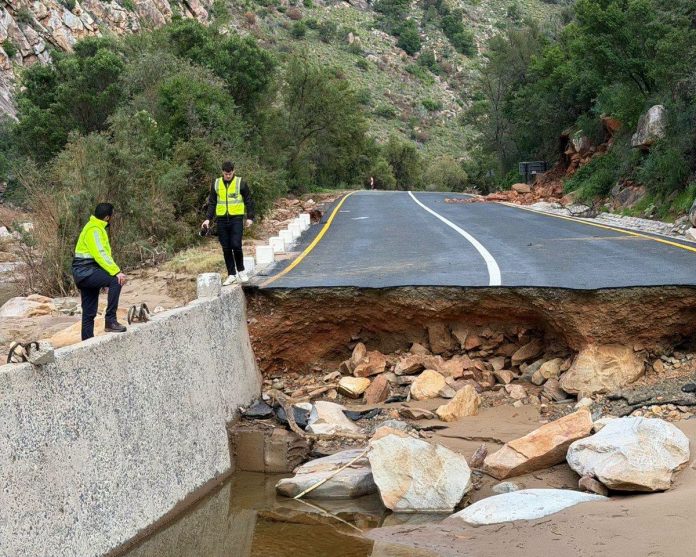
Premier Alan Winde says significant recovery and reconstruction work still lies ahead following the recent severe weather disasters that affected large parts of the province.
Winde and members of his Cabinet provided an update yesterday on the Western Cape Government’s ongoing response to the storms and the assessment of the damage.
Winde says that while the immediate disaster response is now over, they have turned their attention to the recovery efforts.
He says 70% of the roads that were closed have since been reopened in some form, but extensive damage to road infrastructure remains a major challenge.
Western Cape MEC of Infrastructure, Tertuis Simmers, says many roads, bridges and related structures have sustained significant damage and will require major repairs or, in some cases, complete reconstruction.
To support longer-term recovery efforts, the Western Cape Government has identified 19 emergency provincial road repair projects at critical locations across the province. Contractors have already been mobilised, and work has commenced on a number of these priority projects.
Recovery work will be prioritised and implemented in a phased manner, subject to funding availability.
Finance MEC Deidré Baartman says that to assist, the Western Cape Government has made provisions for disasters in its 2026 Budget by allocating funding to its Unforeseen and Unavoidable Reserve.
Provincial Treasury will now table a submission before the provincial Cabinet to reserve R100 million from this reserve for the current financial year to address some of the most urgent infrastructure repairs.
She says all departments have been allowed to reprioritise within their existing budgets and to use disaster procurement mechanisms to expedite procurement in response to the disaster and related maintenance needs.
“We will continue to engage national government to reform the disaster funding process, as the current system is lengthy and largely retrospective. In addition, we will advocate for the consideration of self-insurance within affected sectors, such as agriculture, alongside appropriate insurance-linked products for residents. While government can respond to public infrastructure losses, the impact on the private sector is equally significant.”
The cost of the damage caused by the storms currently stands at over R9 billion.
Winde emphasised that due to the scale of the damage, recovery will take time.
“Our approach is to prioritise the most critical routes and infrastructure while ensuring that all work is properly planned and executed to build greater resilience against future disasters.”
The Premier also highlighted ongoing efforts to restore electricity supply. In daily briefings with Eskom Western Cape management, the Premier and members of the provincial Cabinet have been informed that 97% of residents left without electricity due to the adverse weather have now been reconnected, with restoration efforts being intensified across affected regions.