


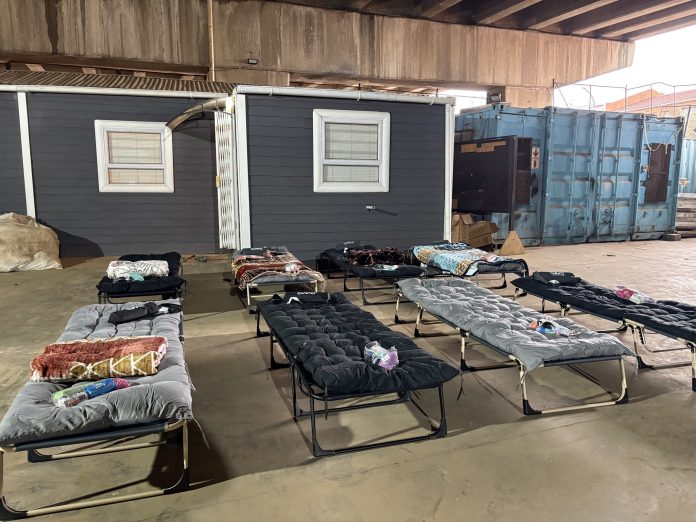
The Cape Town Central City Improvement District (CCID), in collaboration with the Haven Night Shelter, has opened a new Safe Sleeping Zone in District Six, in support of the chronically homeless community in the CBD.
The Safe Sleeping Zone is a four-month pilot project that forms part of the CCID’s Winter Readiness Programme. It will provide temporary shelter, as well as practical support, for chronically homeless individuals who are often excluded from existing facilities due to eligibility criteria.
Tara Gerardy-Bissolati, CCID Social Development manager, says the Safe Sleeping Zone will support vulnerable individuals with dignity and care.
“Winter is very harsh for people living on the streets as they are exposed to freezing temperatures, wet and unsafe conditions. They often have limited access to suitable shelter. Our aim with this project is to improve quality of life and foster a more inclusive CBD.”
The temporary facility is located in District Six under the Selkirk Street carriageway, adjacent to The Haven Night Shelter.
It will operate until September 2026, offering overnight accommodation for between 60 and 80 people per night.
Haven CEO Shaddie Valayadum says that at the heart of the initiative is the idea that no one should sleep exposed to the cold.
“It has been designed as low-threshold sleeping space, or overnight emergency accommodation rather than long-term housing, providing vulnerable individuals with protection during winter.”
CCID CEO Tasso Evangelinos says the temporary nature of the project does not mean it doesn’t have growth potential.
“While it is a targeted response to immediate winter needs, our hope is that its success will pave the way for expansion into other parts of the CBD and beyond.”
CCID Social Development sponsors 43 beds at shelters throughout the year; during winter, it increases this by 45 more beds. The emergency shelter will increase the total bed space sponsored by the CCID during winter to 168.
Controlled referral system
- Access to the site will be managed through a controlled referral and ticket-based system, with individuals referred directly by the CCID from within its 1.6 km² footprint.
- The shelter will open nightly at 19h00, with final entry at 21h30, and residents exiting the site at 06h30 the following morning.
- The facility will be equipped with a maximum of 80 fold-up stretchers, emergency blankets and pillows. Basic nourishment, including a hot drink, will be provided.
- Residents will also receive off-site meal tokens for NGO The Service Dining Rooms.
- Ablution facilities and secure container storage will be available on-site, while the area will be enclosed by perimeter fencing, well-lit, and monitored through CCTV cameras to ensure safety and security.
- Dedicated security guards and overnight supervisors will also be present.
- Couples will be accommodated.
- The shelter will operate under clear rules to support the safety and well-being of all occupants. In addition, six CCID peer field workers will be on duty at the site, all of whom have received training in First Aid, mental health de-escalation, harm reduction and induction processes.
According to the Haven, an estimated 14 000 people are living on the streets in the city, but only around 3 800 shelter beds are available. At its District Six facility, it has 90 beds available.
“Winter places significant strain on shelters as demand for warm beds and basic care increases, particularly during storms and periods of severe weather,” says Valayadum.
“By mid-June, which is only the beginning of winter, we often see our capacity already exceeding 80 %. The Safe Sleeping Zone will provide significant and much-needed relief by helping to ease capacity constraints.”