


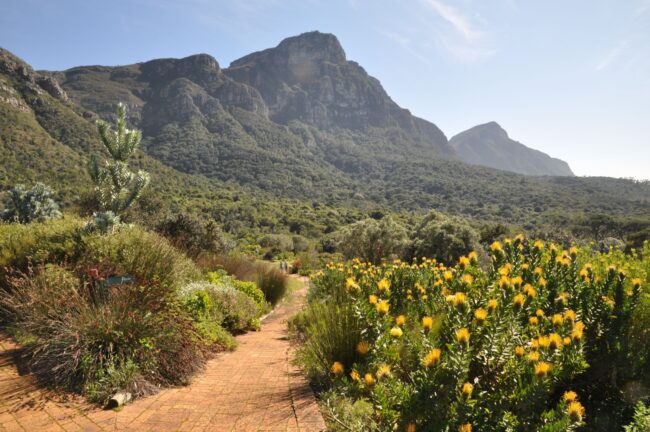
The South African National Biodiversity Institute has rejected claims by well-known naturalist James Deacon that Kirstenbosch Garden is going through a phase of “decay and death”.
In a lengthy Facebook post last week, Deacon wrote that plant collections that have taken decades to establish are sitting neglected and are slowly dying.
Deacon has been involved in the Kirstenbosch garden for close to two decades.
“The Protea collection is less than a third of what it was, and only a fraction of the Ericas remain. One plant has gone from extinct in the wild to completely extinct purely due to a lack of effort to keep it going. Places once full of plants sit empty and, in some cases, full of weeds because the production of plants is so diminished.”
His post resonated with hundreds of Facebook commentators, who agreed that the Garden appeared to be in a poor state at the moment.
Deacon blamed SANBI’s poor financial management for the situation, calling on concerned parties to email the Minister of Environmental Affairs, Willie Aucamp, posting Aucamp’s email address in one of the comments.
He also cited staff shortages and low staff morale, all of which SANBI has responded to (see Q&A below).
In a Facebook post on Friday, SANBI labelled Deacon’s actions as counterproductive and his allegations “inexact”. SANBI says they met with Deacon in February, at the request of the Minister.
“During the engagement, which included discussions and explanations on all issues raised, Mr Deacon conceded that some of his allegations were inexact. Following this meeting, SANBI considered the matter resolved as per the discussion with Mr Deacon. Having been afforded an opportunity to engage with SANBI so soon after lodging his initial complaint as per the Minister’s instructions, it is regrettable that Mr Deacon has now publicly shared the Minister’s private email address and encouraged members of the public to spam him.”
Smile FM sent questions to SANBI to respond to the substance of the allegations levelled by Deacon.
Senior Manager for Marketing, Communication and Commercialisation, Nontsikelelo Mpulo, responded as follows:
1. How does SANBI respond to allegations that key plant collections at Kirstenbosch National Botanical Garden have deteriorated due to neglect and declining nursery capacity?
The collections are not being neglected. They are managed appropriately and with due care. Kirstenbosch manages two large nurseries, namely a production and a living collections nursery. The productions nursery is fully operational and produces plants for display in the garden. Kirstenbosch has upgraded some of its nursery facilities in the past few years. Phase 1 was completed, and Phase 2 is scheduled to continue in 2026/27. Phase 2 will entail the mechanical aspects of the functioning of the nurseries, e.g. the climate control units as well as the refurbishments of the conservatory.
2. What steps are being taken to address claims of staff shortages, low morale, and the departure of experienced botanical specialists from Kirstenbosch?
SANBI has a dedicated Employee Assistance Programme that provides support systems for all its staff and associated families. Monthly meetings with staff are held, at which they can raise issues or concerns. SANBI is currently sourcing additional labour through partnership agreements with a range of government and non-government organisations, which will assist in the ongoing maintenance of the garden while the Garden continues to address human resource capacity gaps. SANBI is continuing to implement processes to ensure staff are adequately resourced to fulfil their roles and responsibilities.
3. Can SANBI confirm whether any plant species maintained at Kirstenbosch have become extinct in cultivation due to a lack of resources or management intervention?
We do not know of a species that has gone from extinct in the wild to extinct at Kirstenbosch. There are instances in which SANBI keeps species in our gardens across the country which are possibly extinct in the wild, critically endangered or threatened.
4. What is SANBI’s response to allegations of procurement delays affecting the maintenance and operation of the garden’s collections?
SANBI is bound to follow procurement prescripts as defined by the Public Finance Management Act (PFMA). The organisation is pursuing continuous improvements to ensure that day-to-day resources necessary for the operation and maintenance of the garden and its collections are sourced in alignment with prescribed national procurement processes and procedures.
5. How does SANBI plan to restore and preserve the Protea, Erica, and other specialised collections that are reportedly in decline?
Kirstenbosch has had a dedicated Erica horticulturist since 2020. Some Erica specialists have left or have passed on, and others have taken their place to continue with the cultivation of Ericas. Specialisation in any plant group takes years to build up. The Protea horticulturist transferred to one of SANBI’s other national botanical gardens in December 2024. The position was advertised, and given the specialised knowledge and skills required, this vacancy took some time to fill. The recruitment process for a protea specialist is in the final stages. Kirstenbosch still has seven experienced and skilled horticulturists as well as a dedicated Garden Manager responsible for oversight over the gardens’ horticulturists and living collections.
6. Are there financial constraints currently affecting operations at Kirstenbosch, and if so, what measures are being implemented to stabilise the garden’s management and conservation work?
Kirstenbosch is one of the eleven national botanical gardens in the SANBI network. SANBI is liquid and solvent, and Kirstenbosch is one of the top three gardens contributing to its own income generation efforts. SANBI has not been spared from budget cuts, hence additional efforts are being implemented through the Financial Sustainability Strategy of the entity. This includes diversifying own revenue streams from outside of the traditional government sources. SANBI will be appointing many beneficiaries through DFFE’s EPWP Environmental Programmes to support garden maintenance, especially of the living collections and display areas, in 2026/27, and extending into 2027/28 to 2028/29. Kirstenbosch will also be receiving Tourism Monitors in the next few months through funding provided from the National Department of Tourism. Kirstenbosch also hosts interns through the Youth Employment Services (YES) programme that support ongoing garden maintenance.