
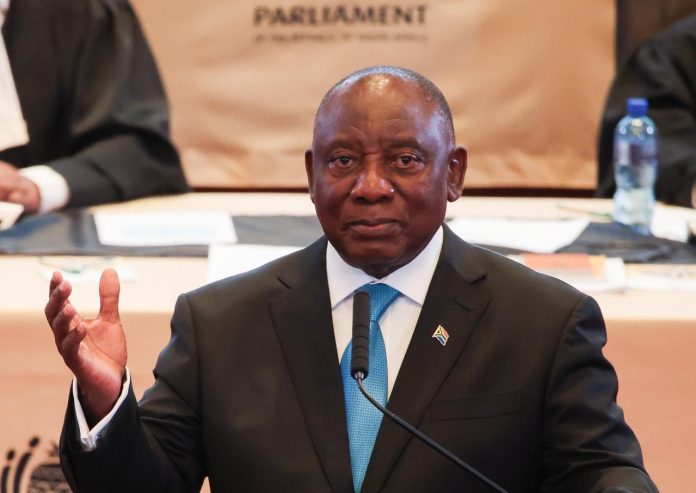
President Cyril Ramaphosa has outlined an ambitious programme to tackle organised crime, accelerate economic growth and overhaul struggling municipalities, declaring that South Africa has “turned a corner” and is entering a new phase of reform and recovery.
Delivering his State of the Nation Address (SONA) at Cape Town City Hall on 12 February 2026, Ramaphosa said the government’s priorities under the Government of National Unity (GNU) are to drive inclusive growth and job creation, reduce poverty and the cost of living, and build a capable, ethical and developmental state.
He acknowledged progress in stabilising the economy but warned that unemployment, violent crime and failing local government remain pressing concerns.
Fight against crime and organised syndicates
Ramaphosa described organised crime as “the most immediate threat to our democracy, our society and our economic development”, saying the government’s primary focus this year will be to step up the fight against criminal syndicates.
He announced that the South African National Defence Force (SANDF) will be deployed to support police in the Western Cape and Gauteng to combat gang violence and illegal mining. A tactical deployment plan will be finalised in the coming days, with Parliament to be informed as required by the Constitution.
The government will also consolidate intelligence at the national level and deploy multidisciplinary intervention teams to dismantle priority syndicates. A new criminal justice reform initiative, modelled on Operation Vulindlela, will be housed in the Presidency to drive implementation across the system.
Other measures include:
- Recruiting 5,500 additional police officers this year.
- Re-vetting senior SAPS and metro police management, including lifestyle audits.
- Establishing a national illicit economy disruption programme targeting sectors such as tobacco, fuel and counterfeit goods, using data analytics and AI.
- Strengthening the Hawks, the National Prosecuting Authority and the Special Investigating Unit.
- Introducing a Whistle-Blower Protection Bill to criminalise retaliation and provide support to whistle-blowers.
- Reforming procurement systems and finalising Public Procurement Act regulations by mid-2026.
“We cannot fight organised criminals by treading softly,” Ramaphosa said. “There will be no impunity for acts of corruption and criminality.”
Water crisis and local government reform
The President said water shortages are now “the single most important issue” for many communities, citing recent protests in parts of Gauteng.
To address immediate and long-term challenges, he announced the establishment of a National Water Crisis Committee, which he will chair. More than R156 billion has been committed over the next three years for water and sanitation infrastructure, including major dam projects.
The government has already laid criminal charges against 56 municipalities for failing to meet their obligations under the National Water Act and plans to hold municipal managers personally accountable where necessary.
Ramaphosa also confirmed that a revised White Paper on Local Government will be finalised in the coming months to overhaul a system he described as too complex and fragmented.
Proposed reforms include differentiated powers for municipalities based on capacity, professionalising senior appointments and strengthening the national government’s ability to intervene where municipalities fail.
Economic growth gathering pace
On the economy, Ramaphosa said South Africa is stronger than a year ago, citing four consecutive quarters of GDP growth, two primary budget surpluses, improved credit ratings and inflation at its lowest level in two decades.
“We have turned a corner,” he said, while cautioning that growth must accelerate to address unemployment and inequality.
Government has committed more than R1 trillion in public infrastructure investment over three years, the largest allocation of its kind in the country’s history. Through Operation Vulindlela, reforms in energy, logistics and telecommunications are being accelerated.
Ramaphosa says load shedding has ended, and more than 40% of electricity generation is expected to come from renewable sources by 2030. Eskom’s restructuring is underway, with a dedicated task team to oversee the establishment of an independent transmission entity.
In transport, private rail operators have been granted access to the network, public-private partnerships are planned for ports and rail corridors, and a partnership has been concluded for the Durban Pier 2 Container Terminal. Preparations are also underway for high-speed rail corridors linking major cities.
Industrial policy, mining and green growth
Ramaphosa said South Africa is positioning itself as a global supplier of critical minerals and green products, with ore reserves valued at more than R40 trillion.
Government is investing in geological exploration and beneficiation, while introducing a 150% tax deduction for investment in new energy vehicles from March. International pledges under the Just Energy Transition Investment Plan now total approximately R250 billion.
The President also highlighted growth in agriculture and tourism. South Africa is now the second-largest exporter of citrus globally, and 10.5 million tourists visited the country last year.
To combat a severe foot-and-mouth disease outbreak, the government will vaccinate the national herd of 14 million cattle and has classified the outbreak as a national disaster.
Supporting small businesses and youth employment
To stimulate job creation, government aims to raise R2 trillion in new investment commitments over the next five years. More than R600 billion of the R1.5 trillion pledged at previous investment conferences has already flowed into projects.
This year, over R2.5 billion will be allocated to support 180,000 small and medium enterprises, alongside R1 billion in guarantees. Regulations under the National Credit Act will be amended to improve access to affordable credit.
Public and social employment programmes, including the Presidential Employment Stimulus and Expanded Public Works Programme, will be expanded and better coordinated. Regulatory changes are planned to make it easier for businesses to participate in the Youth Employment Service.
Education, health and social protection
Ramaphosa emphasised early childhood development, making Grade R compulsory and expanding subsidies for ECD facilities. The matric class of 2025 achieved a record 88% pass rate.
Government is overhauling the skills development system, reducing the number of Sector Education and Training Authorities and strengthening workplace-based training. Plans are also underway to expand higher education capacity and address student accommodation shortages.
On health, preparations for National Health Insurance are continuing, with major investments planned in hospital infrastructure. A national rollout of Lenacapavir, a six-monthly HIV prevention injection, will begin, alongside efforts to eliminate cervical cancer.
The Social Relief of Distress grant will be continued and redesigned to better support livelihoods and skills development.
Foreign policy and sovereignty
Ramaphosa reaffirmed South Africa’s commitment to multilateralism, sovereignty and equality in international relations, saying the country “will not be bullied by any other country”.
South Africa will continue to support African integration and the African Continental Free Trade Area, while seeking to expandthe beneficiation of critical minerals.
A “turning point” for South Africa
Closing his address, Ramaphosa called 2026 a year of transformative change, echoing the start of his speech during which he invoked the legacy of the women of 1956, the youth of 1976 and the adoption of the Constitution in 1996.
“We must fix local government. We must fight crime and corruption. We must create jobs and livelihoods for every South African. And we must build a state that works for the people,” he said.
“We have indeed turned a corner. Now we must look ahead and move with speed.”