

World leaders are meeting in Davos, Switzerland, this week for the annual World Economic Forum, running from January 19 to 23, against a backdrop of mounting geopolitical tension and economic uncertainty caused by the Trump administration.
While US President Donald Trump is scheduled to attend the forum in person for the first time since 2020, much of the attention on Tuesday focused on a flurry of provocative social media posts issued while he remained in the United States.
Just after midnight, Trump’s account claimed he had held “a very good telephone call” with NATO Secretary General Mark Rutte, centred on Greenland. The post asserted that Trump had agreed to a meeting of “the various parties” in Davos and declared that “Greenland is imperative for National and World Security,” adding: “There can be no going back.”
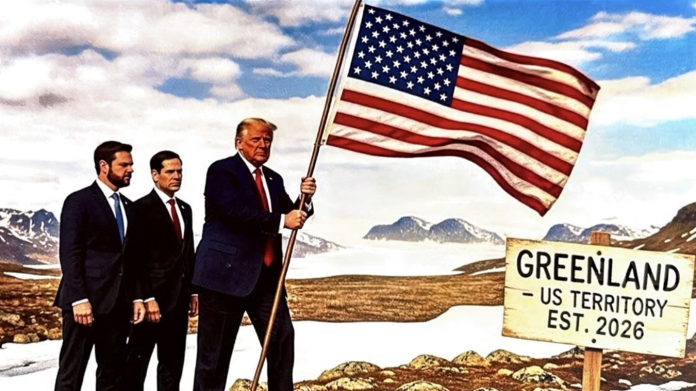
Shortly thereafter, the account shared an AI-generated image depicting world leaders seated before Trump’s desk in the Oval Office, backed by a map of North America entirely covered in the US flag, including Canada and Greenland, as well as Venezuela. Another image followed, showing Trump standing on an Arctic landscape with Vice President J.D. Vance and Secretary of State Marco Rubio, holding a U.S. flag next to a sign reading: “GREENLAND — US TERRITORY EST. 2026.”
As the posts continued, the account published what it claimed were private text messages from Rutte and French President Emmanuel Macron, mocking diplomatic overtures, and reposted inflammatory content attacking NATO, the United Nations, and Islam. Trump also claimed that NATO would no longer exist without him, writing that the alliance would have been “in the ash heap of History” had he not intervened.
In the middle of the night the President was posting private messages from European leaders, criticizing the UK, and sharing a fake image of a map in which the US controls Greenland, Canada, Venezuela, and Cuba. pic.twitter.com/xvOL40uDis
— Jake Tapper 🦅 (@jaketapper) January 20, 2026
Beyond foreign policy, the posts suggested growing concern within Trump’s camp about his domestic standing. The account launched attacks on Federal Reserve Board member Lisa Cook, alleging mortgage fraud, while simultaneously claiming Trump was responsible for lowering mortgage rates. Other posts conflated unrelated issues, including a video captioned “I AM STANDING UP FOR AMERICAN AUTOWORKERS” that in fact showed Trump threatening to cut federal funding to sanctuary cities.
The rhetoric escalated further with claims that people protesting Immigration and Customs Enforcement actions in Minnesota were “agitators and insurrectionists,” whom Trump described as “highly trained” and deserving of imprisonment or deportation. He singled out Democratic Governor Tim Walz, Representative Ilhan Omar, and, later, California Governor Gavin Newsom, labelling them corrupt.
On the sidelines of Davis, Newsom urged European leaders to stand up firmly against Trump.
America’s allies and business leaders need to understand this:
There’s no diplomacy with Donald Trump.
Get off your knees and grow a spine. pic.twitter.com/epAphL4CYn
— Gavin Newsom (@GavinNewsom) January 20, 2026
The account also urged DHS and ICE to publicise the names and faces of alleged violent criminals, claiming — without evidence — that thousands of “vicious animals” were responsible for crime, even as it asserted that national crime statistics were at record lows.
It then pivoted to reposting long-debunked allegations of fraud in the 2020 U.S. presidential election, including false claims involving Nevada, Dominion Voting Systems, and China.
In Washington, Trump appeared before reporters in a rambling speech billed as a review of his administration’s accomplishments. Holding a thick bundle of papers clipped together and labelled “ACCOMPLISHMENTS,” he quickly abandoned the document, eventually throwing it to the floor. Instead, he denied widely reported ICE abuses, including the recent detention of U.S. citizen ChongLy “Scott” Thao in Minnesota, insisting that agents were only arresting “bad people.”
Trump attempted to bolster his claims by displaying photos labelled “WORST OF WORST,” repeatedly referring to “many murderers.” Commenting on the spectacle, journalist Aaron Rupar wrote that the president’s behaviour suggested “the president is not well.”
Trump also returned to familiar grievances, including renewed attacks on former President Joe Biden, Special Counsel Jack Smith, whom he insulted in crude terms, and renewed claims that he deserved multiple Nobel Peace Prizes. He again accused Norway of manipulating the Nobel process.
Trump: “I should’ve gotten the Nobel Prize for each war, but I don’t say that. I saved millions and millions of people. And don’t let anybody tell you that Norway doesn’t control the shots, ok? It’s in Norway. Norway control the shots. It’s a joke. They lost such prestige. That’s… pic.twitter.com/aVxepPHK5s
— Aaron Rupar (@atrupar) January 20, 2026
Markets reacted sharply to Trump’s threats against Greenland and his warning that the U.S. would impose heavy tariffs on Europe if governments there failed to support his ambitions. On Tuesday, the Dow Jones Industrial Average fell 870.74 points (1.76%), while the S&P 500 dropped 2.06% and the Nasdaq Composite slid 2.39%, marking their worst day since October.
The market sell-off came as new reporting underscored the domestic cost of Trump’s previous tariff policies. According to the Wall Street Journal and research by the Kiel Institute for the World Economy, echoing findings from Yale and Harvard economists, U.S. consumers and importers have borne roughly 96% of the cost of Trump-era tariffs, contrary to his repeated claims.
Trump’s threats toward Europe carry even higher stakes. The European Union is the United States’ largest trading partner and investor, and EU leaders are now discussing possible retaliation through the bloc’s Anti-Coercion Instrument, informally known as “the Bazooka,” which could restrict trade and limit U.S. investment.
Amid the turmoil, broader concerns about the global order dominated discussions in Davos. Writing in The Atlantic, Robert Kagan warned that Americans are entering “the most dangerous world they have known since World War II,” arguing that decades of relative stability have left the public unprepared for a breakdown in the liberal international order.
BREAKING: In a stunning moment, French President Emmanuel Macron just delivered the most powerful rebuke of Donald Trump we’ve seen yet. This is incredible. pic.twitter.com/qSNFo5uVRB
— Democratic Wins Media (@DemocraticWins) January 20, 2026
I cannot tell you just how significant this speech is by Ursula von der Leyen, President of the European Commission.
Europe is in my view about to call Trump’s bluff and I really don’t think Americans understand just how catastrophically damaging this could be in terms of long… pic.twitter.com/m8wRgvcthB
— 𝔗𝔯𝔲𝔱𝔥 𝔐𝔞𝔱𝔱𝔢𝔯𝔰 (@politicsusa46) January 20, 2026
Speaking in Davos, Canadian Prime Minister Mark Carney said the world is experiencing a profound “rupture,” as powerful nations increasingly weaponise economic integration to coerce others. Rejecting a future defined by rival “fortresses” and spheres of influence, Carney proposed a model of “variable geometry,” in which middle powers form flexible coalitions around shared interests and values.
Under this approach, countries would strengthen domestic resilience while building dense networks of cooperation across trade, investment, and diplomacy. “We know the old order is not coming back,” Carney said. “Nostalgia is not a strategy. But from the fracture, we can build something bigger, better, stronger, and more just.”
For anyone who would like to hear Mark Carney’s outstanding Davos speech in full here it is. This is what true global leadership looks like.
Canada should be immensely proud today, because they are leading the fight back when others dare not.
🎥 TikTok – https://t.co/BExGV2YIDq pic.twitter.com/QTef90Ceo4
— 𝔗𝔯𝔲𝔱𝔥 𝔐𝔞𝔱𝔱𝔢𝔯𝔰 (@politicsusa46) January 20, 2026
This is how most Americans feel right now…
Danish Member of European Parliament to Trump:
“Mr. President, f*** off.” pic.twitter.com/nchMWNGpmE
— Brian Krassenstein (@krassenstein) January 20, 2026