

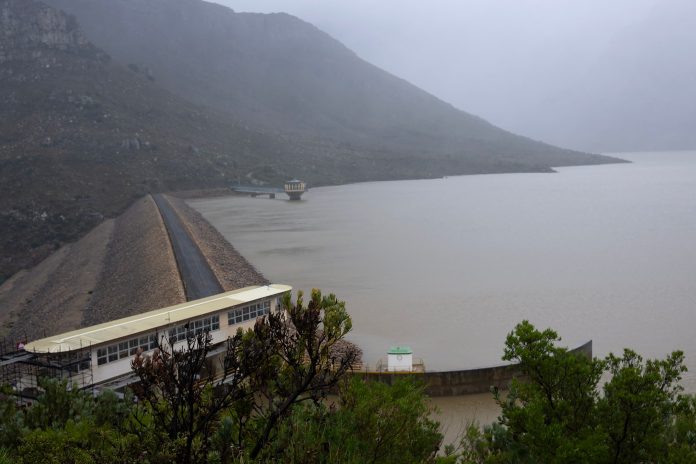
Despite indications earlier this year that the Western Cape would be in for a drier than normal winter, good rains in late June and early July have resulted in the excellent recovery of dams across the province’s catchment areas.
The Department of Water and Sanitation in the Western Cape has expressed its delight with the downpours, and although dams are not overflowing as they were at the same time in 2024, recent rainfall has led to good dam inflows.
The 44 dams in the Western Cape are currently on average at 78,96 % of total storage capacity. 31 dams are Department-owned and the remainder are under municipal or Water User Association control.
The Cape Town Water Supply System, consisting of the 6 largest dams supplying water to Cape Town and surrounds, is at 84,54% capacity, a decrease of 12% compared to 101.34% same time last year.
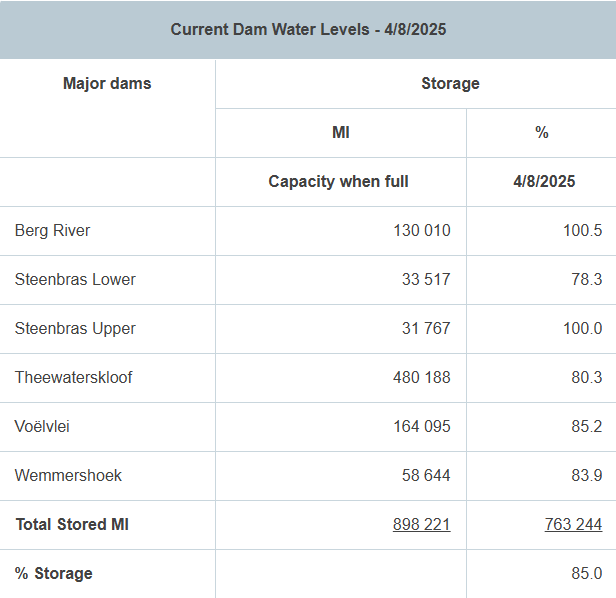
Notable statistics:
- Winter Rains in late June to early July caused a notable recovery in dam levels. The system rose from 60,71 % (Week 23) to 83,17 % (Week 30).
- Catchment Performance over that period:
o Berg River Catchment: 90,18 % (↓ from 98,75 %)
o Breede River Catchment: 76,68 % (↓ from 91,62 %)
o Olifants/Doorn Catchment: 80 % (↓from 84.58 2024)
o Gouritz Catchment: ~70 % (↑ from 21% five years ago)
The Department says rainfall remains unpredictable for the rest of the winter season, due to climate influences (El Niño / La Niña).
In addition, the below-average winter rainfall, forecasted by the South African Weather Services, remains in place, even though full capacity is still possible.
Given this outlook, the Department has urged all water users to continue their conservation efforts, despite positive dam levels, to harvest rainwater where possible and monitor small dams.
Officials also stressed that the availability of Bulk water does not guarantee that local restrictions will not be implemented; this could be due to infrastructure costs, repairs and other challenges of municipalities.