


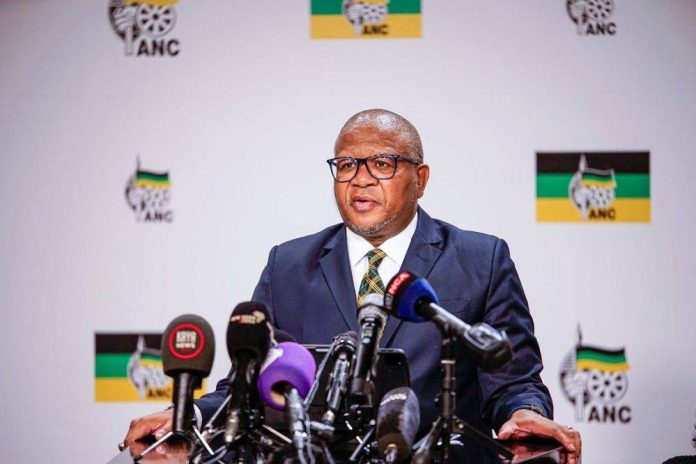
The ANC has accused former president Jacob Zuma and his MK Party of fuelling tensions around planned anti-immigration protests, warning that the current climate bears similarities to the unrest that rocked South Africa in July 2021.
Speaking at a post-National Working Committee briefing at Luthuli House on Thursday, ANC secretary-general Fikile Mbalula alleged that political forces were exploiting public frustration over illegal immigration to destabilise the country ahead of the upcoming local government elections.
Mbalula specifically criticised Zuma, saying it was ironic that the former president had aligned himself with calls for undocumented foreigners to leave South Africa despite presiding over the country’s migration challenges during his tenure.
#ANCNWC Mbalula: Jacob Zuma is irresponsible, he is promoting violence with ‘Mabahambe’, he is fuelling violence against fellow Africans. #sabcnews pic.twitter.com/4dw6j4Kyq3
— #LordOfTheMedia (@samkelemaseko) June 25, 2026
“Because what is unfolding on some of our streets is not, at its heart, about immigration at all,” Mbalula said.
“We have seen this architecture before. In July 2021, our country was dragged to the very edge of the abyss by a coordinated assault dressed up as a grievance; an organised attempt to render the country ungovernable and to challenge the authority of the democratic state itself.”
While Zuma has not personally endorsed the March and March movement’s demand that undocumented foreign nationals leave the country by 30 June, the MK Party has confirmed it will participate in demonstrations planned for that day. March and March leaders have repeatedly denied receiving support from the MK Party.
Mbalula drew direct parallels between the current tensions and the riots that followed Zuma’s imprisonment for contempt of court in 2021.
The unrest, which spread across KwaZulu-Natal and Gauteng, claimed more than 350 lives, led to over 5,500 arrests and inflicted an estimated R50 billion in economic losses.
“What we are witnessing now carries the same fingerprints,” Mbalula said.
“Unlawful immigration is being manipulated by new political formations whose real purpose is to manufacture chaos, to collapse the institutions of the state, and to engineer fear and unfair conditions on the very eve of our local government elections.”
The ANC said it supported the enforcement of immigration laws but rejected vigilantism and violence directed at foreign nationals.
Mbalula says the government has stepped up efforts to tackle illegal immigration, with the Department of Home Affairs reporting more than 110,000 deportations this year and the cancellation of about 2,000 fraudulently obtained study visas.
Law enforcement agencies have also arrested more than 40,000 undocumented persons, including over 7,400 in the past month, while 143 people have been detained for allegedly inciting violence against foreign nationals.
Mbalula also condemned what he described as the misuse of traditional Zulu heritage symbols by groups seeking to justify acts of intimidation and violence.
“There are formations in our politics that have embraced an open ethno-nationalism and sought to hijack the proud heritage of the amabutho and the sacred symbols of our people’s history,” he said.
“The regiments of our forebears were raised to defend the nation and its people, not to terrorise the vulnerable, to loot the trader, or to burn the home of the poor.”
He welcomed recent calls by Zulu King Misuzulu kaZwelithini against the abuse of traditional institutions and violence targeting foreign nationals.
Despite its criticism of the protests, the ANC acknowledged that concerns about illegal immigration, access to jobs, housing and public services were legitimate and required government intervention.
“The anxieties of South Africans about work, shelter, dignity, safety and access to services are real and legitimate,” Mbalula said, adding that these concerns must be addressed through lawful enforcement and effective governance.
[WATCH] MIGRATION, COMMUNITY TENSIONS AND THE THREATS AROUND 30 JUNE
Nowhere is the first promise of the Freedom Charter — that South Africa belongs to all who live in it more sorely tested today than on the question of migration. We speak with compassion and with firmness, and… pic.twitter.com/NMOoKQEz0f
— ANC SECRETARY GENERAL | Fikile Mbalula (@MbalulaFikile) June 25, 2026