


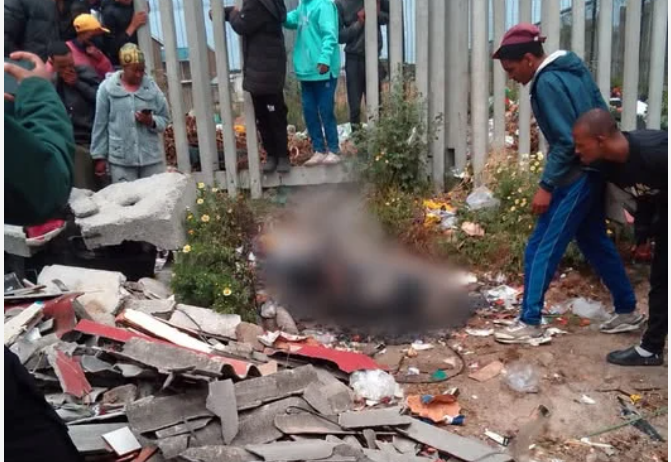
Police have arrested a murder suspect following the gruesome discovery on Saturday afternoon, 17 October, of a burning body next to a trash bin.
Officers responded to a complaint about a body that was burning at the corner of Hugenote Street and AZ Berman Drive, next to what appears to be a dump site.
On arrival on the scene, officers saw that a wheelie bin was also on fire, and the burning body was next to the wheelie bin.
Lt. Col. FC van Wyk confirmed that a murder case was opened for investigation, and that a postmortem would be conducted to determine the race and gender of the victim, as well as the cause of death.
A video of the burning body was shared on Facebook.
Angry community members gathered outside the alleged murderer’s residence on Tuesday morning, 20 October, prompting the deployment of public order policing.
The crowd was eventually dispersed, with eight men arrested for public violence. The murder suspect was also apprehended.
While police did not confirm reports that the victim was a woman, the Chairperson of the Police’s Portfolio Committee, Ian Cameron, said his information confirms that the victim was indeed female.
He says this disturbing incident once again raises serious questions about the safety of women in South Africa.
Cameron compared it to the murder of Siphokazi Booi, the 27-year-old woman found murdered in Mbekweni, Paarl, in September 2021.
Siphokazi was killed by her boyfriend, who placed her body in a wheelie bin and attempted to burn it. He had previously been arrested for assaulting her and was released on bail, which he violated. In August 2024, he was sentenced to life imprisonment.
“We cannot assume the circumstances of these two cases are the same, but the treatment of Siphokazi’s body and the circumstances reported in Tafelsig are deeply troubling. We are still not winning the fight against violence directed at women.”
According to the most recent crime statistics, 569 women were murdered in South Africa between April and June 2026 alone.
“Behind these figures are families whose lives have been permanently changed. How many more women must die before we start measuring the state’s response by the lives protected and perpetrators successfully prosecuted?”