

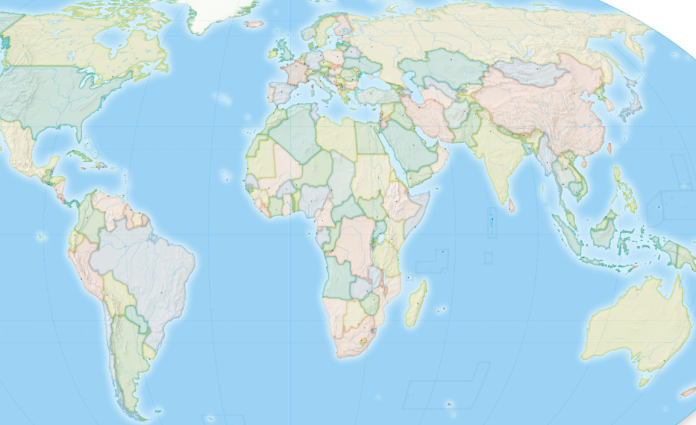
The African continent will finally get recognised for its true size after the UN General Assembly backed an African-led campaign to correct distortions caused by the Mercator map projection.
On Friday, 164 countries voted in favour of encouraging the use of equal-area maps, including Equal Earth, which better reflects the true size of continents.
The US was the only country to vote against, with six abstentions. Togo sponsored the resolution. The US dismissed the initiative as part of a “radical ideological project.”
The resolution does not ban the Mercator projection or impose a replacement. Instead, it encourages governments, schools, international organisations and technology companies to use the Equal Earth projection and other so-called equal-area maps when relative size matters, and to teach the limitations of any flat map in representing a spherical planet.
What is the Mercator projection?
Gerardus Mercator, a Flemish cartographer, devised his projection in 1569 to solve a practical problem of maritime navigation. Because straight lines on his map correspond to constant compass directions, sailors could use it to plot their courses.
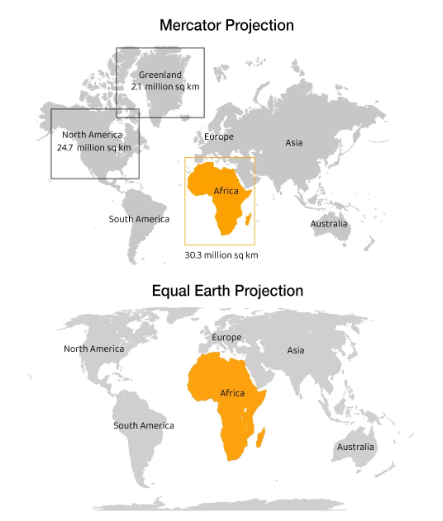
But preserving direction came at the expense of area. Landmasses appear increasingly enlarged the farther they are from the Equator.
Greenland, for instance, can look roughly comparable in size to Africa, even though Africa is about 14 times larger. Northern Europe and North America are similarly magnified, relative to equatorial regions.
Despite its original navigational purpose, Mercator remains common in educational, media, digital and official materials. The resolution says those distortions have contributed to the “symbolic minimisation” of Africa and perpetuated an unbalanced view of the world.
How big is Africa?
Africa covers about 30.3 million square kilometres, making it the second-largest continent on Earth.
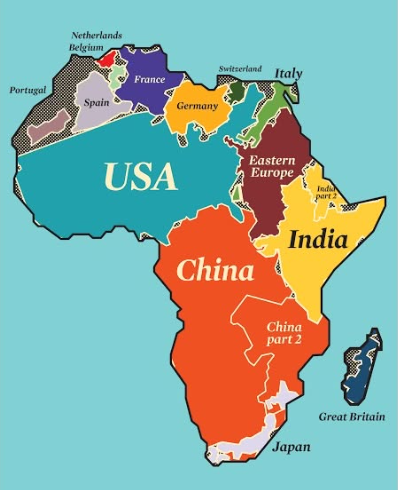
Africa is so massive that several giant countries and regions can fit inside its borders at the same time. The United States (9.83 million sq km), China (9.60 million sq km), India (3.29 million sq km), Japan (0.38 million sq km), Mexico (1.96 million sq km), and much of Europe can fit inside Africa’s borders.