


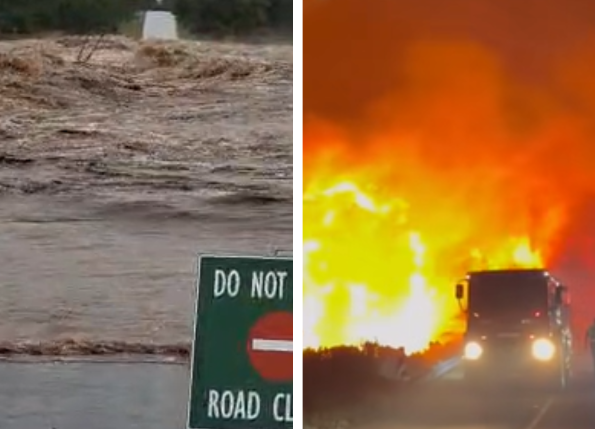
South Africa is experiencing a “summer of extremes” marked by severe flooding, widespread fires and growing water shortages – a clear sign of the escalating impacts of climate change, according to WWF South Africa.
The organisation says the combination of flooding in Limpopo and Mpumalanga, fires across the Eastern and Western Cape, and water supply challenges along the Garden Route shows that climate change is no longer a future threat but a present reality.
Fresh data released this week by the Copernicus Climate Change Service and the World Meteorological Organisation indicates that global temperatures have already warmed by about 1.4°C above pre-industrial levels, placing the world dangerously close to the 1.5°C limit set by the Paris Agreement.
In the Western Cape, hot, dry and windy conditions have fuelled fires that have burned close to 100 000 hectares, hitting the agricultural sector hard and prompting calls for a provincial state of disaster to be declared.
In Limpopo and Mpumalanga, an extended tropical weather system, driven by warm waters in the Mozambique Channel, has caused severe flooding, disrupting schooling and affecting the Kruger National Park and surrounding tourism towns.
Meanwhile, Knysna and other Garden Route towns are facing water supply challenges, with indications that Cape Town could also enter another period of water stress.
Senior Climate Specialist at WWF South Africa, James Reeler, said South Africa and the world were already paying a high price for inaction.
“Our heart goes out to all those affected by recent extreme weather events. In the South African context, these weather events carry very heavy economic and human costs.”
He warned that while much of the debate focuses on the cost of climate action, the cost of doing nothing is far higher.
“We need to start spending money where it counts – on limiting emissions and preparing our people for a changing climate.”
Reeler added that the years 2020 to 2030 were meant to be the critical decade for action, but with 2026 already here, many of the interim targets under the Paris Agreement have not been met.
Copernicus estimates long-term global warming has reached about 1.4°C above the 1850–1900 average, while the WMO puts the 2025 global average temperature at around 1.44°C above pre-industrial levels. The three-year average from 2023 to 2025 has reached 1.48°C, the closest the world has come to the Paris limit.
WWF says these rising temperatures are translating directly into more intense heatwaves, droughts, storms and floods, making the past three years the costliest on record for climate-related disasters.
The organisation is calling for faster cuts to emissions, protection and restoration of natural ecosystems, and scaled-up solutions to help communities adapt to a changing climate.