

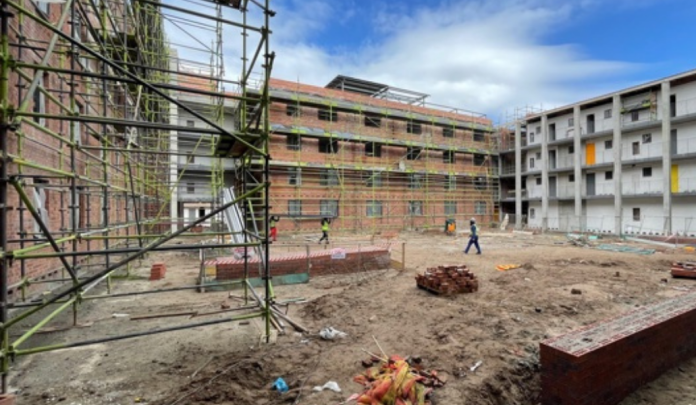
The City has announced that it has Gazetted the revised Municipal Planning By-law (MPBL), which is set to make it easier to build and develop affordable housing in the City.
The new land-use right will enable micro-developers to fast-track the building of affordable rental units in identified neighbourhoods with the highest demand. This will be effective as of 1 September 2025.
The City says this will mean more people can move out of informal housing into dignified, formal housing.
All of the other amendments will come into effect on 1 October 2025 to allow stakeholders to prepare for these changes.
The now promulgated revised MPBL includes the following amendments and new provisions, amongst others:
- Incentive overlay zonings (IOZs) for development focus areas in Athlone, Maitland, Parow/Elsies River, Bellville and Diep River. The IOZs assign additional and enhanced development rights to properties that fall within certain areas in these overlay zonings.
- Additional use rights for R1 include affordable rental flats, supplementary dwelling units, and a place of instruction. These are subject to certain conditions to control any impact.
- An ‘affordable rental flat’ is a new additional use right to enable the development of small-scale affordable rental accommodation in identified areas. The number of small-scale affordable rental units on a single property may not exceed eight units plus a dwelling house, or 12 units if there is no dwelling house on the land.
- New additions under Section 135 allow the City to impound moveable property that is being used for illegal building or demolition work if an order to stop work is being disobeyed. This amendment intends to address the challenge of owners and contractors continuing illegal work without tangible consequences.
- Revised or new definitions for ‘affordable rental flat’; ‘affordable rental unit’; ‘commune’; ‘electric vehicle charging station’; ‘structure-mounted energy system’; ‘ground-mounted energy system’; ‘micro wind turbine’; ‘outdoor restaurant dining area’, and so forth.
- Single Residential zoning is renamed ‘Residential Zoning’ (R1) and provides for single-family dwelling houses and additional use rights in low- to medium-density residential neighbourhoods.
- Amendments to the emergency housing provisions, now called ‘temporary disaster housing’, under Section 68 to enable the City to provide temporary housing on land that may not be zoned for such purpose for 12 months without needing to undertake a public participation process beforehand if it is reasonable and justifiable, and complies with the Promotion of Administrative Justice Act. The amendment allows for those who are left homeless due to emergencies such as fires and floods to be temporarily relocated to an alternative site in a timely manner.
- Amendments under Section 111 to allow the City to use email as the method of contacting and notifying interested and affected parties; that parties must provide the City with their email addresses and update these; and a person who does not have access to email may apply for notification by other means. If a resident already has their latest email address with the City, they do not have to update it again.
- A new rectification chapter combines the existing regularisation provisions with new revocation and amendment provisions to provide an internal remedy for irregular decisions. This is a cost-effective and quicker alternative to review litigation. The process is procedurally fair.
Eddie Andrews, the City’s Deputy Mayor and Mayoral Committee Member for Spatial Planning and Environment, thanked residents and stakeholders for their robust engagement on the revisions and for their invaluable contributions.
“The amended MPBL refines planning processes, offers greater clarity, and strengthens our ability to promote social and economic development. It also gives greater effect to policies such as the Municipal Spatial Development Framework, and related district and local frameworks.”