

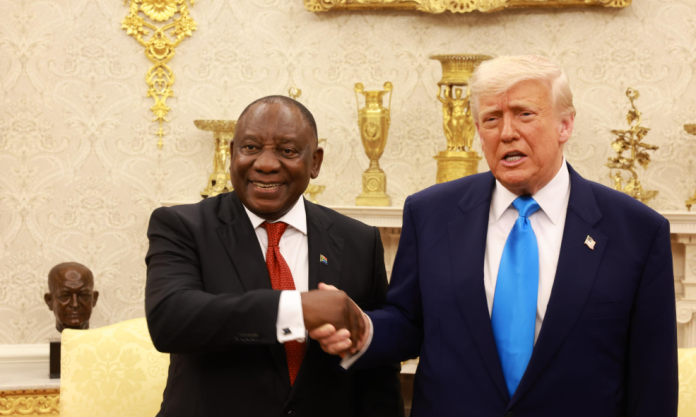
President Cyril Ramaphosa has hailed his bilateral meeting with U.S. President Donald Trump as “robust and fruitful,” marking what he described as a new chapter in South Africa–United States relations, especially in the areas of trade and investment.
Speaking to South African media at the conclusion of his Working Visit to Washington, D.C., Ramaphosa highlighted the positive tone of the discussions, which ranged from informal topics like golf to substantive issues concerning economic cooperation and shared strategic interests.
“We had a really good bilateral, although a number of issues came up, which you will all have observed, and we were able to have a robust engagement with Mr. Trump in your presence,” he said.
“Following that engagement, which you all witnessed, we retired to the Cabinet Room for lunch. We were then able to have really good in-depth exchanges with President Trump and his other officials,” he added.
A key outcome of the meeting, Ramaphosa said, was a renewed commitment to ongoing dialogue, particularly around trade, tariffs, and access to U.S. markets under initiatives such as the African Growth and Opportunity Act (AGOA).
“I want to confirm that there will continue to be engagement between South Africa and the United States officials, particularly at the trade and industry level, to deal with the package of issues that we had tabled that have to do with trade and investment,” Ramaphosa noted.
“I was rather pleased that there’s a firm agreement and undertaking that we are going to continue engaging, so there’s no disengagement. For us, that was one of the key outcomes that we had wanted.”
Ramaphosa said the visit aimed to “reset relations” between the two countries after what he termed a period of strain, and to “reposition” the partnership going forward.
Addressing Trump’s Claims on White Farmers
The President also used the opportunity to confront perceptions and clarify concerns, particularly those stemming from Trump’s previous comments about violence against white farmers in South Africa.
“It turned out that President Trump’s concern is about the safety of the people of South Africa. Much as he zeroed it down to white farmers, we kept saying there is a security problem and we are not running away from that. There is criminality.”
“We even sought to deal with it from its genesis… When the economy is not growing, when there is poverty and when there’s unemployment, one of the social ills that we get as a derivative is criminality that spreads itself around the country. It’s not only in farms — it’s in rural and even urban areas. He [President Trump] expressed his views on that, and I was rather pleased that a number of our compatriots were able to deal with that.”
READ: EFF, Malema slams Ramaphosa-Trump meeting
Adding to the conversation, Zingiswa Losi, President of the Congress of South African Trade Unions, addressed Trump directly during the Oval Office engagement, reframing the issue as one of crime and inequality rather than race.
“If you go into the rural areas where the black majority are, [there is gender-based violence against] women and the elderly… The problem in South Africa is not necessarily about race, but it is about crime and we are here to [look at] how both nations can work together to reset trade relations and investment, and also help us [to] have the technology that is needed to address the level of crime we have in our country,” Losi said.
ALSO READ: Ramaphosa’s Oval Office visit overshadowed by ‘white genocide’ claims
Focus on Investment
On the economic front, Ramaphosa reiterated South Africa’s call for increased U.S. investment, pointing to existing American business interests as a foundation for deeper cooperation. He cited a recent U.S. investment in a South African lithium company as a positive sign.
“In the discussions over lunch, we didn’t dwell on that issue. However, he did ask what help do we need as a country,” Ramaphosa recalled.
“The main thing we said, in terms of assistance, is investments… We require more investments from the United States, and we require a more positive disposition from the United States because once the United States government and the President emits a very positive disposition towards South Africa, it unlocks a lot of investments, and investors would then be willing to come and invest their money.
“We want foreign direct investment. We want to keep the jobs that we have that have been created by U.S. companies, and we want more and more U.S. companies to come and invest.”
G20 and Global Cooperation
Ramaphosa also confirmed that the G20 was among the issues discussed during the meeting. As current chair of the G20, he extended a personal invitation to President Trump to attend the upcoming summit in South Africa.
“We also discussed the G20 and we stressed that the G20, having been formed by the United States, of course, together with other countries, it is important that the United States should continue playing a key role… I want to hand over the Presidency of the G20 to President Trump in November, and I said he needs to be there.
“I don’t want to hand over the Presidency of the G20 to an empty chair. I want to hand it over to him, sitting in that chair in November, and he is going to give serious consideration to it. In fact, I expect him to be come to South Africa,” Ramaphosa said.
A Symbolic Exchange
The meeting concluded on a lighter note, with the two leaders exchanging gifts.
Ramaphosa presented Trump with a golf book, while he received a publication authored by the U.S. President — a gesture the South African leader said symbolised the cordial tone of their engagement.
Reflecting on the visit, Ramaphosa said the trip had achieved its goals.
“I do believe that our visit here has been a great success. We’ve been able to achieve what we set out to achieve: re-engagement with the U.S., to put the issues of investment and trade on the table, and to ensure that we continue engaging through the various other formations. All in all, I’m rather pleased I go back [home] having a sense that we have done well,” he said.