


Queen Elizabeth II has been laid to rest after a state funeral attended by world leaders and a final journey through the streets of London.
Monday’s funeral comes 11 days after the longest-serving monarch in British history died aged 96 at Balmoral Castle in Scotland on September 8.
Thousands of people lined the streets surrounding Westminster Abbey and Buckingham Palace to witness the passage of the queen’s casket from Westminister Hall to the church and eventually to Windsor Castle, where she was laid to rest alongside her late husband, Prince Philip and her father, King George VI.
People queued 24 hours a day from late Wednesday until 6.30am on Monday, the day of the Queen's funeral, to see her coffin in Westminster Hall https://t.co/iDZedkctfP
— Sky News (@SkyNews) September 20, 2022
Millions watched the funeral on television at home after a public holiday was declared to mark the passing of the queen.
In the lead-up to the funeral, many people across the country camped out and queued for upwards of 13 hours to visit the queen’s coffin in Westminister Hall and pay their respects.
On Monday, Westminister Abbeys’ tenor bell tolled 96 times at one-minute intervals – one for every year of her life – stopping before the service started at 10:00 GMT to mark the only monarch most Britons have ever known.
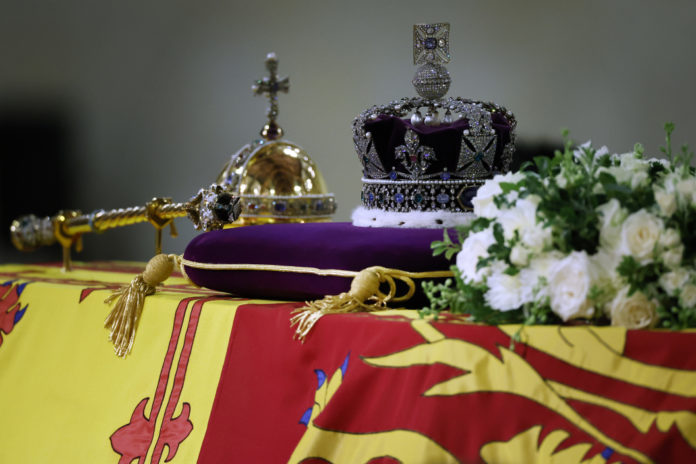
The oak coffin was covered with the Royal Standard flag, the queen’s colours, with the Imperial State Crown on top, placed on a gun carriage and pulled by naval personnel to Westminister Abbey, where she was crowned and married.
Tuesday's Guardian: "The final farewell"#BBCPapers #TomorrowsPapersToday https://t.co/kiD58O9ziu pic.twitter.com/ujzT4sg623
— BBC News (UK) (@BBCNews) September 19, 2022
Among 2,000 people in the congregation, there were about 500 world leaders, including US President Joe Biden, Emperor Naruhito of Japan and South African President Cyril Ramphosa.
“All the people of the United Kingdom: our hearts go out to you, and you were fortunate to have had her for 70 years; we all were. The world is better for her,” Biden said after signing a book of condolence.
The funeral, which lasted for under an hour, closed with the Last Post trumpet salute and the national anthem, “God Save the King”, welcoming the transition from one reign to the other.
Congregation at funeral of Queen Elizabeth II sings God Save the Kinghttps://t.co/8LgREEhmuP pic.twitter.com/MyKSsi0JcY
— BBC News (UK) (@BBCNews) September 19, 2022
King Charles led mourners and 6,000 members of the armed forces who had marched the coffin to the royal hearse, alongside his three siblings, his heir, Prince William, and younger son Prince Harry, to Wellington Arch.
In the afternoon, people lined the route, throwing flowers, cheering and clapping as it passed the hearse traveled from the city to the countryside that she had loved throughout her life.
Crowds line the Long Walk as Queen Elizabeth II's coffin makes its way to St George's Chapel in Windsor Castlehttps://t.co/jGVAGRvtFI pic.twitter.com/YlvbA1XZIt
— BBC Breaking News (@BBCBreaking) September 19, 2022
During the ceremony, the crown, orb and sceptre, all symbols of the monarch’s power and sovereignty, were removed from the coffin and placed on the altar.
Once the royal items were removed, Lord Chamberlain, the most senior official in the royal household, broke his “Wand of Office” to place it on the casket, signifying the end of his service to the queen.
The queen was lowered into the royal vault, and a private family service followed at the King George VI Memorial Chapel, where she was buried.
The coffin of the Queen's husband, Prince Philip, has been moved from the Royal Vault to the memorial chapel to join her https://t.co/KyXL7DepDh
— Sky News (@SkyNews) September 19, 2022
The queen’s death has prompted reflection on the country she ruled over and the legacy of its past, its present state and what the future might hold for the country under a new reign.
The family released an image of the monarch on moorland, with the caption often borrowed from Shakespeare's Hamlet: "May flights of Angels sing thee to thy rest." https://t.co/5aa6fRJ7GT
— Sky News (@SkyNews) September 19, 2022
Read more: Analysis: Queen Elizabeth modernised the British monarchy
Source: Al Jazeera, Sky News, BBC