


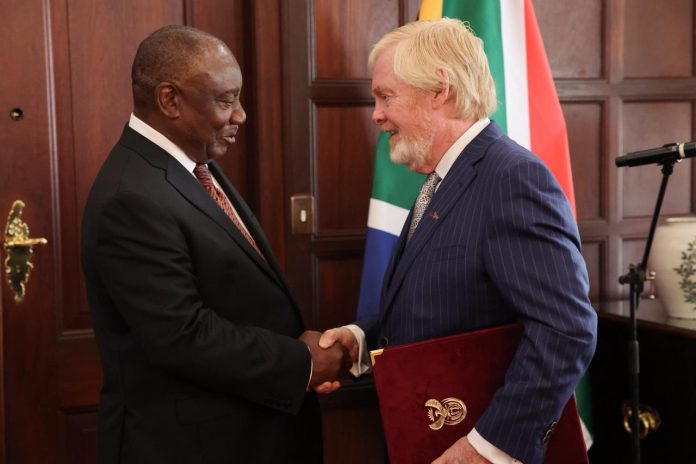
New US Ambassador Leo Brent Bozell has repeated his view that the struggle song Kill the Boer is hate speech, but that he respects the South African judiciary.
President Cyril Ramaphosa today accepted Bozell’s credentials, a month after he was issued a formal reprimand for questioning the ”Kill the Boer” court ruling.
The Department of International Relations and Cooperation issued a formal démarche to the Ambassador in March this year.
Speaking at a business conference in Hermanus in early March, Bozell was quoted as stating, “I don’t care what your courts say,” in reference to the legal determination that the struggle song in question does not constitute hate speech.
The “Kill the Boer” ruling, finalised by the Supreme Court of Appeal (SCA) and not heard by the Constitutional Court in March 2025, determined that the “Kill the Boer, Kill the Farmer” chant is not hate speech, but rather a protected political “liberation chant”.
The court ruled it is a form of political expression.
Bozell, along with the envoys from 19 other nations, was formally accredited at a ceremony in Pretoria this morning.
When probed by the media afterwards, Bozell had the following to say about the song, but stressed that this did not mean that he disrespected the courts:
“The position of my country is that it’s wrong. That it is hate speech. The position of the civilised world is that it’s hate speech.”
The greatest respect is for the judiciary. I take nothing away from that. I will say that men, that judges, can be wrong. American judges are wrong all the time.”
In comments delivered after Ramaphosa accepted the letters of credence from all 20 newly appointed ambassadors, the President called on all countries to respect international law and the sovereignty and territorial integrity of all nations.
“I expect South Africa’s Ambassadors and High Commissioners to your country to exercise diplomatic tact and discretion and desist from interfering in the internal affairs of your country.”
“If they have any manner of concern, they should raise those concerns directly with officials in your country’s foreign affairs department and engage in quiet diplomacy.”