11.9 C
Cape Town
Monday, July 13, 2026
Home Blog Page 238

New export market for South African table grapes unlocked

export


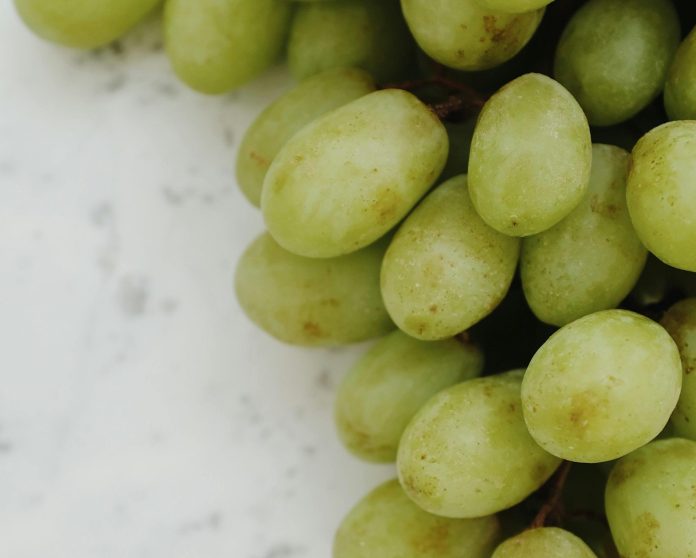
The National Department of Agriculture has announced the opening of a new export market for South African table grapes to the Republic of Korea (ROK).


The Department says negotiaions for this market started over 20 years ago, and the first consignment is being prepared after the ROK notified South Africa that they had opened the market on 23 January 2026.


It follows a physical field verification visit which was initiated a year ago, in February 2025, in South Africa. This field verification visit led to the conclusion of the ROK’s phytosanitary import requirements.


South Africa ranks among the top five global table grape exporters. The table grape industry plays a major role in the SA economy to generate substantial foreign exchange earnings, create employment opportunities, and contribute significantly to the growth of the agricultural sector.


According to the South African Table Grape Industry (SATI), SA exports about 55% of table grapes to the European Union (EU) and 20% to the United Kingdom (UK).


The 2025/26 South African table grape season is progressing well, with an estimated 79,4 million 4,5 kg cartons for export, marking a 0,6% increase from the 2024/25 season.


The Agriculture Department has recently seen a number of markets in Asia open up to South African produce.


In October 2025, the Minister of Agriculture, John Steenhuisen, and his counterpart, Minister Sun Meijun of China’s General Administration of Customs, signed a historic stone fruit trade protocol in Shanghai, China.


The agreement opened the Chinese market for the first time to five types of South African stone fruit, namely apricots, peaches, nectarines, plums, and prunes. It was also the first instance where China has negotiated access for multiple stone fruit types from a single country under one deal.


Steenhuisen said the opening of the Chinese market could unlock approximately R400 million for South Africa over the next five years, a figure which is projected to double over the next ten years.


In November 2025, South Africa signed a Memorandum of Understanding (MoU) with the Socialist Republic of Vietnam which has secured a strengthened partnership and unlocking new opportunities for South African producers in one of Asia’s fastest-growing markets.


Vietnam first opened its market to South African oranges in May 2024 after the successful conclusion of a bilateral protocol. This MoU is designed to accelerate this growth by strengthening cooperation and fast-tracking market penetration.


Philip Oakey from The Human League chats to us ahead of their SA tour

This is exciting! We’re happy to tell you that BreakOut Events in association with Smile FM – legendary British synth-pop pioneers The Human League will be heading to South Africa this May. One of the the original members of the band is Philip Oakey – we caught up with him on breakfast this morning:
Catch The Human League live in Cape Town on Tuesday, 12 May 2026, at the Grand Arena in GrandWest. They will be joined by special guests Blancmange. Tickets available at Webtickets.

Milestone reached as SA resumes local FMD vaccine production

FMD


South Africa has restarted local production of Foot-and-Mouth Disease (FMD) vaccines for the first time in more than two decades, marking a major step in the country’s fight to control ongoing outbreaks.


Minister of Agriculture John Steenhuisen visited the Agricultural Research Council’s Onderstepoort Veterinary Research (ARC-OVR) facility on Friday, 6 February, where ARC President and CEO Dr Litha Magingxa handed over the first batch of locally produced vaccines. The milestone signals a shift from emergency response measures to a long-term, science-driven strategy to eradicate the disease.


The country’s goal is to regain its FMD-free status from the World Organisation for Animal Health (WOAH). This will be supported by locally manufactured vaccines developed through collaboration between the government, the ARC, and Onderstepoort Biological Products (OBP).


Support for Farmers


Steenhuisen acknowledged the heavy financial and emotional toll the outbreaks have taken on farmers.


He said the government is moving “from defence to offence” in tackling the disease and is committed to a focused ten-year strategy aimed at fully eradicating FMD and protecting the livestock sector for the future.


First Doses Produced


South Africa stopped producing its own FMD vaccines in 2005 due to outdated facilities that no longer met international manufacturing standards. After nearly 20 years of research and upgrades, the ARC has now produced an initial 12,900 doses using modern bioreactor technology.


Scientists worked to identify the FMD strains circulating in the Southern African Development Community (SADC) region and to ensure the vaccines meet strict international biosafety and potency standards. The pilot batch serves as proof that the new production methods and strains are effective.


The first doses will be distributed as follows:


  • Free State: 2,300
  • Eastern Cape: 2,600
  • North West: 2,000
  • Gauteng: 2,000
  • Limpopo: 2,000
  • Mpumalanga: 2,000


From March 2026, ARC is expected to produce 20,000 doses per week of monovalent SAT 1, SAT 2, or SAT 3 vaccines. Production is set to increase to 200,000 doses per week from 2027.


Vaccine Supply From Abroad


While local production ramps up, the Department of Agriculture is continuing to import vaccines to ensure a steady supply.


The department said it supports the use of designated agents importing vaccines from international manufacturers, including Biogénesis Bagó in Argentina and Dollvet in Turkey. Officials stressed that strict controls are necessary, warning that unregulated imports could undermine disease control efforts.


So far, the state has sourced two million vaccines through the Botswana Vaccine Institute (BVI). A further 700,000 doses are expected by the end of February, with additional monthly shipments planned. Millions more doses are due from suppliers in Argentina and Turkey in the coming months.


Path Back to FMD-Free Status


To regain FMD-free status with vaccination, South Africa must show there has been no virus transmission for at least 12 months. This requires tightly controlled vaccination, surveillance, and livestock movement measures that can be verified by WOAH.


The government has also sent local virus samples to the Pirbright Institute in the United Kingdom for further analysis and strain matching.


Meanwhile, the Department of Agriculture has finalised a memorandum to declare a National State of Disaster over the outbreaks. The declaration, once approved by Cabinet, will unlock emergency funding for large-scale vaccination campaigns in affected provinces.

Weather alert for the Western Cape


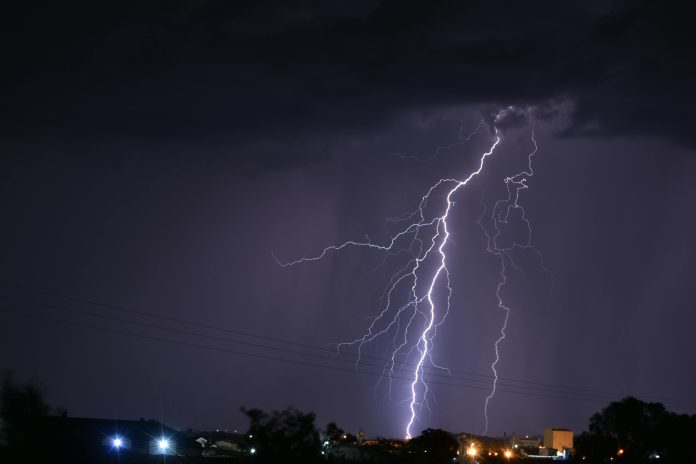
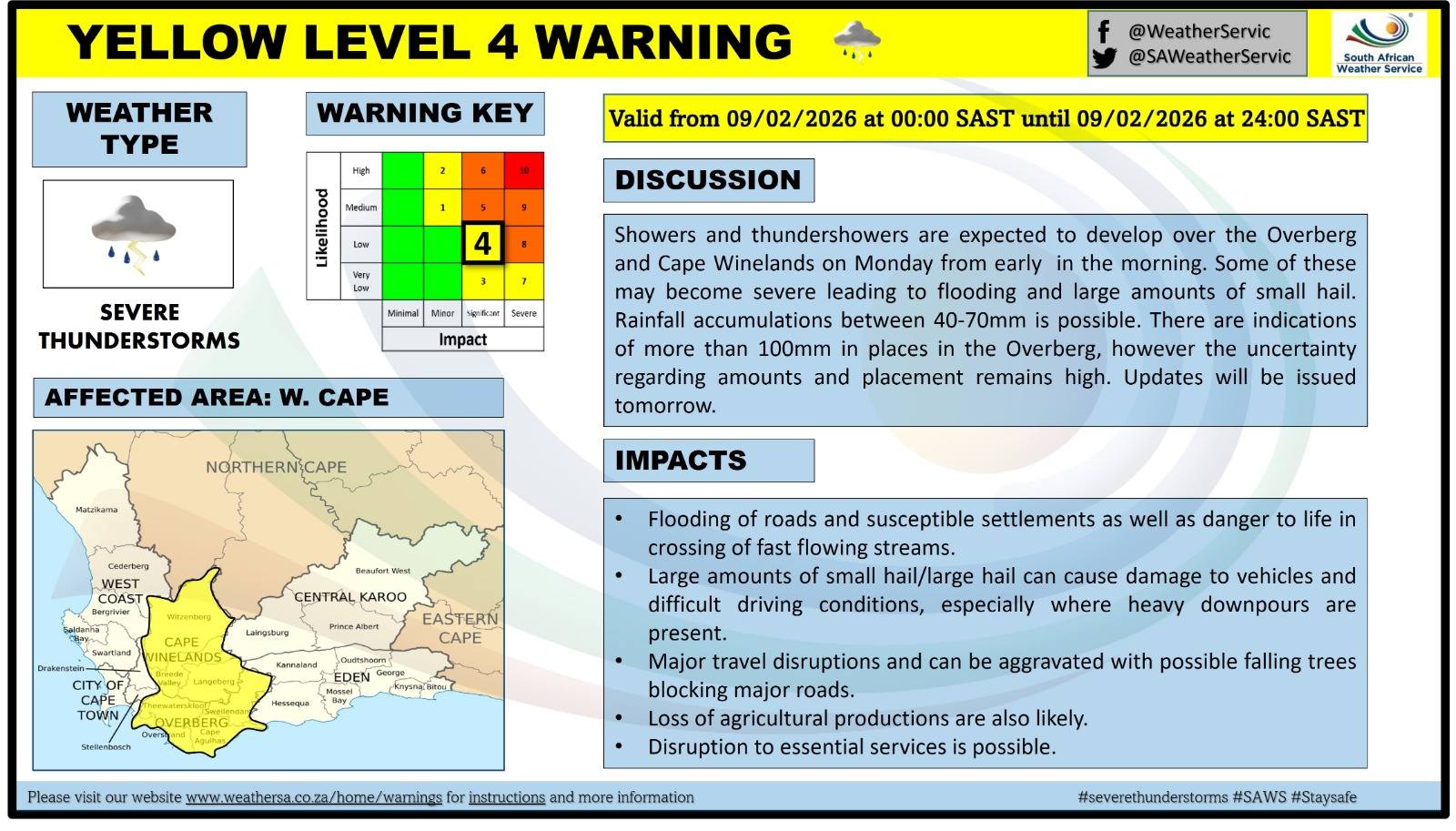
The South African Weather Service has issued warnings for severe thunderstorms over parts of the Western Cape on Sunday, 8 February, and Monday, 9 February.


A Yellow Level 2 warning is in place for the Cape Winelands and Central Karoo on both days, with the City of Cape Town included on Monday. Forecasters say storms could bring localised flash flooding and large amounts of small hail.


Meanwhile, a more serious Yellow Level 4 warning has been issued for the Overberg District and Langeberg Municipality on Monday, where heavy downpours could lead to widespread flooding.


While the rain may offer some relief amid ongoing drought conditions, officials warn that dry, hardened ground increases the risk of rapid runoff and flash flooding. Residents are urged to stay alert and avoid crossing flooded roads or low-lying bridges.


Event Organisers Urged to Plan Ahead as City Rejects Late Permit Applications


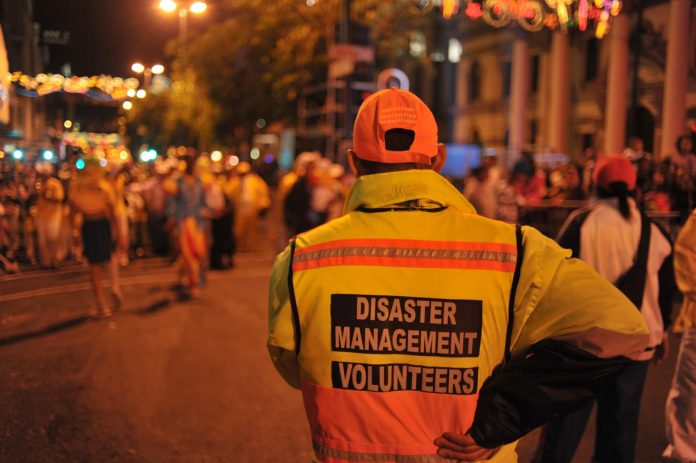
The City of Cape Town’s Events Permit Office says no late permits for events will be accepted, after the City recorded an increase in last minute and incomplete submissions.


According to the City, the Events Permit Office has recorded a steady rise in late applications over the past three financial years, with a growing number of organisers submitting paperwork just days before their planned events.


“The Events Permit Office processes between 1 700 and 2 000 permit applications annually. The increasing number of delayed submissions has significantly impacted the workload of City employees, leading to extended processing times and potential delays for all applicants,” the City said.


City officials warn that late or incomplete applications place pressure on emergency services, regulatory processes and multiple municipal departments, while also increasing the risk to surrounding communities.


“While our teams are committed to ensuring public safety and compliance through the permitting process, late applications will not be processed,” the City emphasised.


The City’s Events By-Law requires organisers to submit complete applications within the following minimum timeframes:

  • Small events (200–2 000 attendees): at least 15 working days before the event
  • Medium events (2 001–5 000 attendees): at least 20 working days
  • Large events (5 001–10 000 attendees): at least 25 working days
  • Very large events (10 001+ attendees): at least 60 working days, with three to six months preferred


Organisers are also reminded that additional approvals may require longer lead times. These include:

  • Liquor licence applications: minimum 21 working days
  • Food vendor approvals and Certificates of Acceptability: minimum 15 working days
  • Noise exemption applications: minimum 15 working days
  • Land use planning approvals: minimum 60 working days


The City says late submissions limit its ability to properly assess the impact of events on surrounding communities and undermine careful planning aimed at minimising disruption and ensuring safety.


“Cape Town’s events calendar plays a critical role in job creation, tourism growth and economic development. The permit process exists to ensure events are safe, protect public infrastructure and balance the needs of organisers, residents and businesses,” the City added.


Event organisers are encouraged to engage with the Events Permit Office early in the planning process. Assistance is available by calling 021 417 4035 or emailing events.permit@capetown.gov.za


error: Content is protected !!