


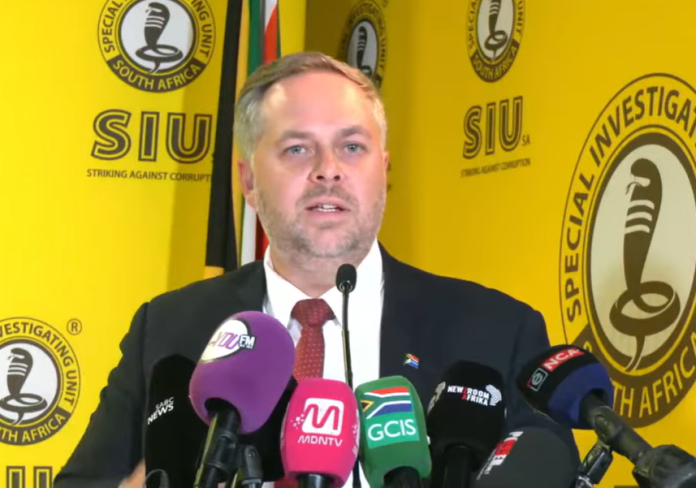
South Africa’s immigration system was effectively turned into a “marketplace” where permits, visas and even citizenship outcomes were sold for cash, according to explosive findings released by the Special Investigating Unit (SIU).
Presenting the interim report on Monday, the SIU’s Acting head, Leonard Lekgetho, said its investigation uncovered widespread corruption involving Department of Home Affairs officials, syndicates and external actors who exploited systemic weaknesses to secure fraudulent immigration status.
The probe was authorised by President Cyril Ramaphosa under Proclamation 154 of 2024, following allegations of large-scale fraud within the department.
Officials allegedly sold permits for cash
According to the SIU, officials entrusted with safeguarding South Africa’s borders instead turned immigration processes into profit-making schemes.
Investigators found evidence that asylum seeker permits and visas were issued unlawfully in exchange for payments ranging from R500 to R3,000. Transactions were allegedly concealed through cash hidden in application files, electronic wallet transfers using unregistered cellphone numbers, and payments routed through spouses’ bank accounts.
Cyber forensic analysis of seized devices revealed direct communication between officials and applicants, including WhatsApp messages used to fast-track approvals. In several cases, payments were deposited shortly after permits were approved, establishing what investigators described as a clear link between approvals and bribery.
The SIU said four officials earning less than R25,000 per month collectively received more than R16.3 million in unexplained deposits. Some allegedly purchased multiple properties and developed high-value homes inconsistent with their salaries.
In one instance, deposits totalling R8.9 million flowed through a construction company registered in the name of an official’s spouse, with payment references linked to permanent residence applications.
Asylum system exploited
The investigation began after a whistleblower alleged that foreign nationals were fraudulently obtaining asylum permits and later using them to secure permanent residence and citizenship.
Search-and-seizure operations conducted with the Hawks at five Refugee Reception Offices led to the confiscation of computers, cellphones and documents, with 237 items subjected to forensic analysis.
The SIU found that applicants were able to remain in South Africa for extended periods by exhausting appeal processes, even when asylum claims lacked merit.
Religious figures and external actors implicated
The report also detailed how certain religious leaders allegedly exploited immigration loopholes.
Shepherd Bushiri case
Malawian preacher Shepherd Bushiri allegedly secured permanent residence through fraudulent documentation and conflicts of interest involving an adjudicator who belonged to his church.
Investigators said a chartered accountant admitted to being paid simply to sign a financial independence letter supporting Bushiri’s application. The SIU further raised concerns about large cash payments linked to aircraft purchases and the alleged diversion of religious donations into personal assets and company holdings.
Timothy Omotoso investigation
Nigerian pastor Timothy Omotoso was found to have entered South Africa using a fraudulently obtained work permit and later exploited administrative loopholes, including an unlawfully granted ministerial waiver, to extend his stay despite visa noncompliance.
Kudakwashe Mpofu conviction
The SIU confirmed that Kudakwashe Mpofu obtained a fraudulent permanent residence permit in 2018 for R3,000. Despite irregularities, he secured senior executive positions at the North-West Development Corporation, earning up to R1.6 million annually.
Mpofu was later convicted of fraud in the Mmabatho Regional Court and sentenced to three years’ correctional supervision with an additional suspended sentence.
Border control failures highlighted
Investigators also examined the case of Nigerian national Prince Daniel Obioma, who allegedly overstayed a visitor’s visa but later re-entered South Africa without any official movement record before being linked to a high-profile McLaren crash in Cape Town in 2025.
The SIU said the case exposed serious failures in border management and movement control systems.
Identity fraud and DNA manipulation uncovered
The report revealed additional schemes involving identity fraud, including foreign nationals allegedly using the fingerprints of unsuspecting South African citizens while substituting their own photographs on passport applications.
Investigators also uncovered evidence suggesting DNA samples used in immigration applications were manipulated to favour certain applicants, prompting warnings to multiple government departments and international partners, including Interpol.
Abuse of the retirement visa category was also flagged, with investigators noting that the absence of age restrictions and poor post-approval monitoring created opportunities for fraud.
I welcome the SIU’s interim report on visa maladministration over a 20 year period between 2004 and 2024. Over the past 20 months, we’ve made major strides holding corruption to account and driving digital transformation to close systemic loopholes. Rebuilding the rule of law! 🇿🇦 pic.twitter.com/lAEbHuPVji
— Leon Schreiber (@Leon_Schreib) February 23, 2026
Wider national impact
The SIU warned that immigration corruption has far-reaching consequences across sectors such as housing, banking, healthcare, education and infrastructure, contributing to urban overcrowding, labour tensions and potential tax revenue losses.
The unit said the findings demonstrate that corruption in the visa system was “organised, deliberate and devastating to public trust”.
Recommendations to government
Among its recommendations, the SIU called for:
- stricter employee vetting and ethics training,
- integrated verification systems across government departments,
- stronger quality assurance before visas are issued,
- improved monitoring of visa compliance after approval, and
- tighter access controls and biometric safeguards at Home Affairs offices.
The SIU concluded that without coordinated reforms across government, systemic vulnerabilities in South Africa’s immigration framework will persist.
“The findings make one thing clear,” investigators said. “South Africa’s immigration system was treated as a commodity, permits and visas were sold, traded and laundered.”
Minister welcomes report
Home Affairs Minister Leon Schreiber has welcomed the SIU’s interim report, emphasising that the investigation spans 20 years between 2004 and 2024.
He says since he took office, 20 months ago, the Department has made major strides in holding corruption to account and driving digital transformation to close systemic loopholes.
Schreiber also confirmed that a total of 20 officials have already been dismissed since April last year.
75 disciplinary cases against all implicated individuals have also been completed, over the past two financial years, resulting in 16 suspensions without pay and 22 written warnings.
I welcome the SIU’s interim report on visa maladministration over a 20 year period between 2004 and 2024. Over the past 20 months, we’ve made major strides holding corruption to account and driving digital transformation to close systemic loopholes. Rebuilding the rule of law! 🇿🇦 pic.twitter.com/lAEbHuPVji
— Leon Schreiber (@Leon_Schreib) February 23, 2026