

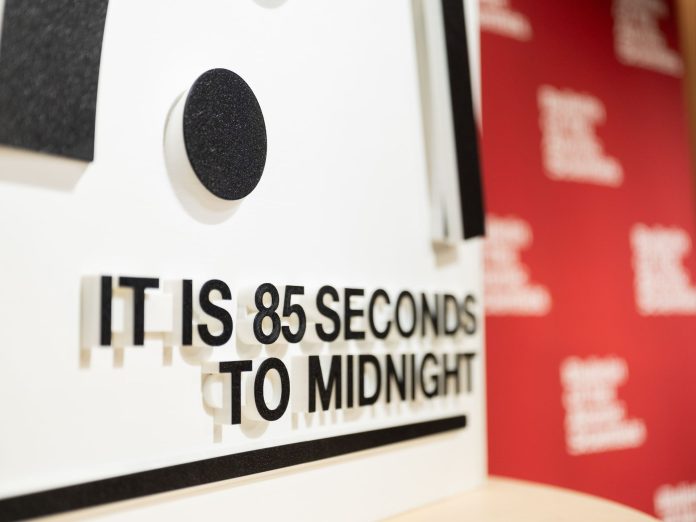
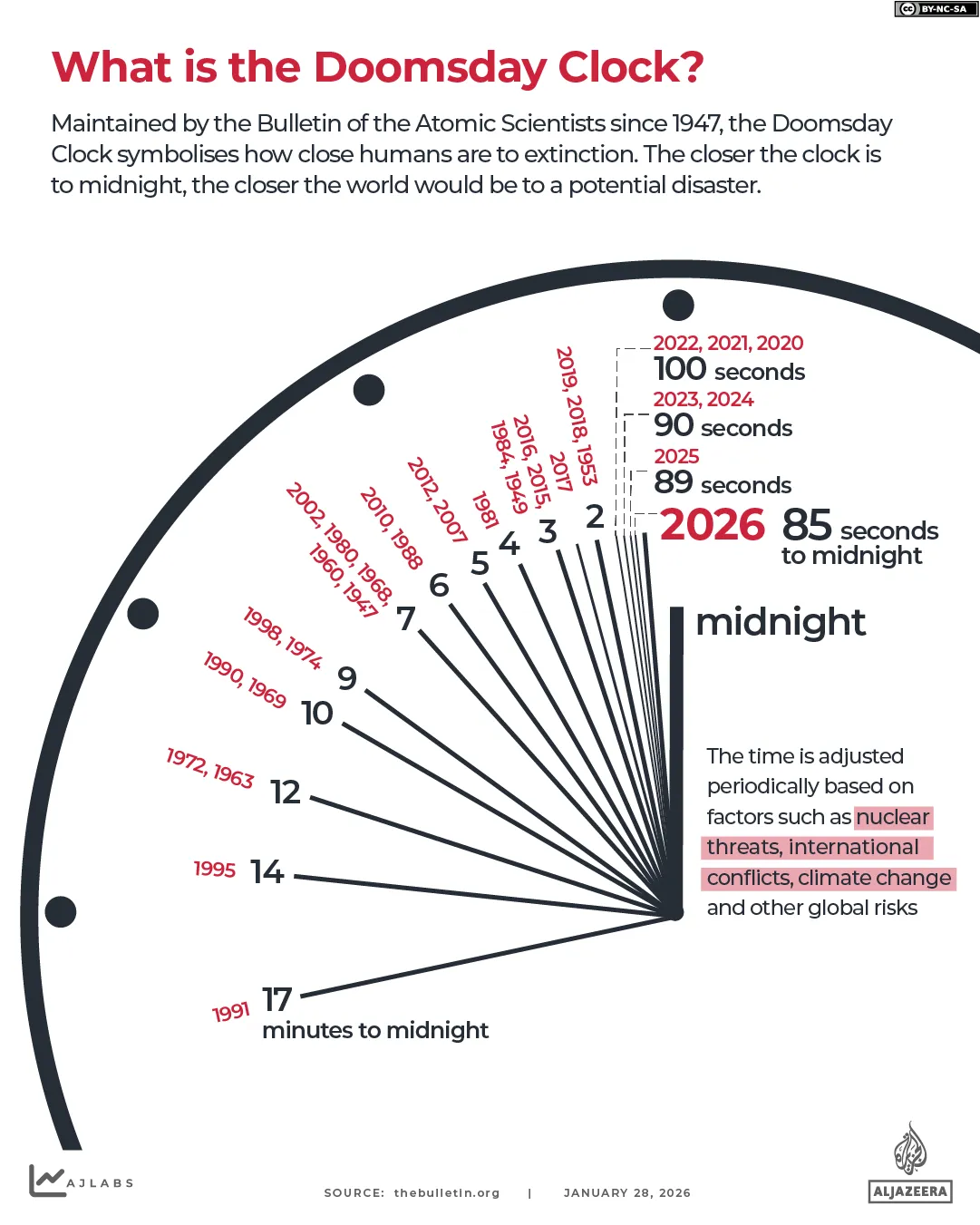
The world is four seconds closer to catastrophe, with the Doomsday Clock now 85 seconds to midnight.
The clock was reset by the Bulletin of the Atomic Scientists’ Science and Security Board (SASB) on 27 January 2026 to reflect what it described as “the closest the Clock has ever been to midnight”.
As such, the President and CEO of the Bulletin of the Atomic Scientists, Alexandra Bell, called for immediate action.
“The risks we face from nuclear weapons, climate change and disruptive technologies are all growing. Every second counts, and we are running out of time,” said Bell.
The clock was created in 1947 and is symbolic of the current state of humanity and to warn of the threats to it.
According to the board, humanity is facing escalating, with threats driven mostly by human activity and political decision-making.
The board said the world was already “perilously close to global disaster” a year ago but add that global leaders failed to change course. Instead, major powers have become “increasingly aggressive, adversarial, and nationalistic”. The clock was on 89 seconds last year.
“Hard-won global understandings are collapsing, accelerating a winner-takes-all great power competition and undermining the international cooperation critical to reducing the risks of nuclear war, climate change, the misuse of biotechnology, the potential threat of artificial intelligence, and other apocalyptic dangers,” the SASB statement read.
The statement highlighted rising nuclear dangers, pointing to ongoing conflicts involving nuclear-armed states and the breakdown of arms control agreements. It noted that the failure of leadership has increased the likelihood of catastrophe, prompting the decision to move the clock forward.
Climate change was also cited as a major accelerant of global risk.
Record global temperatures, rising sea levels, deadly heatwaves and widespread droughts and floods were presented as evidence that current responses are not enough.
Emerging technologies, particularly artificial intelligence and advances in biotechnology, were flagged as additional dangers. The board called for “urgent action” to limit nuclear arsenals, establish international rules for AI, and strengthen cooperation to address biological threats.
READ MORE: It is now 85 seconds to midnight