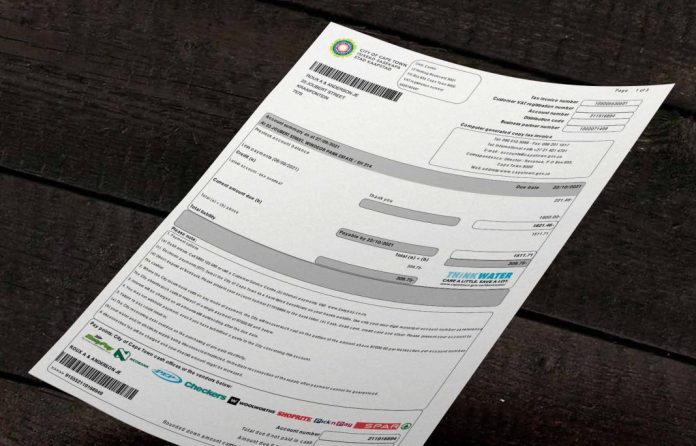
The City of Cape Town is facing growing legal opposition to its 2025/26 municipal tariff structure, with AfriForum confirming that it too will approach the courts to challenge it.
This as the South African Property Owners Association (SAPOA) has also asked the court for a date to take legal action against charges linked to property values.
The Cape Town Collective Ratepayers’ Association (CTCRA), representing 57 neighbourhood groups, has also voiced support for the legal challenges, saying middle-class families are already struggling under rising costs.
But Mayor Geordin Hill-Lewis has come out strongly in defence of what he calls a “fair, pro-poor, and sustainable” budget, arguing that the fixed charges at the heart of the dispute are not only lawful but vital to protecting infrastructure investment and service delivery across Cape Town.
AfriForum: Tariffs Must Reflect Usage, Not Wealth
AfriForum confirmed it is filing an independent High Court application within the next week, arguing that the City’s tariff model, particularly fixed sanitation and water charges linked to property values, violates constitutional principles of fairness and proportionality. The organisation says basic services should be charged based on measurable consumption, not perceived wealth.
“This model deviates from the principle of charging for services based on actual use. It risks disproportionately impacting certain residents without evidence of rationality or fairness,” AfriForum’s Jurie Ferreira told Smile FM.
But he says they are not opposing for the sake of it; they are defending the long-term integrity of municipal revenue systems across South Africa.
AfriForum added that Cape Town’s model introduces a layer of legal complexity not seen in the Tshwane case, where a court struck down a levy charged to residents who did not receive services. Cape Town, in contrast, does provide services — but AfriForum says this doesn’t exempt it from meeting constitutional tests.
SAPOA and CTCRA: Burden on Middle Class and Smaller Owners
SAPOA, which represents commercial, industrial, and some residential property owners, launched its legal action in July, arguing that the new charges constitute unlawful taxation disguised as service fees.
While the City has delayed applying the charges to commercial properties until July 2026, SAPOA warns that unless challenged now, the tariffs will be locked into future budgets and harder to reverse.
CTCRA agrees, saying many of the affected households are not wealthy but middle-income families already squeezed by high inflation and rising municipal costs. “Property value does not equal ability to pay,” said CTCRA.
“This charge unfairly affects families in areas like Goodwood, Pinelands, and Mowbray, who may own homes valued at R4 million but live on modest incomes.”
The group has welcomed SAPOA’s legal action and is set to join the case as amicus curiae.
Hill-Lewis: Tariffs Are Lawful, Logical, and Protect the Poor
Mayor Hill-Lewis has rejected claims that the City’s tariff structure is unlawful or unfair, accusing SAPOA of trying to protect vested interests at the expense of Cape Town’s broader social and infrastructure needs.
“SAPOA represents some of the wealthiest property owners in the country, including mall and commercial property portfolios, and now wants these large owners to be charged the same as low-income families. That would be regressive and unfair,” Hill-Lewis has been quoted as saying.
He insists the new fixed charges are not new revenue streams, but a reallocation of existing charges that were previously hidden within electricity tariffs.
The city-wide cleaning charge, he says, is not for refuse removal but for services like street sweeping, illegal dumping clean-ups, and public bin servicing, all of which benefit the entire metro.
A Budget Designed for Equity
The mayor said the revised budget already reflects concessions made after extensive public consultation, including:
- Expanded rates relief for pensioners up to R27,000 monthly income;
- Lower fixed water and sanitation charges for homes under R2.5 million;
- A scrapped “pipe levy”, replaced by a more equitable property value-linked charge;
- Significant infrastructure and safety investments, including 700 new neighbourhood officers.
“We ask a little more of those who can afford it, while protecting those who can’t.”
“Fixed costs like pipes, cables, and trucks don’t go away when consumption drops — and infrastructure must be available for everyone, always. That’s why fixed contributions are necessary, and why they must be fairly allocated.”
He added that 97% of ratepayers will not see increases above 20%, with most middle-class homes experiencing reduced or comparable charges due to the revised model.
With multiple parties preparing to litigate, the dispute moves into a broader national conversation about how municipalities fund basic services.
While SAPOA, CTCRA, and AfriForum argue for consumption-based billing, Hill-Lewis insists that equitable fixed contributions are the only viable way to build a functioning, inclusive city.