

President Cyril Ramaphosa has again described his controversial meeting with US President Donald Trump at the White House as an “ambush”, saying the American leader had been misinformed about South Africa.
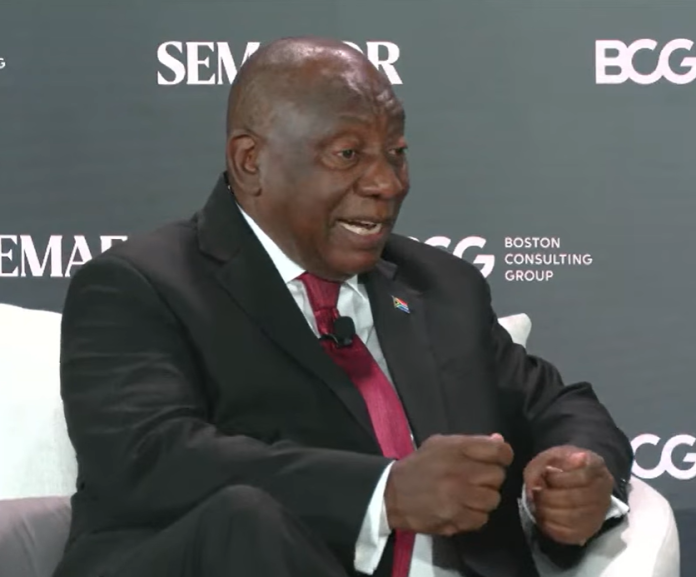
Speaking to ABC News Chief Washington Correspondent Jonathan Karl in Silicon Valley, California, Ramaphosa reiterated that video footage and press clippings shown during the meeting did not accurately depict South Africa.
The interview took place during Ramaphosa’s high-level working visit to the US, where he is leading a delegation of around 300 South Africans, including government ministers, technology entrepreneurs and university postgraduate students.
The visit, which runs until November 21, is aimed at strengthening ties with major US technology companies and positioning South Africa to benefit from developments in artificial intelligence.
During the interview, Ramaphosa re-emphasised that there was no white genocide in the country, saying South Africa respected the human rights of everyone.
Ramaphosa believes false information has influenced the way the US administration has dealt with South Africa, despite efforts to correct the record.
“We are Nelson Mandela’s children, and we respect the human rights of everyone, black, white, everyone. And the constitution of our country would never allow us to do something like that. So we never target any national group for either persecution or genocide. It will never happen in South Africa. So I sought to point that out to him. So I do think that he was seriously misinformed. And that is a great pity that he was.”
He acknowledged that the strained relationship between the two countries has had an impact, but said the government is managing the situation and remains committed to rebuilding ties based on mutual respect and fair engagement.
The President also addressed criticism from fellow South African-born billionaire Elon Musk, who has accused the government of building “Apartheid 2.0”.
Ramaphosa said Musk does not fully understand the devastating impact apartheid policies had on black South Africans.
“I think Elon, by nature, is very conservative, and he doesn’t fully understand the extent of what the apartheid policies did to black South Africans. And I think he, being a white South African, maybe has not really appropriated and come to understand the harm that the apartheid policies did and the way the apartheid policies chose white people only for advancement by law, by practice, by protocol, by everything.”
Ramaphosa added that Musk should consider giving back to the country that helped shape him.
He also confirmed that discussions around Musk’s Starlink satellite internet service in South Africa have centred on government policy, which he said all companies wanting to operate in the country must comply with.
“There have been discussions, and they revolve around policies. And he is one of those who has had difficulty understanding the policy position. And all countries have policies in terms of how they admit companies to operate. The United States has the same. It has its own policies, and when you want to come and operate here, you’ve got to subscribe to the policies of the country.”
Moving to AI, Ramaphosa said South Africa wants to be more than just a consumer of AI, and hopes to help shape the technology while using it to grow the economy and create jobs.
“We don’t want AI that is going to destroy jobs. We often see the risks that are inherent in AI as being job destroyers. We want AI to be a revolution that will help to create more jobs that will help us to have more advanced education and advance our economy, healthcare, agriculture, and a whole number of other disciplines, and to increase productivity in our country.”
On the growing establishment of data centres in South Africa, President Ramaphosa said the country has become an important destination for the infrastructure underpinning AI development. He noted that South Africa is now home to almost 70% of the data centres established on the African continent.