


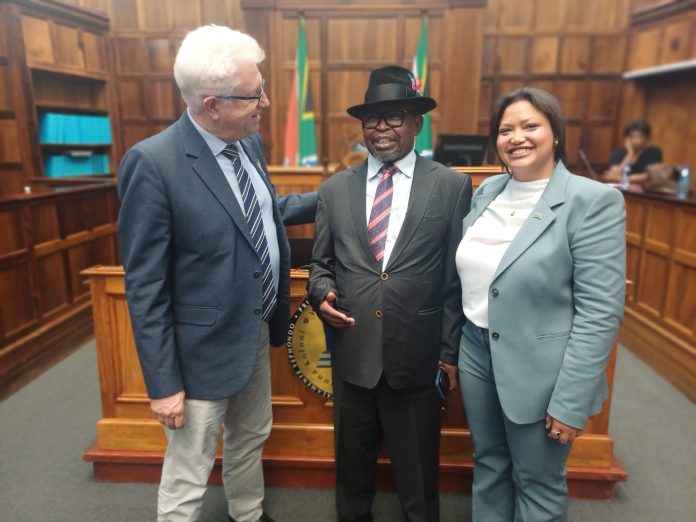
Western Cape Finance MEC Deidré Baartman has tabled a R93.538 billion provincial budget for the 2026/27 financial year, outlining spending priorities aimed at economic growth, job creation and strengthening social services.
Presenting the budget in the Western Cape Provincial Parliament on Thursday, Baartman described the plan as “a budget that delivers growth with discipline and care.”
The province will spend R285.8 billion over the medium-term expenditure framework (MTEF) from 2026/27 to 2028/29.
The largest share of funding will go toward education, health and social development, while infrastructure, safety and economic growth initiatives are also prioritised.
Economic outlook
Baartman said the provincial economy is expected to grow 1.6 % in 2025, slightly above the national outlook. The Western Cape also recorded unemployment of 18.1 % in the fourth quarter of 2025, significantly lower than the national rate.
However, she warned that global trade tensions, supply chain pressures and domestic infrastructure constraints – particularly electricity, logistics and water – continue to limit stronger growth.
Key spending priorities
Growth and job creation
Economic growth remains the province’s top priority, with R36.651 billion allocated over the medium term for the government’s Growth for Jobs strategy.
Key investments include:
- R396.9 million for Wesgro to promote investment, exports and tourism
- Funding for industrial hubs including Freeport Saldanha and the Atlantis Special Economic Zone
- New export and agriculture support programmes to expand market access
- Skills development funding for business-process outsourcing and technology sectors
The government also plans to support infrastructure and economic growth through R31.1 billion in infrastructure spending over the next three years.
Major infrastructure allocations include:
- R11.1 billion for roads construction and maintenance
- R6.4 billion for education infrastructure
- R5.6 billion for human settlements
- R5.2 billion for health facilities and technology
Energy and water resilience
Responding to infrastructure pressures and climate risks, the province has set aside funds for resilience projects, including:
- R452.5 million for energy resilience, including solar installations at schools, clinics and emergency services
- R177.9 million for water security, drought response and groundwater development
The province also plans to support green energy opportunities such as green hydrogen development.
Safety and crime prevention
A total of R8.595 billion has been earmarked for safety initiatives over the medium term.
Key allocations include:
- R1.14 billion for the Law Enforcement Advancement Programme (LEAP) to maintain more than 1 000 officers in high-crime areas
- Funding for neighbourhood watches and community policing forums
- R47.1 million for gender-based violence prevention and survivor support
- R396 million for substance-abuse prevention and treatment services
Education, health and social services
The largest share of the budget supports the province’s Educated, Healthy and Caring Society priority, which receives R208.6 billion over the MTEF.
Education spending will increase to R35.1 billion in 2026/27, including funding for:
- 701 new educator posts
- R330 million for school infrastructure upgrades
- R1.77 billion for the school nutrition programme
The Department of Health and Wellness will receive an additional R2.305 billion, largely to stabilise staffing and operational costs.
Social Development will also receive additional funding to support vulnerable groups, including:
- Child protection services and child-care centres
- Expanded support for people leaving alternative care
- Additional funding for services for older persons and people with disabilities
- Disaster and resilience funding
The province has set aside R949.8 million to respond to disasters and emergencies, including:
- R139.7 million to combat foot-and-mouth disease
- R67 million to repair fire damage at Paarl Hospital
- R65.5 million for wildfire management and aerial firefighting
Baartman said the province is also establishing a new Alternative and Blended Financing Reserve, with R518.8 million set aside to help leverage private investment for infrastructure projects.
Funding sources
About 95% of the provincial budget comes from national transfers, mainly through the Provincial Equitable Share and conditional grants.
The remaining 5% is raised through provincial revenue, including motor vehicle licence fees, gambling taxes and liquor licence fees.
Baartman said the Western Cape’s share of national provincial funding has increased slightly due to updated population and economic data.