
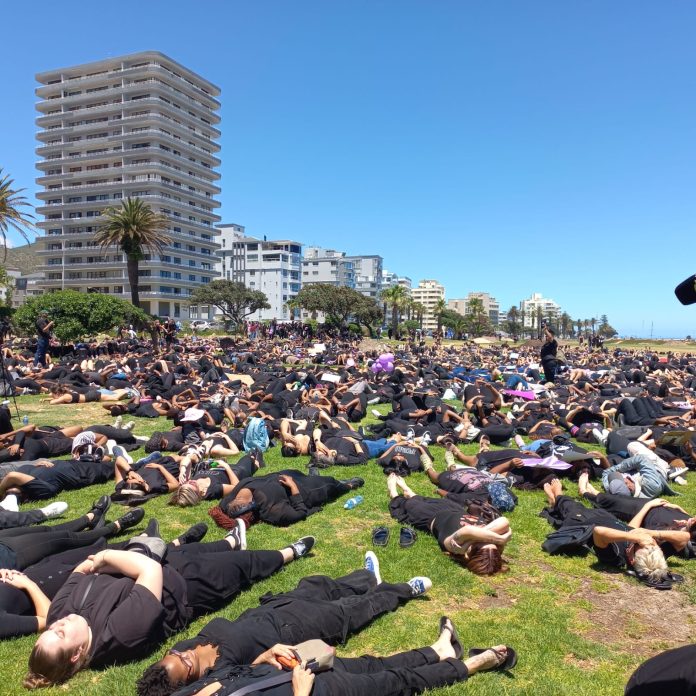
South Africa’s government took an unprecedented step last week by officially classifying gender-based violence and femicide (GBVF) as a national disaster, placing it in the same category as major floods, fires or disease outbreaks.
It came on the eve of the nationwide G20 Women’s Shutdown, which saw scores of people across the country come together to protest the scourge.
The announcement was made by Dr Elias Sithole, head of the National Disaster Management Centre (NDMC), who said GBV now poses an “immediate life-safety risk” on a national scale.
The move also followed updated reports from government departments showing that, despite years of interventions, the levels of violence against women and children continue to threaten lives daily.
What does this classification mean?
By declaring GBVF a national disaster, the NDMC has handed primary responsibility for coordinating the response to the National Executive, meaning the Cabinet must now lead a unified, countrywide strategy to tackle the crisis.
This allows the government to:
- Strengthen and fast-track national interventions
- Improve coordination between the government, police, NGOs and municipalities
- Monitor efforts more tightly
- Put in place large-scale prevention and support measures
This is not the same as declaring a “national state of disaster,” which would unlock emergency powers, but it does require national-level action and oversight.
Government, businesses and communities told to step up
Dr Sithole has issued a call to:
- Government departments and municipalities to strengthen their support systems and ensure proper GBV response plans are in place.
- The private sector, NGOs and community groups to improve their prevention programmes, awareness campaigns and support services.
- Individuals to actively avoid harmful behaviours and reject acts of violence.
He also recommended that national, provincial and municipal leaders implement a multisectoral plan, covering prevention, victim support, policing, justice, and rehabilitation.
Regular progress reports are now compulsory
All organs of state must submit ongoing progress reports to the NDMC to monitor and evaluate the national response. This includes updates from NGOs and community-based initiatives working on GBV.
When will the “national disaster” label be lifted?
The classification will only be revoked once the NDMC reassesses the situation and concludes that GBV and femicide no longer meet the criteria of a national-level disaster, a benchmark that experts say is still far off.
A turning point in South Africa’s GBV battle
The decision marks the strongest acknowledgement yet that GBV is not just a crime problem but a country-wide emergency requiring long-term, coordinated action.
Government leaders, civil society and activists have repeatedly called for a more unified national response, saying fragmented efforts have failed to match the scale of the crisis.
With this new classification, GBVF is now formally treated as an urgent national priority, one that requires every sector of society to act.