


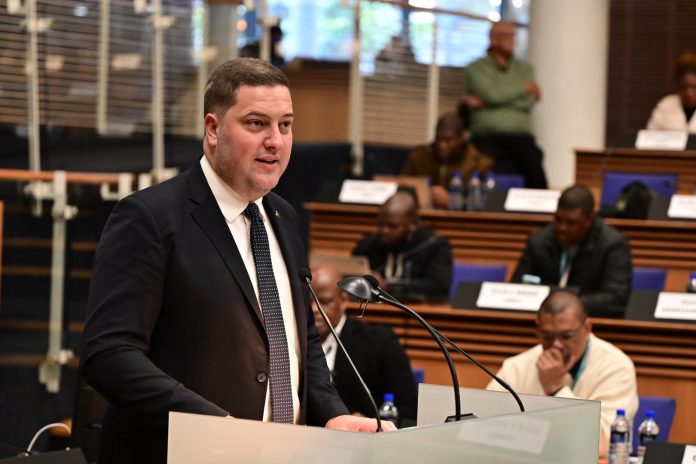
The Cape Town Council on Thursday adopted and approved the 2025/26 Budget, which includes various rates relief measures and a R40 billion infrastructure programme over three years.
The budget also includes a major safety investment for dedicated neighbourhood policing in every ward, and expanded cleaning services for highways and CBDs.
In his address to the City Council, Mayor Geordin Hill-Lewis thanked all who participated in the vigorous public debate on the budget.
“Our budget asks a little more of those who can afford it, while protecting basic services for those who can’t afford it. The budget was largely welcomed by lower-income residents, and we’ve also managed to significantly lower increases for middle-class residents, in the end building broad support for the budget across the city.
We’ve been pleased to protect our full infrastructure investment programme, and our full safety investment of over 700 new officers spread across every ward in the city. Those are key features of this budget: more infrastructure investment for a better city, and more investment for a safer city.”
There was widespread unhappiness about the first iteration of the Budget tabled in March, but after public scrutiny and a further period for public comment, the Budget was amended to lessen tariff increases on households.
READ: Cape Town Budget Vote Delayed After Public Outcry — GOOD and BOSA Hail Democratic Win
Having announced expanded rates relief measures on 28 May, Mayor Hill-Lewis announced further additional measures with the adoption of the final budget.
“We have already raised the pensioner support qualifying threshold to R27 000 income – regardless of property value – and I have even better news for pensioners today. We have even further improved this deal – already SA’s best – following the second round of public participation.”
Hill-Lewis says a 100% pensioner rebate on rates and city-wide cleaning charges will now be available up to R10,000 monthly income (up from R7,500), and a 50% rebate will be available up to R20,000 income.
Discounts of 20% are also available up to R24,000 income, and 10% up to the R27,000 maximum threshold.
He says they are also including special debt write-off measures as an incentive for more households to enter payment arrangements with us.
He’s emphasised that debt write-offs are not handouts.
“They are incentives for struggling households to make a payment arrangement and, from a clean slate, begin making the necessary contributions to our City’s running.”
Potential beneficiaries of the special debt write-off measures may include:
- Pensioners and social grant recipients with debt older than a year
- Various types of civic and non-profit organisations with debt older than a year
- Active indigent customers
- Residents of city rental stock and BNG housing
- Owners of properties up to R7m with historical debt or interest accumulating on their debt
- Those with outstanding debts on final accounts older than one year (instead of three years)
The Mayor said other relief in the final budget included major electricity price relief, lower city-wide cleaning and fixed water charges compared to the March budget draft, and an extension of the ‘first R450 000 rates-free benefit to homes up to R7 million in value.
“This all ensures that 97% of ratepayers won’t experience an increase over 20%, and the 3% that might are generally those with solar installations who can sell power back to us for municipal bill credits, and even cash.”
Fixed charges linked to property value
Mayor Hill-Lewis said the City had elected to retain the cross-subsidisation principles at the heart of the original budget draft, in the form of fixed charges linked to property value.
“This final revised budget will ensure that we not only protect households under R2,5 million as this budget was designed to do, but that we also bring meaningful relief to more homes. The only other alternative to property value determining your fixed contribution to infrastructure and fixed service costs is for everyone to pay a flat charge regardless of whether you are low-income or affluent. We must be clear that lower-income and wealthy households cannot make equal contributions to infrastructure and fixed service costs. It’s not fair, nor sustainable, and believe me, households at all levels of the property value spectrum do contribute their fair share within their means.”
He says getting rid of the former ‘pipe levy’ based on pipe size, and basing it now on property value, means that all homes under R2,5m will pay less for their fixed water charges than they would have on the pipe-size system for 25/26.
Hill-Lewis says when adding the new sanitation charge, 200,000 families in homes under R2,5m will pay less fixed charges for Water and Sanitation together this year, compared to what they would have paid on the pipe-size system.
Regarding commercial customers, the Mayor said the City would allow commercial customers more time to adapt to the phased introduction of the City-wide Cleaning Tariff.
Therefore, in 25/26 commercial customers in particular will continue to contribute to funding the city-wide cleaning service in the way they currently do – via a percentage of their electricity price.
Invested in Hope Budget highlights
- Over 700 new municipal police officers: 500 Metro Police spread across every ward, and over 200 officers to protect service delivery teams from criminals
- R4,5 billion for the new MyCiTi route linking Khayelitsha, Mitchells Plain and various other communities to Wynberg/Claremont
- Bringing down sewer spills and water pipe bursts by replacing 100km of sewer and 50km of water pipes per year, a R2bn project
- Major bulk sewer upgrades such as the Cape Flats sewer upgrade, which is SA’s biggest sewer upgrade project
- Road upgrades, repairs and congestion relief – R3,5bn
- Informal settlement upgrades – R3,4bn
- Street light upgrading and repair – R1bn
- CRU rental unit upgrades and maintenance – R2bn
- Public Transport station upgrades – R397m
- Informal trading infrastructure upgrades – R272m