
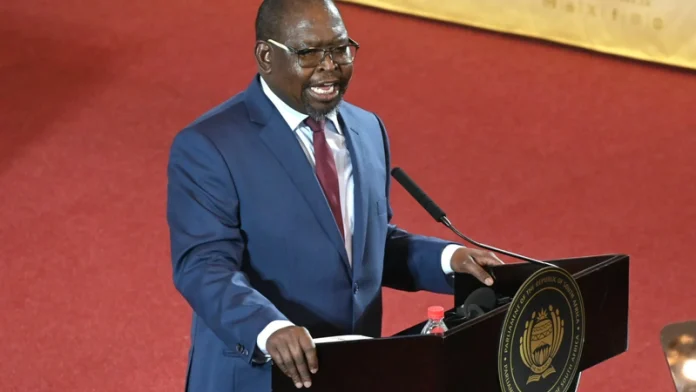
Finance Minister Enoch Godongwana delivered the 2025 Budget in Parliament today, but it remains to be seen whether it will be supported.
He has proposed a Value-Added Tax (VAT) increase of 0.5% in 2025/26 and another 0.5% in 2026/27, bringing VAT to 16% by 2026/27. This will affect all consumers, as VAT is applied to most goods and services.
Shortly before the speech commenced, DA Leader John Steenhuisen posted on X that his party would not support the budget.
The DA is remaining resolute that it will not support any VAT increase.
However, to mitigate the impact on vulnerable groups, Godongwana has proposed the following:
- Expand the list of VAT zero-rated food items (including canned vegetables, dairy liquid blends, and organ meats).
- Provide above-inflation increases for social grants.
- Maintain the fuel levy at current levels, preventing additional costs for consumers.
- Additionally, there will be no inflationary adjustments to personal income tax brackets, rebates, or medical tax credits, which means that as salaries increase with inflation, more individuals will move into higher tax brackets (known as “bracket creep”), leading to higher income tax payments.
How Income Will Be Balanced with Expenditure
The budget aims to maintain fiscal stability by:
Raising Revenue:
- The tax increases (VAT and lack of inflation adjustments for income tax) will generate R28 billion in 2025/26 and R14.5 billion in 2026/27.
- Strengthening tax enforcement by allocating R4 billion to SARS to improve revenue collection and address tax evasion.
Managing Expenditure:
- A primary budget surplus is expected to grow from 0.5% of GDP in 2024/25 to 0.9% in 2025/26, meaning the government will collect more than it spends (excluding interest payments).
- Debt stabilization: Government debt is expected to stabilize at 76.2% of GDP in 2025/26, reducing the long-term burden of debt repayments.
- Reducing Eskom debt relief commitments, saving R20 billion by restructuring financial support.
- Investing in infrastructure (R1 trillion over three years), focusing on transport, energy, and water to drive economic growth and job creation.
Key Spending Priorities:
- Health: R28.9 billion added to retain 9,300 healthcare workers and ensure access to medicines.
- Education: R19.1 billion allocated to keep 11,000 teachers in classrooms, plus R10 billion to improve Early Childhood Development funding.
- Social Grants: R284.7 billion allocated, with increases for old-age pensions, disability grants, and child support grants.
- Security & Defense: R9.4 billion allocated for defense and correctional services, including R5 billion for peacekeeping in the Democratic Republic of the Congo (DRC).
The relevant Parliamentary Committees will now consider the budget, before a debate will take place. Therafter, a vote will take place on whether to pass the budget.