


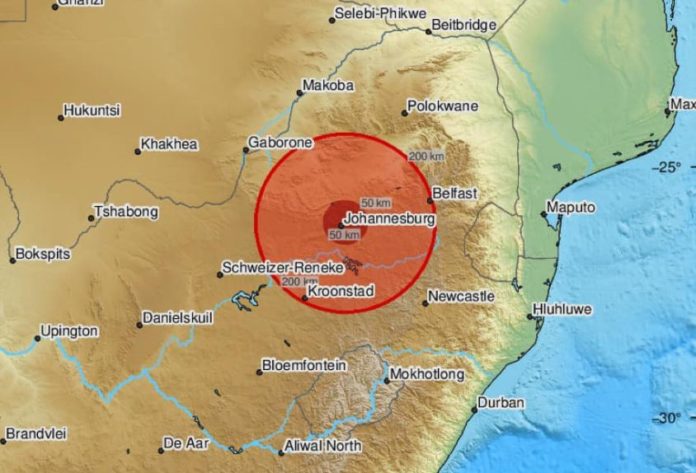
The Council for Geoscience is investigating the cause of the earthquake that shook parts of Gauteng in the early hours of Sunday morning, at around 2:38.
The earthquake registered a local magnitude of approximately 4.4 as recorded by the South African Seismograph Network (SANSN).
Many people on social media say they were woken up by the earthquake, and while no major damage was reported, it is one of the biggest seismic events in the area in recent years.
It was initially registered as a 4.7 magnitude, but later graded down to 4.4.
The epicentre was located in the Boksburg area a few kilometres outside East Rand Proprietary Mine (ERPM), in the East Rand of Johannesburg.
An #Earthquake of magnitude 5.1 hit #Johannesburg #earthquake #earthtremor pic.twitter.com/q3svukvSDx
— Mariyam Sofi (@mariyam_sofi) June 12, 2023
Seismologist at the Council for Geoscience, Michelle Grobbelaar, told eNCA that while they can’t conclusively say that mining activity is the cause of the earthquake, it is very likely, if one looks at the history of the area, and previous tremors experienced there.
She explains the area is known to experience tremors, and it could be that when some of the old mines flood, it lubricates the faults inside the mine.
Grobbelaar says in order for them to get a clearer picture of the cause, they need the assistance of residents who may have experienced the tremor, to fill out this online questionnaire.
She adds that the area may experience after-shocks for up to a month, but it will be nothing like the main event – and many people may not even feel the aftershocks.
😭😭😭 https://t.co/QYpoTDBsqE pic.twitter.com/V9nmFbXLj6
— Sizwe Dlomo (@SizweDhlomo_) June 11, 2023
Following the 2014 Orkney earthquake, which was assigned a magnitude of 5.5, aftershocks could be felt for months afterwards. One person was killed, and 17 injured in the 2014 earthquake.
The biggest earthquake in South Africa remains the 1969 Tulbagh earthquake, which had a magnitude of 6.3.
It caused widespread damage in the towns of Ceres, Tulbagh and Wolseley and led to 12 deaths, and was followed by a long series of aftershocks. The largest aftershock occurred nearly six months later on April 14 1970 and had a magnitude of 5.7.
#Earthquake This was Benoni on the East Rand. pic.twitter.com/V6W30FbagO
— Yusuf Abramjee (@Abramjee) June 11, 2023
ALSO READ: President Ramaphosa apologises to Hammanskraal residents